





The night began with a forceful bang on a bedroom door in Kaduna. Brigadier-General Samuel Ademulegun and his pregnant wife were already asleep when Major Timothy Onwuategwu burst in demanding the armoury keys.
“Timothy, what the devil do you think you are doing?” Ademulegun asked, asserting his superior rank.
When the Brigadier refused to surrender the keys, his wife stepped forward, pleading for her husband’s life. It made no difference. Both were cut down by gunfire.
This scene from the early hours of January 15, 1966, was replicated across Nigeria as young military officers executed the country’s first coup d’état—a convulsive event that fundamentally altered the nation’s trajectory.
A Night of Violence Across Nigeria
In Kaduna, coup leader Major Kaduna Chukwuma Nzeogwu pursued and killed the Premier of the Northern Region, Sir Ahmadu Bello, the Sardauna of Sokoto. When Nzeogwu later confronted Hassam Usman Katsina with a pointed question—”are you with us or against us?”—Katsina, eyeing the gun, wisely answered affirmatively and was spared.
Lagos saw similarly dramatic scenes. Major Emmanuel Ifeajuna, a Commonwealth high-jump record holder turned soldier, led the operation in the capital alongside Majors Wale Ademoyega, Don Okafor, Chris Anuforo, and Humphrey Chukwuka.
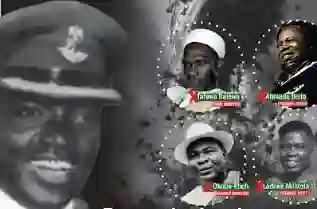
Around 2 a.m., Ifeajuna and his team overpowered guards at Prime Minister Abubakar Tafawa Balewa’s residence. Ifeajuna kicked down the bedroom door and led Balewa out at gunpoint. Though Balewa’s arrest appeared planned, his execution may not have been. When it became clear the coup was failing, Balewa was permitted to pray before being shot.
Ifeajuna’s most treacherous act came against his own commanding officer, Brigadier Maimalari. After initially escaping by jumping a wall, Maimalari encountered what he thought was safety—his Brigade Major’s car. Not realizing Ifeajuna was part of the conspiracy, Maimalari waved down the vehicle and was immediately shot dead. His loss devastated northern soldiers and the army as a whole. So legendary was Maimalari’s toughness that northern soldiers executing the revenge coup six months later refused to believe he was dead, demanding that their captives reveal his whereabouts.

The plotters employed deception throughout. At the Ikoyi Hotel, Ifeajuna forced a desk clerk to summon Lt-Col Abogo Largema for a fabricated phone call. When Largema emerged, he was ambushed and killed.
Lt-Col James Pam, the Army Adjutant-General and father of six, was abducted and shot after warning Major-General Ironsi about the coup. Major Chris Anuforo proved particularly trigger-happy, personally killing Pam, Lt-Col Unegbe, Colonel Kur Mohammed, and Finance Minister Chief Festus Okotie-Eboh—the latter thrown into a Land Rover “like a sack” before being executed despite his pleas.
Resistance in Ibadan
In Ibadan, Western Region Premier Chief Samuel Akintola had sensed danger. After unsuccessfully warning Ahmadu Bello in Kaduna, he returned home and armed himself. When Captain Emmanuel Nwobosi’s detachment arrived, Akintola opened fire, wounding several soldiers including Nwobosi himself. After a fierce gunfight, Akintola was killed.
Contested Narratives
Today marks 60 years since that violent dawn reshaped Nigeria. Like the disputed 1993 presidential election, the coup’s story contains multiple narratives. The most authentic accounts should come from participants, but most are now dead. Those who survived left conflicting written records.
Certain facts remain undisputed: the coup was exceptionally bloody, and it spawned a persistent perception that Igbo officers sought ethnic dominance. Veterans like Brigadier-General Godwin Alabi-Isama have contested this interpretation, insisting Nzeogwu did not lead a tribal coup. However, eight of the nine plotters were Igbo, and the casualties—predominantly northern senior officers and politicians, with only one Igbo officer killed (Lt-Col Arthur Unegbe, who refused to surrender armoury keys)—fueled ethnic suspicions at a time when the officer corps included 37 Igbo, 10 Yoruba, and 8 northern officers.
The coup failed. Major-General Aguiyi Ironsi, the most senior officer, assumed power. But the damage was done. A counter-coup followed on July 28-29, 1966, triggering a cycle of military intervention that would see six more coups in Nigeria’s history.
The events of January 15, 1966, remain a watershed—a single night of violence whose reverberations continue to shape Nigeria’s political landscape six decades later.
READ ALSO:
- Kano to Get ₦1 Trillion Metro Rail System as FG Approves Major Transport Project
- Angola Oil & Gas Launches in Luanda as $70B Investment Momentum Accelerates
- Nigeria Launches Locally-Made Armoured Combat Vehicle, Pledges Continued Support for Domestic Defence Manufacturing
- NIWA Intensifies Campaign to Eliminate Boat Accidents Across Nigeria
- Activists Soweto and Frank Get N200,000 Bail Over Lagos Anti-Demolition Protest