






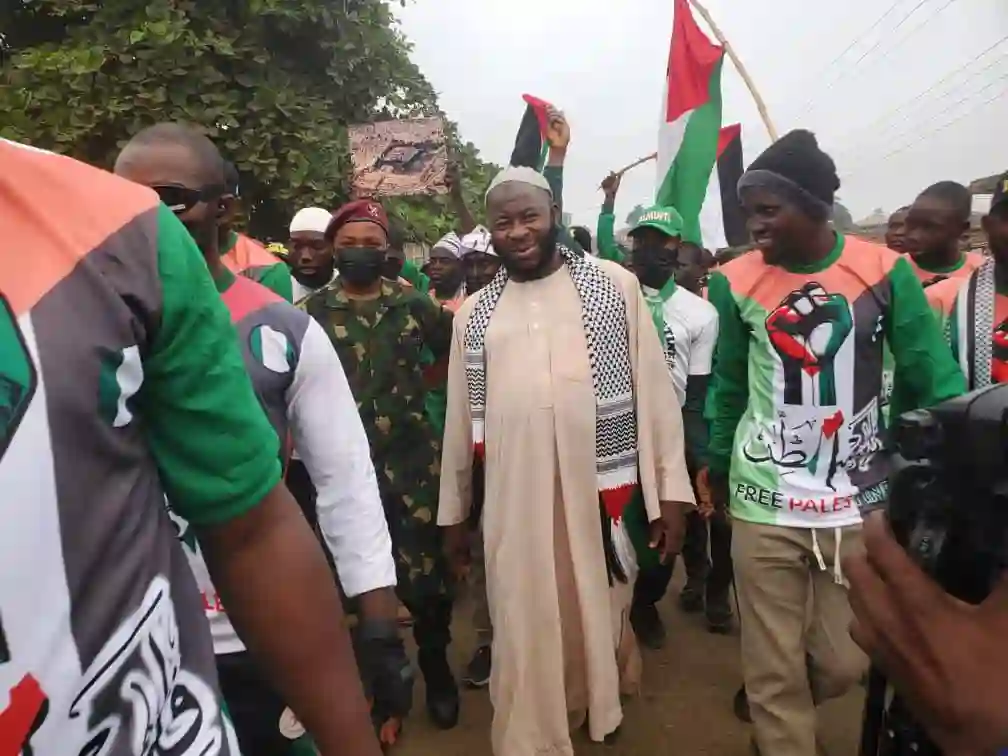
A solidarity march organized by the West Africa Coalition for Quds and Palestine in Iwo, Osun State, has sparked widespread concern and debate after participants were filmed carrying Palestinian flags and chanting Arabic slogans, prompting calls for security agencies to investigate the demonstration.
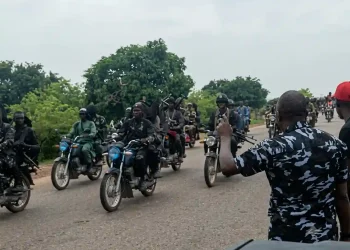
The march, led by Sheikh Daood Imran Molaasan, President of the West Africa Coalition for Quds and Palestine, drew a crowd of Muslims including children and adults who marched through the streets of Iwo while displaying Palestinian flags and chanting prayers in Arabic. Demonstrators could be heard chanting “Free Palestine” and other solidarity slogans during the procession.
Video footage circulating widely on social media platforms shows participants waving Palestinian flags and engaging in coordinated chants. According to subtitles accompanying the viral video, some chants referenced Quranic verses, land liberation, and themes associated with establishing an Islamic caliphate, raising questions among observers about the nature and underlying message of the demonstration.
In his address at the rally, Sheikh Molaasan delivered an impassioned speech calling on Muslim and Arab nations to take decisive action to end what he described as ethnic cleansing and the ongoing humanitarian crisis in Gaza. “The struggle for Palestine is not just a regional conflict, it is a test of humanity and justice,” he stated, appealing to both religious and secular leaders to rally global opinion and pressure international institutions to intervene in the Israel-Palestine conflict.
The West Africa Coalition for Quds and Palestine, under Sheikh Molaasan’s leadership, has organized multiple solidarity rallies and awareness campaigns aimed at amplifying Nigerian voices in support of Palestinians. The organization has positioned itself as a leading advocate for Palestinian self-determination in the West African region.

However, the march has triggered intense reactions on social media platform X, with many Nigerians expressing alarm over several aspects of the demonstration. Some social media users reported observing gestures resembling Nazi salutes during the march, though this remains unverified by independent sources and has not been confirmed by video analysis.



Critics have raised concerns about the display of foreign flags on Nigerian soil, with some commentators questioning whether such demonstrations could potentially foster radicalization or extremist ideologies. Several users drew historical parallels to religious uprisings in Nigeria, including the Maitatsine uprising in Kano and the emergence of Boko Haram in Maiduguri, expressing fears about possible security implications.
A widely shared post by 36kinniun media directly addressed both the Osun State and Federal Governments, criticizing the public display of foreign flags in Nigeria. The post described such displays as “potentially dangerous and unacceptable,” particularly in the country’s southwest region, which has traditionally maintained relative religious harmony.
Multiple social media users tagged defense and intelligence agencies, including the Department of State Services (DSS), the Nigerian Police Force, and military intelligence, demanding urgent intervention. Key questions being raised include: Who authorized the march? What is the full agenda of the organizing group? And should foreign conflict symbols be permitted in public demonstrations on Nigerian soil?
Several commentators have specifically called for investigations into Sheikh Daood Imran Molaasan and the West Africa Coalition for Quds and Palestine, demanding that authorities examine the group’s funding sources, membership structure, and stated objectives. Some have questioned whether the organization has proper registration with relevant Nigerian authorities and whether its activities align with national security interests.
As of Monday afternoon, there had been no official statement from the Osun State Government, the Nigeria Police Force, the Department of State Services, or other security agencies regarding the march. The silence from government authorities has itself become a subject of criticism, with many Nigerians demanding clarity on the state’s position regarding such demonstrations.
Nigeria officially maintains a balanced position on the Israel-Palestine conflict, supporting a two-state solution while calling for peaceful resolution and respecting Palestinian self-determination. The country has historically maintained diplomatic relations with both Israel and Palestine, and has consistently advocated for dialogue and negotiation at international forums.
Security analysts note that domestic displays linked to foreign conflicts become particularly sensitive when they intersect with internal security concerns, religious harmony, and questions of national sovereignty. Nigeria has experienced religious tensions in various forms over the decades, and authorities have typically been cautious about activities that could potentially inflame sectarian divisions or import foreign conflicts into the domestic space.
Legal experts point out that the display of foreign flags and symbols associated with international conflicts occupies a grey area in Nigerian law. While not explicitly prohibited, such displays can be scrutinized under various provisions related to public order, national security, and prevention of activities that could threaten the peace and stability of the nation.
Some civil society organizations have defended the right of Nigerian Muslims to express solidarity with causes they believe in, arguing that peaceful demonstrations are a legitimate form of political expression and that attempts to criminalize it would set a dangerous precedent for freedom of expression in Nigeria.
Others argue that the charged nature of the Israel-Palestine conflict, combined with Nigeria’s own complex religious dynamics, makes such demonstrations potentially destabilizing. They point to the presence of children in the march as particularly concerning, raising questions about whether minors are being exposed to ideologies that could shape their worldview in potentially problematic ways.
The debate has also drawn attention to how Nigerian Muslims engage with international Islamic causes. While solidarity with Palestinians has long been a feature of Muslim activism in Nigeria, the intensity and symbolism of recent demonstrations have prompted renewed scrutiny of these movements and their potential implications.
Many observers emphasize that the government’s response to this incident will be closely watched as an indicator of its ability to manage religious and security-related tensions in the region. The handling of this situation could set precedents for how similar demonstrations are treated in the future and will likely influence public confidence in the government’s approach to balancing civil liberties with security concerns.
The West Africa Coalition for Quds and Palestine has not issued any public statement responding to the security concerns raised by critics. Attempts to reach Sheikh Daood Imran Molaasan for comment were unsuccessful at the time of publication.
As Nigeria continues to navigate complex internal security challenges, including insurgency in the northeast, banditry in the northwest, and separatist agitations in various regions, any activities perceived as potentially importing foreign conflicts or fostering radicalization are likely to receive heightened scrutiny from both authorities and the public.
This is a developing story. Updates will be provided as more information becomes available from official sources and as government authorities respond to public concerns.