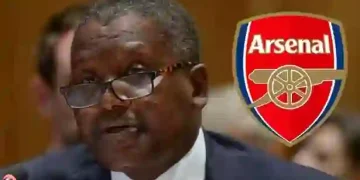


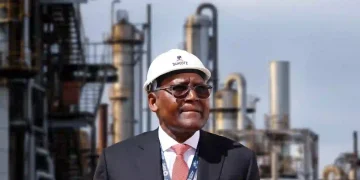




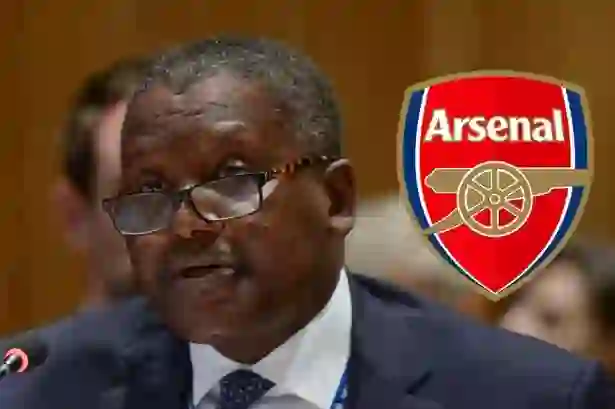
Africa’s richest man, Aliko Dangote, has explained why he did not proceed with his long-considered plan to buy English Premier League club Arsenal, saying his massive refinery project in Lagos took priority.
Dangote made the disclosure in a podcast hosted by Nicolai Tangen, CEO of Norges Bank Investment Management, published on YouTube.
He said that at the time he seriously considered acquiring the North London club, Arsenal was valued at about $2 billion, but he was already deeply committed to financing and completing his $20 billion refinery, fertilizer, and petrochemical projects in Nigeria.


According to him, he had to make a choice between investing heavily in football ownership or focusing on completing his industrial projects.
“When I was really very focused on buying Arsenal, I was also facing the challenge of making sure the refinery gets completed… Should I put my $2 billion in Arsenal or complete my business?” he said.
Dangote explained that he ultimately decided to prioritize his business empire, adding that he remains a loyal supporter of the club rather than its owner.
“I decided to continue to support them, watch their games… I am a fan—I should remain a fan and continue to fund my business,” he added.
The billionaire noted that his interest in Arsenal dates back over 15 years. He had previously told BBC Africa Sports in 2015 that he intended to make a takeover bid once his refinery project was completed, and reiterated a similar position in a 2020 interview with American financier David Rubenstein.
Dangote also used the opportunity to encourage young Africans to embrace hard work and believe in the continent’s future potential.
READ ALSO:
- Dangote Explains Why He Abandoned Arsenal Takeover Bid
- Police Dismiss Officers Over Alleged Kidnapping, Armed Robbery and Extortion in Rivers
- 2027 Presidency: Atiku, Obi, Amaechi, Makinde, Hayatu-Deen Move Against Tinubu
- Dangote Opens Up On Battle To Build $20bn Refinery
- ADC Knocks Tinubu Over Fresh $1.25bn World Bank Loan, Describes Economy as ‘Ponzi Scheme’