








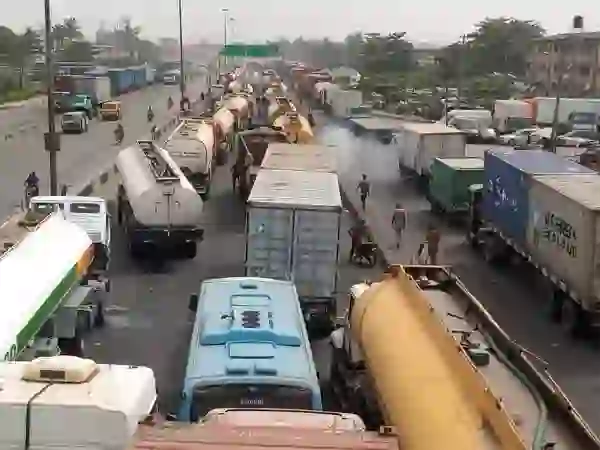
The persistent traffic gridlock along the Apapa and Kirikiri corridors in Lagos has been blamed on oil marketers, tanker operators, transport unions and weak enforcement by relevant agencies, with stakeholders warning that the situation continues to cripple businesses and disrupt economic activities.
The congestion, which has plagued the industrial and commercial hub for years, is taking a heavy toll on thousands of businesses, commuters and residents who rely on the Apapa-Kirikiri road network for daily activities.
Industry stakeholders said the movement of petroleum products, including Premium Motor Spirit (PMS), diesel and aviation fuel, has increasingly spilled onto public roads due to poor logistics planning, inadequate truck holding facilities, indiscriminate roadside parking and poor enforcement of traffic regulations.
Major roads linking Apapa, Kirikiri, Coconut and Tin Can Port are frequently occupied by hundreds of fuel tankers waiting to load products from depots and tank farms. Instead of remaining in designated holding bays, many trucks queue for several kilometres, reducing multi-lane roads to a single lane and causing severe traffic congestion.
Several petroleum companies, including TotalEnergies, Conoil, Bovas Oil, Rahamaniyya, Obat Oil, Techno Oil, Aiteo, MRS Oil, Ardova, NIPCO, Integrated Oil & Gas, Folawiyo Energy, Matrix Energy, Eterna and Northwest Petroleum, operate depots within the Apapa and Mile 2-Kirikiri corridor.
While traffic around the Naval Base section of Apapa has improved, the Mile 2-Kirikiri axis continues to suffer chronic congestion due to the high volume of tanker activities.
Stakeholders also alleged that although some depots have holding bays, many are no longer sufficient for current operations. They further claimed that available parking facilities are not fully utilised because some operators allegedly prefer roadside parking, where illegal payments are reportedly collected.
The National Association of Road Transport Owners (NARTO) accused tank farm operators of admitting more trucks than their facilities can accommodate.
According to NARTO National Secretary, Aloga Gbogo, some tank farms receive payments from far more trucks than they can load daily, leaving hundreds of tankers stranded on public roads while awaiting their turn to access products.
He noted that Apapa hosts more than 60 tank farms, many of which load hundreds of trucks every day without having adequate holding bays to contain them.
Another NARTO official, Inuwa Mohammed, said the Electronic Call-Up System has worked successfully at the Lekki Deep Sea Port because tanker operators were fully integrated into the process before operations began.
He, however, alleged that efforts to fully integrate tanker operators into the Apapa Electronic Call-Up System have faced resistance.
The Ports Authority Police also denied responsibility for the persistent congestion, stating that the Mile 2-Apapa-Kirikiri expressway falls outside its operational jurisdiction.
Police spokesperson ASP Isaac Hundeyin said the force’s responsibility is to manage traffic and maintain security, not to provide loading bays or truck parks.
He explained that permanent solutions require improved infrastructure, including adequate transit parks and holding bays, which fall under the responsibility of terminal operators and the Nigerian Ports Authority (NPA).
Attempts to obtain reactions from the Depot and Petroleum Products Marketers Association of Nigeria (DAPPMAN), the Independent Petroleum Marketers Association of Nigeria (IPMAN), senior police officials and the Nigerian Ports Authority were unsuccessful.
Meanwhile, the Major Energies Marketers Association of Nigeria (MEMAN) maintained that its member companies are not responsible for the roadside congestion.


MEMAN Chief Executive Officer, Clement Isong, said member depots operate designated truck parks and automated scheduling systems that regulate truck movement and minimise unnecessary queuing.
He called for stronger collaboration among government agencies, regulators, terminal operators and transport unions to address the problem.
According to him, expanding holding bays, strengthening the electronic truck call-up system, ensuring only trucks with valid loading tickets access depot corridors and enforcing strict sanctions against indiscriminate roadside parking are critical measures needed to permanently resolve the Apapa and Kirikiri traffic crisis.
READ ALSO:
- Tinubu Warns Political Allies Against Using His Name for Personal Ambitions
- Wale Fapohunda, 67 Others Elevated to Senior Advocate of Nigeria
- INEC Disowns Fake Governorship Candidates’ List Circulating Online
- CDS Urges More Investment in Nigeria’s Indigenous Space Technology
- World Bank, IMF Warn AI Could Worsen Jobs Crisis in Nigeria