





With two months to the presidential election, the PDP, NDC, Labour, NNPP and ADC are fighting themselves into irrelevance. One old party is watching quietly. The party of June 12 is building in private. Whether that quiet adds up to a real choice is a question Nigerians must settle before January 16.
Something strange is happening in Nigerian politics right now, and if you blink, you will miss it. Everybody is shouting, fighting, defecting. The ruling party is shouting that it has already won 2027 before a single ballot has been cast. The opposition is shouting that it has already been rigged out, also before a single ballot has been cast. Governors are crossing from one party to another like pedestrians dashing across Ikorodu Road at rush hour, without looking left or right. A minister in an APC government is unveiling candidates of two different parties at the same rally in Port Harcourt. A governor who spent six months side-lined by a presidential emergency rule is now one of the president’s loudest campaigners.
And in the middle of all this noise, there is one party that is not shouting. It is not begging governors to cross over. It is quietly, patiently, almost suspiciously, building something. That party is the Social Democratic Party, the SDP.
With the presidential election fixed for January 16, 2027, barely two months away, and with the PDP, the Labour Party, the NNPP and even the ADC coalition coming apart in full view of the nation, the question every serious Nigerian should be asking is simple, but uncomfortable. Is the SDP becoming the real alternative?
I know what you are thinking, “SDP?” That small party people only remember when they talk about MKO Abiola and June 12? The party that has never produced a sitting president? That scepticism is fair. It is also exactly why the question is worth asking.
In Nigerian politics, the party everybody is watching is not always the party that wins. The party everybody is laughing at is sometimes the party that is learning. And the party that keeps quiet while others make noise is often the party that is listening. In 2027, listening may prove more valuable than shouting.
To understand where we are going, we must first remember how we got here. For most of the Fourth Republic, Nigeria has had two parties that really matter, the PDP and the APC, plus a third force that appears every four years to disturb them and then fades away. The PDP ruled for sixteen years and boasted it would rule for sixty. Power made it arrogant. It became the party of godfathers, where without money you could not buy a nomination form, and without a godfather you could not even dream of becoming a councillor.
In 2015, Nigerians grew tired and voted for the APC, a merger that promised change. It promised to fight corruption, fix the economy and secure the country, and for a while, many believed. But after eight years of Muhammadu Buhari and more than three years of Bola Tinubu, many Nigerians are asking the same question they asked in 2015. Is this the change we voted for?
That question is not partisan. It is the question of the market woman in Onitsha who can no longer afford the tomatoes she sells. It is the question of the farmer in Benue who is afraid to go to his farm because he is not sure he will return alive. These are not merely political questions. They are human questions. And when the big parties cannot answer human questions, people begin to look elsewhere. That is the opening the SDP is quietly stepping into.
Look at the PDP today and tell me whether you see a political party, or a house on fire where the people inside are still arguing over who owns it. Since the 2023 elections, at least nine PDP governors have walked out of the party. Delta, Akwa Ibom, Enugu, Bayelsa, Rivers, Plateau, Taraba and Adamawa went to the APC; Osun went to Accord. Not one. Not two. Nine. The party that once boasted of ruling for sixty years is left with barely a handful of governors.
Rivers tells the whole story in one state. Nyesom Wike, still claiming the PDP as his home, serves as a minister in an APC government and leads a so called Rainbow Coalition backing President Tinubu’s bid for a second term. At a single rally in Port Harcourt, his coalition unveiled 49 candidates for 2027; 34 on the APC ticket and 15 on the PDP ticket. Governor Siminalayi Fubara, the man Wike installed in 2023 and then fought for two bitter years, has himself crossed into the APC. How can a man be a minister in an APC government and still present himself as a leader of the PDP? This is not a party. It is the shadow of one.
Now look at the Labour Party. In 2023, Labour was the party of the youth, the party of hope, the home of the Obidients. Peter Obi polled more than six million votes and won Lagos, a state the Tinubu political machine had controlled since 1999. That was not just an election result. That was a movement. But what happened to that movement? It was not destroyed by the APC. It was destroyed from inside. Julius Abure and the caretaker committee led by Senator Nenadi Usman have spent the better part of two years fighting over who is the real national chairman. The courts have delivered judgment after judgment. The Court of Appeal affirmed Usman in April 2026, and Abure has taken the matter to the Supreme Court. Today, each faction has produced its own presidential candidate. One party, two flagbearers. IObi himself did not stay to fight it out. He moved into the ADC coalition, left that too in April 2026 citing its endless crisis, and is now the presidential candidate of the Nigeria Democratic Congress. They followed the man, not the party, and that is the lesson. A party built around one personality, rather than around an idea, becomes an empty building the day that personality walks out.
The NNPP teaches the same lesson in a different accent. In 2023, Rabiu Musa Kwankwaso proved that a small party with deep local roots could capture a big state. The NNPP won Kano. Three years later, that fortress has fallen without a single vote being cast. Then in January 2026, Governor Abba Kabir Yusuf, Kwankwaso’s own political son, resigned from the NNPP and joined the APC, taking with him the state assembly majority and all 44 local government chairmen. Kwankwaso called the day a “World Day of Betrayal”, and before long he had left the party too. He is now Peter Obi’s running mate in the NDC.
When a party loses its governor to the ruling party and its leader to another opposition party in the same season, what remains is little more than a name on the ballot paper.
And then there is the ADC. It was supposed to be the great coalition, the umbrella under which Atiku Abubakar, Peter Obi, Rotimi Amaechi, Nasir El-Rufai, David Mark would gather to defeat Tinubu. For the first time in years, Nigerians saw the opposition appear to unite. The excitement did not last. David Mark said he was chairman. Nafiu Bala said he was chairman. Obi and Kwankwaso walked out. Atiku won the ticket, with Amaechi as his running mate. Then, on November 5, 2026, Justice Peter Lifu of the Federal High Court in Abuja nullified the leadership headed by Mark, along with every decision it took, including the primary that produced Atiku. The ADC insists that an earlier judgment of the same court had upheld Mark, and it has headed to the Court of Appeal. The legal question is not yet settled. The political damage already is.
How do you convince Nigerians that you can run Nigeria when you cannot settle who runs your own party? While the ADC is in the courtroom, the APC is on the campaign field.
Even the APC is not as solid as its numbers suggest. On paper, it is a colossus: the presidency, more than 30 of the 36 state governors, and a comfortable majority in the National Assembly. But the party is winning governors and losing members. Every new arrival from the PDP displaces an old loyalist who waited years for his turn, and the primaries left aggrieved members in state after state. Its national chairman, Abdullahi Ganduje, resigned in 2025, and his successor, Nentawe Yilwatda, has spent much of his tenure fighting fires.
None of this means the APC is weak. It means the APC is crowded. And a crowded house, filled with people who arrived for protection rather than conviction, is not the same thing as a united one.
In Nigeria, power without unity can look invincible right up until the moment it is not.
So, if the PDP is collapsing, Labour is split in two, the NNPP has lost its base, the ADC is in court and the APC is overcrowded, where do Nigerians who want a genuinely different option go?
This is where the SDP comes in. The SDP is not new. It was created in 1989 under the military’s two-party experiment, and in 1993 it produced MKO Abiola, winner of the June 12 election that is still widely regarded as the freest and fairest in Nigeria’s history. The military annulled that election. Abiola died in detention five years later, still insisting on the mandate Nigerians had given him. That history matters. Abiola was voted for by Muslims and Christians, Northerners and Southerners, Yoruba, Hausa and Igbo alike. He defeated a Kano man, Bashir Tofa, in Kano. To many older Nigerians, the letters S, D and P do not summon images of looted treasuries. They summon June 12, and the memory of a country that once voted across every line that usually divides it.
In politics, brand counts for a great deal. The APC carries the brand of power. The PDP carries the brand of old power. NDC carries the brand of youth. The SDP carries the brand of history, democracy and sacrifice. For young Nigerians searching for a platform not stained by the last quarter century, that brand is an asset. But history alone wins nothing. Today’s SDP is not Abiola’s SDP. The party was rebuilt under the Fourth Republic and has spent most of it on the fringes. It must earn its present.
To its credit, the SDP appears to understand this. While other parties fight in public, it has been building in private. While others run to court, it has gone to the grassroots. While others beg governors to defect, it has been recruiting young people, professionals, civil society activists and disillusioned members of the APC and PDP who are tired of godfatherism.
Let us be honest, though. The SDP has not been a stranger to crisis. Its own leadership dispute, between Professor Sadiq Gombe and Shehu Gabam, travelled from the Federal High Court to the Court of Appeal and finally to the Supreme Court, which affirmed Gombe. It is also in court over INEC’s failure to publish the names of some of its candidates, and its own vice presidential candidate has publicly alleged that some figures within the party worked with the APC to create a false opposition.
So, the difference is not that the SDP has had no quarrel. The difference is in how the quarrel ended. The dispute went to the final court, it was settled, and the party moved on to a convention, a candidate and a campaign. In a season when the ADC and Labour cannot close their case files, finishing a fight is itself a form of discipline. Whether that discipline holds under the pressure of a general election is the next test.
The SDP also offers something many of its rivals have lost: a story about what it believes. Ask yourself honestly, What is the ideological difference between the APC and the PDP today? Remove the logos, and can you tell them apart? Both have backed subsidy removal, Both have borrowed heavily. Both have tolerated godfatherism. A politician can be PDP in the morning, APC by afternoon and ADC by evening, and nobody stops to ask, what exactly do you believe in? That is why Nigerians are tired. They are tired of parties without a soul.
The SDP, at least on paper, says it believes in social democracy: welfare, free education, affordable healthcare, jobs for young people, and a government that works for the many rather than the few. Whether it will practise what it preaches is another question entirely, and voters must hold it to account if it ever gets the chance. But at least it has something to preach. In a contest where most parties are selling personalities, a coherent message is a competitive advantage.
This brings us to the two men carrying the SDP flag, because a party is only as credible as the people it puts forward. The presidential candidate is Prince Adewole Adebayo. His running mate is Dr Usman Bugaje. Their supporters argue that this ticket is gathering a slow but genuine momentum. That claim deserves examination, not applause. Start with consistency, Nigerians are used to candidates who shout, who promise heaven at a single rally, and who cannot explain their own manifesto without reading from a script someone else wrote. Adebayo, a lawyer and businessman who flew the SDP flag in 2023, has stayed on the same platform and preached the same message since then. He has not drifted to the APC in the morning and the ADC in the evening. In a political class where defection has become a profession, that consistency is worth noting. He also has a document. In September 2026, he publicly presented his policy blueprint in Abuja, titled Farewell to Poverty and Insecurity. His campaign says the plan has been translated into Hausa, Yoruba, Igbo, Kanuri, Fulfulde and other Nigerian languages. If that holds up, it means the plan speaks not only to elites in Abuja but to the market woman in Sokoto and the fisherman in Bayelsa. How many candidates have trusted Nigerians enough to say, go and read my plan, criticise it, and question me?
The central idea of that plan is simple. Security and welfare are the primary duties of government. For years, governments have treated security as a contract to be awarded and welfare as a favour to be dispensed. A candidate who insists that both are obligations, and who talks about ending poverty through jobs, schools and clinics rather than election day handouts, is at least speaking the right language.
Groundedness is not posing in ankara beside a roasted corn seller for the cameras; it is understanding the problem from the ground up. The test is whether the numbers behind that language add up.
Then there is Bugaje. If Adebayo is the voice of the ticket, Bugaje is meant to be its weight. He is not a social media creation or the product of a viral video. He is a veteran northern politician and public intellectual who chaired the convention that produced the ticket, with a reputation for speaking his mind even when it is inconvenient. His allegation that some within his own party colluded with the ruling party shows that he does not shy away from uncomfortable truths, even about his own side.
The choice of a running mate tells you what kind of president a candidate wants to be. Pick a godfather, and you want a deal. Pick someone who can sit across the table and say, this policy will not work in the North, and here is why, and you are at least signalling that you want a government. A vice president should be neither a spare tyre nor a ribbon cutter. The ticket is also balanced in the way Nigerian politics demands.
Adebayo, from the South West, brings the language of enterprise, the private sector and the law. Bugaje, from the North, brings the language of legislation, scholarship and the grassroots. And neither man arrives carrying the record of a governor or minister who must explain how a state’s treasury was spent. In a country where many leading politicians carry heavy baggage from past office, that is not a small thing. It is, however, partly a consequence of never having held executive power. Voters are entitled to ask how two men without that experience would manage the most complex government in Africa, and the SDP owes them a convincing answer.
Momentum in Nigerian politics is often manufactured, It is a rented crowd. It is a convoy of 100 cars that disappears the day after the election. What the SDP claims to be building is different: slow, gradual, the kind of momentum that spreads when one person asks another, have you heard this man? Have you read this plan? There are signs that the claim is not empty.
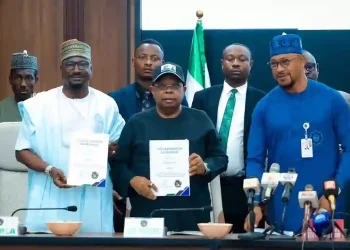
On November 11, 2026, the party inaugurated its National Campaign Council in Abuja, and Dr Yunusa Tanko accepted the role of Director General of the presidential campaign. Tanko is no ordinary recruit. He was spokesman of the Obi and Datti presidential campaign in 2023 and later national coordinator of the Obidient Movement, a man who knows how to mobilise young people without bags of money. Whatever one thinks of Obi, the defection of his former coordinator is a signal. Part of the energy of 2023 is looking for a new home.
RelatedPosts
The party chairman, Professor Gombe, has also drawn a clear line. The SDP, he insists, is not part of any rainbow coalition and will contest on its own platform, while working with other opposition parties on the joint training of polling agents and a common situation room to protect votes. That is a party that seems to know who it is.
The party has also met with its nine governorship candidates, from Nasarawa, Oyo, Benue, Niger, Adamawa, Plateau, Kano, Gombe and Bauchi, to align strategy, and has taken its manifesto to radio stations across the country. Radio is where farmers listen, and that is where elections are won and lost.
If this is real momentum, it will not arrive with a bang, it starts with a whisper. One whisper becomes ten whispers. Ten whispers become a conversation. A conversation becomes a movement, and a movement, if it is organised, becomes votes.
The biggest prize in this election is the young voter. In 2023, young Nigerians proved they could change the game. They turned a party with little structure into a national force. After 2023, many were left disappointed. Some swore they would never vote again.
But disappointment is often just wounded hope, and wounded hope can heal if it finds a platform free of the old baggage. The SDP is not burdened by Obi versus Abure or Atiku versus Wike. It is, if not clean, at least cleaner. And young people want a party they can join, contest in and win without paying tens of millions of naira for a nomination form. If the SDP truly opens its doors to them, it could build an army that money cannot buy.
If it does not, the NDC, with Obi at the top of its ticket, remains the obvious destination for much of that energy, and the SDP would be foolish to pretend otherwise. This is not a praise song for the SDP. The party faces serious problems, and if it does not confront them, it will become like the parties it criticises.
First, money. Nigerian elections are brutally expensive; forms, delegates, campaigns, posters, radio, television, transport and agents on election day. The APC has money and the full weight of incumbency. The SDP has no sitting governor to bankroll it. It must find another way, through volunteers, small donors, technology and social media, the model the Obidients used in 2023 when young people gave their own money, their own time and their own data.
Second, structure. Elections are won at the polling unit, not on X. If the SDP cannot put trained agents in the vast majority of the country’s more than 176,000 polling units, its votes will be counted by someone else.
Third, temptation. The trap that ruined Labour and the ADC was the trap of ownership. One man treating the party as his property, tickets sold to the highest bidder. If the SDP sells its tickets, it becomes the APC. If it allows a godfather to own it, it becomes the PDP. Its own recent leadership crisis is a reminder that it is not immune.
And fourth, scale. A party with limited presence in the National Assembly and the state houses of assembly is asking to be trusted with the entire country. Even in victory, it would have to govern alongside a legislature controlled by others. Nigerians deserve to hear exactly how it would manage that.
So, is the SDP becoming the real alternative? The honest answer is yes, but with conditions.
Yes, because the others are collapsing. Yes, because Nigerians are searching for something new. Yes, because the SDP has, so far, been more disciplined than its rivals and carries a history Nigerians respect. But it will only become the real alternative if it does the hard work in the weeks that remain. If it builds structure, If it opens its doors to young people and women. If it refuses to be bought, If it presents a clear, simple, human plan for Nigeria. A plan that says we will fix the economy by creating jobs, not by borrowing. We will fix security by building trust and capability, not only by buying weapons. We will fix education by building schools, not by building statistics.
And what about you? You are not just a reader, or are you just a voter. You are a citizen. You can continue voting for the same arrangements that have disappointed you for 25 years and expect a different result. That is the very definition of madness. Or you can look beyond the noise and ask the hard questions of every candidate on the ballot, the SDPs included. Who is this person? What does he believe in? What has he done before? What will he do for me after election day, not what will he give me on election day?
Nigeria is at a crossroad. On January 16, we cannot afford to vote by tribe, by religion, or by who shared rice and wrappers at the ward meeting. We must vote on character, competence and compassion. We must choose those who will serve us, not those who will rule us. If the SDP can show that it offers that, it deserves a hearing. If it cannot, Nigerians must keep looking. But we must not stop looking, and we must never give up on Nigeria. Because Nigeria is not the APC. Nigeria is not the PDP. Nigeria is not the ADC, the NDC or the SDP. Nigeria is us!
READ ALSO:
- South Africa Warns Femi Fani-Kayode Over Conduct, Cites Vienna Convention
- ‘I Don’t Owe Anyone an Apology for Doing the Right Thing’ – Commissioner Tokunbo Wahab Defends Tough Environmental Decisions
- EKSU’s NAPE Triumph Signals Bigger Ambition for African Geology Leadership
- Odukoya Rejects Removal, Insists he Remains Senior Pastor of Fountain of Life Church
- Jimmy Odukoya Removed As Senior Pastor Of Fountain Of Life Church