





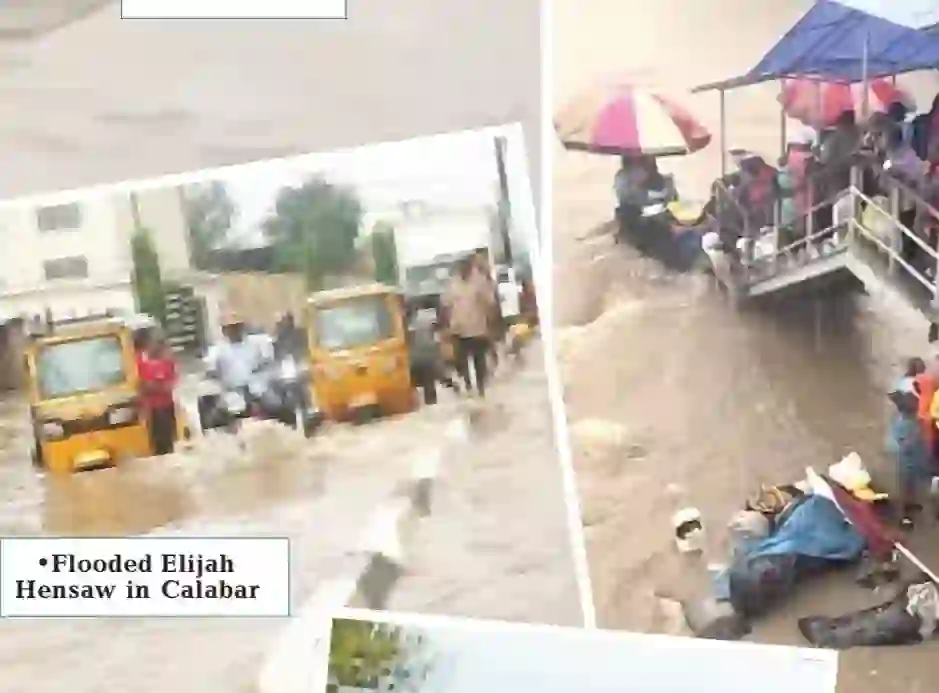
Heavy rainfall that has battered Calabar, the Cross River State capital, for more than a month has left a trail of destruction, claiming at least 10 lives, destroying homes and displacing residents as floods and mudslides continue to ravage communities across the city.
Since the first week of July, persistent downpours have inundated Calabar and surrounding areas, leaving many roads submerged, disrupting commercial activities and forcing residents to remain indoors. Schools have also been affected, while nightlife and businesses have been brought to a standstill in many parts of the city.
The continuous rainfall has resulted in widespread flooding, landslides and erosion, with properties worth hundreds of millions of naira reportedly destroyed.
One of the worst incidents occurred in Ikot Anwatim, where a massive landslide buried several buildings after the ground collapsed into a gully. Five people lost their lives in the disaster, including four children from the same family. A father was also buried alive while attempting to rescue his children from the collapsing earth.
Elsewhere, a man drowned after being swept away by floodwaters along Elijah Henshaw Street, while a one-year-old child was reportedly carried away by floodwaters at Webber Street. Two children also drowned in Otop Abasi, while another landslide at Boropit, near Idim Otop, claimed the lives of two young girls after their home collapsed.
The latest disaster struck Diamond Hill near the former Unicem headquarters, where a large section of land gave way, sending several houses into the adjoining sea and severely damaging the road leading to the Nigerian Navy Base and Calabar Jetty.
Residents say the scale of destruction has left many families devastated, with some losing both loved ones and their homes within moments.
Environmental experts have linked the increasing frequency of flooding and landslides in Cross River State to widespread deforestation, warning that the destruction of the state’s tropical rainforest has weakened the environment’s natural ability to withstand extreme weather.
Speaking during a conservation conference in Calabar, the Conservator-General of the Nigeria National Park Service, Dr. Ibrahim Goni, revealed that about 14,000 hectares of Cross River’s tropical rainforest were destroyed in 2025 through illegal logging, mining and uncontrolled farming activities.



According to him, the environmental degradation has contributed significantly to climate change and the recurring floods now affecting the state.
He warned that unless urgent action is taken to restore the forests and protect the environment, flooding could become even more severe in the coming years.
Reacting to the worsening situation, Cross River State Deputy Governor, Dr. Peter Odey, appealed to the Federal Government for immediate intervention, describing the disasters as an ecological emergency beyond the state’s capacity to manage.
During an inspection of the Diamond Hill landslide site, Odey said the government had directed the Commissioner for Works to begin emergency response efforts to secure the affected area and prevent further destruction.
He disclosed that officials of the National Emergency Management Agency (NEMA), who are currently in Cross River State, had already visited the disaster sites and would work closely with the state government to assess the damage and provide necessary support.
Odey stressed that the scale of destruction requires both financial assistance and technical expertise from the Federal Government, warning that continued erosion could threaten critical infrastructure, including roads serving the Nigerian Navy and other federal institutions.
He noted that Cross River had previously been identified as one of Nigeria’s environmentally vulnerable states during a federal hazard mapping exercise, adding that recent events had confirmed those warnings.
The deputy governor assured residents that the administration of Governor Bassey Otu would continue to respond swiftly to affected communities while intensifying efforts to secure lasting solutions.
He also urged the Federal Government to urgently deploy ecological and engineering experts to prevent further landslides and flooding, warning that failure to act promptly could worsen the humanitarian situation and endanger strategic public infrastructure across the state.
READ ALSO:
- CBN Approves Oxford-Trained Adedapo Olagunju To Head JPMorgan’s Proposed Nigeria Merchant Bank
- 2027: North-West Has Chosen Tinubu, Says APC Campaign Council Member
- Stakeholders Call For Inclusive Policies To Promote Gender Equality In Nigeria
- Kaduna Government Debunks N2.3tn APC Rally Spending Claim
- Two Nigerians Wanted In US Over $3.1m Medicare Fraud, Marijuana Conspiracy