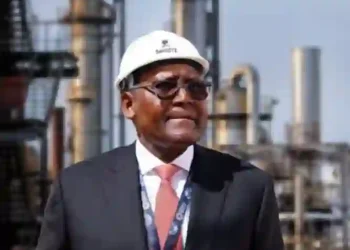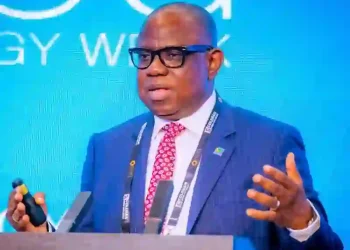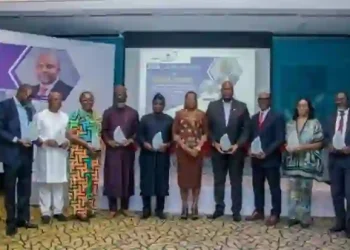



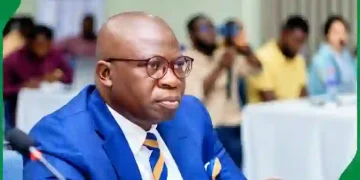




“This year, we are moving into construction phase.” Julius Rone, the man steering UTM Offshore, delivered the line with the certainty of someone who has already done the math, secured the funding, and lined up the machinery.
It came on an evening when The Sun Newspaper named him Investor of the Year 2026—timing so precise it felt almost scripted. Because Rone wasn’t there merely to shake hands and pose for photographs. He was there to announce that Nigeria’s first Floating Liquefied Natural Gas facility is about to become concrete and steel.
The significance is hard to overstate. For a country that has spent decades watching its gas reserves flare into the atmosphere while importing cooking fuel, this project represents a fundamental shift in ambition and capability.
Rone quickly pivoted credit toward the administration in Aso Rock. President Bola Ahmed Tinubu’s government, he argued, has built the policy scaffolding that makes projects of this magnitude feasible.
“The administration has continued to create an enabling environment to encourage investors, to tap into the Renewed Hope Agenda,” Rone said, his tone measured but emphatic. “The President has given significant incentives to those willing to develop the gas industry.”
It was more than platitude. Nigeria’s gas sector has long operated in oil’s shadow—enormous potential, glacial execution. Tinubu’s economic recalibration, Rone suggested, is finally altering that equation. UTM Offshore is the proof of concept.
“Receiving this award is an encouragement to do more,” he continued. “It will spur us to move the country forward from an investor’s perspective.”
The Project That Could Rewrite the Narrative
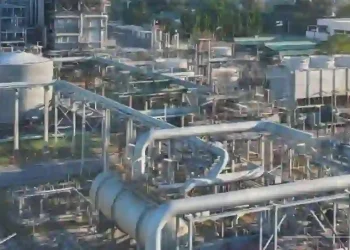
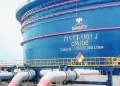
At the core of Rone’s vision sits infrastructure designed for scale and endurance. The UTM Offshore FLNG facility, anchored at the Yoho field within Oil Mining Lease 104—roughly 60 kilometers off the Niger Delta coast—will produce 1.5 million tonnes of LNG annually for export markets and 300,000 tonnes of LPG for domestic use. Beneath it: 2.2 trillion cubic feet of proven reserves, enough to sustain two decades of operations.
But the domestic angle cuts deeper. Nigeria has endured the absurdity of being energy-wealthy yet dependent on imported cooking gas. Rone intends to end that contradiction.
“This project will address domestic LPG requirements. Instead of importing, we will achieve self-sufficiency,” he stated. “One quarter of current LPG imports will cease. We will deliver at least 300,000 metric tonnes annually to the domestic market.”
He continued: “This will strengthen Nigeria’s economy, generate substantial employment, and deliver revenue to the nation.”
From most executives, such declarations would sound like awards-night filler. From Rone, they carry weight—because the financing, partnerships, and reserves are already locked in.
Follow the Money
The financial architecture backing the FLNG project is formidable by any standard. UTM Offshore secured Afreximbank as lead financier, mobilizing $2 billion for Phase One. Phase Two already has $3 billion committed. Five billion dollars directed toward a single Nigerian-led energy venture. In an era where large-scale energy projects routinely collapse during due diligence, this signals extraordinary investor confidence.
The ownership model reinforces that confidence: NNPCL holds 20 percent, Delta State Government 8 percent, UTM FLNG retains 72 percent. It balances sovereign participation with private-sector execution speed—a structure built not just to launch, but to endure.
The Architect Behind the Vision
Behind the spreadsheets and contracts is a career forged across decades in Nigeria’s energy landscape. Rone’s path—from OMPADEC to the Niger Delta Development Commission, eventually assuming leadership of the UTM Group of Companies in 2008—is not accidental. It’s the arc of someone who studied the terrain, cultivated alliances, and waited for the optimal moment to execute.
That moment appears to be now.
The project has enlisted global engineering firms—JGC Holdings, Technip Energies, KBR—and completed rigorous environmental and social impact assessments. These aren’t performative gestures. In a sector where public trust has historically been sacrificed for expediency, they indicate Rone is constructing something built to last.
Asked what sustains a man through a project of this complexity, Rone’s answer was remarkably straightforward.
“The key principles for success are focus, hard work, and consistency.”
The Test Nigeria Always Faces
Nigeria has never suffered from lack of energy ambition. What it has lacked—repeatedly, painfully—is execution capacity and political will. The UTM Offshore FLNG project is, in every substantive sense, a referendum on whether that pattern finally breaks.
The Sun Newspaper’s Investor of the Year recognition, viewed through this lens, transcends acknowledgment of past achievement. It’s an early nod to what Julius Rone is about to deliver.
And if the Gas King makes good on the construction timeline he just committed to, 2026 may be remembered as the year Nigeria’s gas sector stopped making promises and started delivering power.
READ ALSO:
- Sanwo-Olu Appoints Sanuth as New LAWMA MD Amid Lagos Waste Crisis
- Obi Denies Asking UK-Based Nigerians to Stop Supporting Families
- Fuel Subsidy Return Could Push Naira to ₦4,000/$, Oyedele Warns
- Who Truly Has The Presidential Material? | The Surge By Boma Lilian Braide (Esq)
- Former Delta Governor Emmanuel Uduaghan Dies At 71