









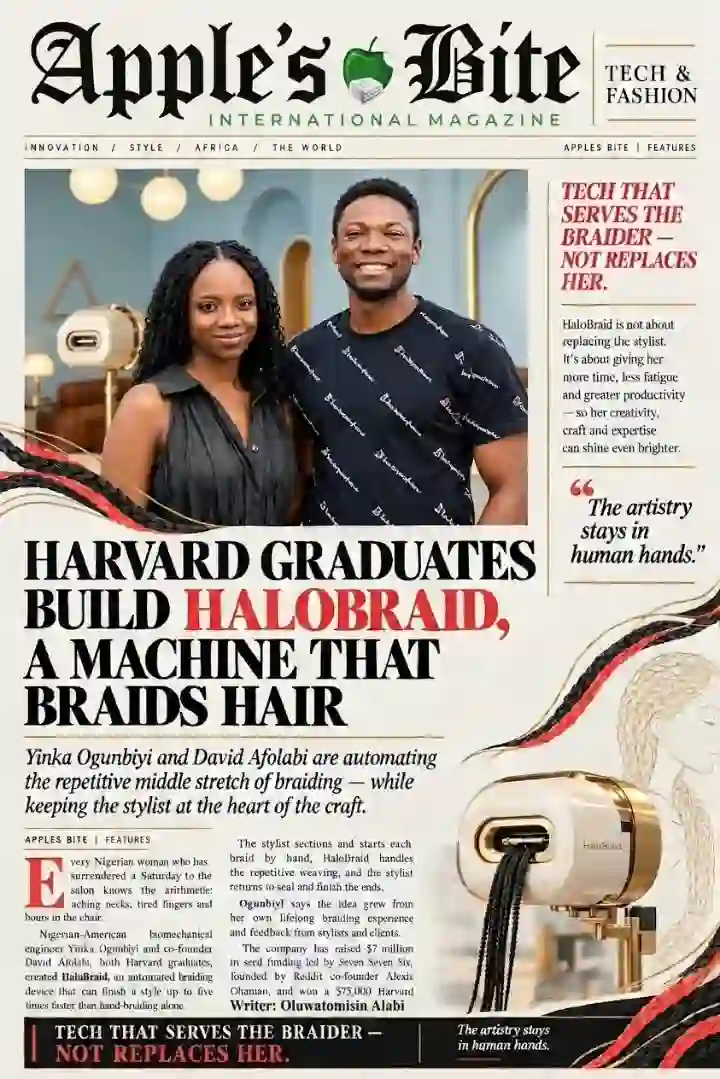
Every Nigerian woman who has surrendered a Saturday to the salon knows the arithmetic: the neck aches, the stylist’s fingers tire, and the hours stretch long after the first cup of zobo is gone. Now, two Harvard graduates have built a machine to change that sum.
Yinka Ogunbiyi, a Nigerian-American biomechanical engineer, and her co-founder, David Afolabi, are the minds behind HaloBraid, an automated braiding device that can finish a style up to five times faster than hand-braiding alone. A new public demonstration shows how it works in practice, and the surprise is that the stylist is not pushed aside. She remains at the center of the craft.
The stylist still sections the hair, applies the products, and starts each braid by hand. She then feeds it into HaloBraid, which takes over the long, repetitive weaving down the length of the hair. When the machine is done, she returns to the seal and finishes the ends. The tiring middle stretch is mechanised, while the artistry and the final signature stay with the human hand.
For Ogunbiyi, the idea is deeply personal. Her braiding story began at age four, seated between her mother’s knees, and she has since spent thousands of hours in the chair. Stylists and clients alike told her the same thing again and again: braiding is beautiful, but it takes too much time and puts too much strain on the body. As an engineer, she believed there had to be a better way. She says HaloBraid was built with stylists from the very beginning, alongside inventors, designers, and builders behind some of the world’s most loved hair and beauty products. She dedicates it to her mother, her stylists, her aunties, and everyone who knows what it means to spend hours in the chair.



Investors have taken notice. HaloBraid has raised $7 million in seed funding, led by Seven Seven Six, the venture firm founded by Reddit co-founder Alexis Ohanian, husband of tennis champion Serena Williams. The venture also won a $75,000 Harvard innovation prize.
For an industry built on the skill and stamina of African women, many of them running small salons, the message is clear. Technology can be made to serve the braider, not replace her.
READ ALSO:
- Harvard Graduates Yinka Ogunbiyi, David Afolabi Build, HaloBraid, a Machine That Braids Hair
- Uba Sani Says He Can Take a Bullet for Tinubu
- IPOB Challenges UIPC, Says Nnamdi Kanu’s Conviction Was Based On Repealed Law
- Abiodun Assures Ijebuland Of New Awujale Before May 2027
- Sanwo-Olu Gives Lagos Residents December 31 Deadline to Obtain Health Insurance