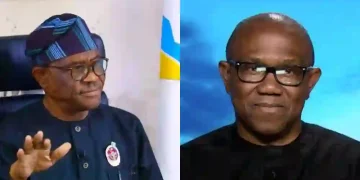






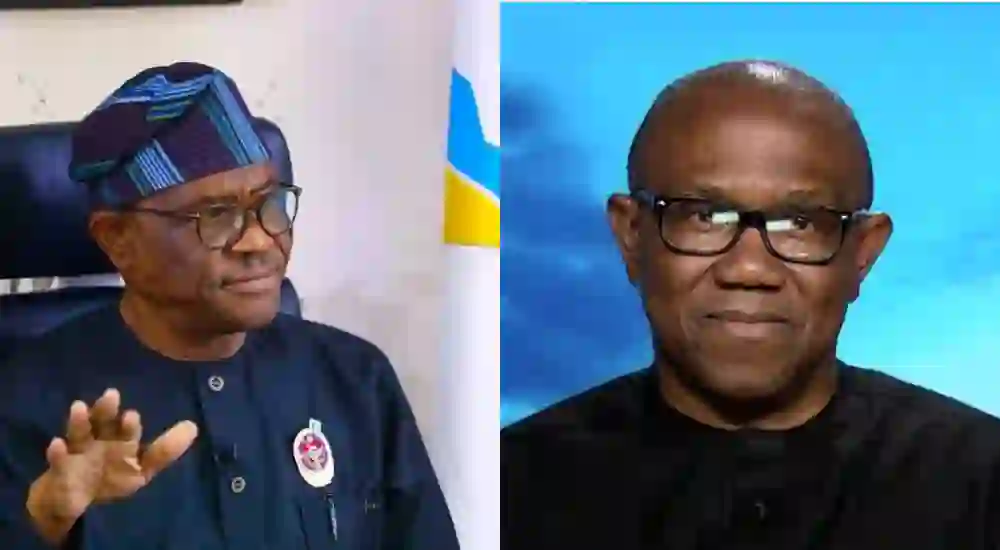
The Lagos State chapter of the All Progressives Congress (APC) and the Minister of the Federal Capital Territory, Nyesom Wike, have criticised the presidential candidate of the Nigeria Democratic Congress (NDC), Peter Obi, over his participation in the recitation of Nigeria’s former national anthem at a political gathering in Lagos.
The APC questioned Obi’s leadership qualities, accusing him of placing political theatrics and nostalgia above national development. The party also argued that his actions raised concerns about his judgment, respect for national institutions and readiness to lead a country of more than 200 million people.
The Lagos APC spokesperson, Seye Oladejo, expressed the party’s position in a statement issued on Saturday, describing the incident as an indication that Obi’s political movement was struggling to distinguish between nostalgia and national progress.
Obi had participated in the recitation of the former national anthem, Arise, O Compatriots, alongside Funso Doherty, the NDC governorship candidate in Lagos State, and other party supporters during a town hall meeting on Thursday.
A video from the event showed Obi and several attendees remaining seated when the current national anthem, Nigeria, We Hail Thee, was introduced. The event anchor subsequently switched to the former anthem, which Obi and others stood up to recite.
Reacting to the incident, Oladejo maintained that national symbols should not be used selectively for political purposes, stressing that Nigeria had adopted its current national anthem through a lawful legislative process.
He acknowledged that Nigerians were entitled to their personal preferences and historical sentiments but argued that deliberately turning a discontinued national symbol into a political statement raised questions about the priorities and judgment of those involved.
The APC spokesperson also questioned Obi’s ability to exercise independent leadership, alleging that the former Anambra State governor appeared easily influenced by the emotions and expectations of his supporters.
According to him, anyone seeking to lead a country as diverse and populous as Nigeria must demonstrate maturity, independent thinking, intellectual discipline and the courage to make decisions beyond the immediate expectations of political supporters.
Oladejo further criticised what he described as Obi’s inconsistent political alliances, changing positions and unclear policy direction, insisting that Nigerians deserved more than emotional mobilisation and political symbolism.
He argued that although the former national anthem might hold historical and emotional significance for some Nigerians, it could not provide solutions to unemployment, insecurity, inadequate infrastructure and the country’s economic challenges.
He added that political parties should focus on presenting practical ideas, credible alternatives and policies capable of advancing national development rather than engaging in symbolic confrontations with established national institutions.
Meanwhile, Wike also condemned Obi over the incident, questioning his patriotism and suitability for the presidency.
The FCT Minister made his position known on Friday during a stakeholders’ town hall meeting in Ogu-Bolo Local Government Area of Rivers State.
Wike faulted Obi for remaining seated during the rendition of the current national anthem but standing up when the former anthem was introduced.
He described the action as disrespectful to Nigeria, arguing that anyone aspiring to become the country’s president should demonstrate respect for its national symbols.
Wike said the incident raised serious questions about Obi’s commitment to national unity and suggested that his conduct should count against his presidential ambition.

It would be recalled that President Bola Tinubu signed the National Anthem Bill into law on May 29, 2024, restoring Nigeria, We Hail Thee as the country’s national anthem.
The anthem was originally adopted when Nigeria gained independence in 1960 before being replaced in 1978 by Arise, O Compatriots, which remained in use for 46 years.
Oladejo maintained that Nigeria needed leaders capable of promoting national unity, protecting institutional integrity and providing practical solutions to the country’s challenges.
He urged Nigerians to carefully examine Obi’s leadership philosophy and determine whether the country needed a president guided by clear policies, sound judgment and commitment to national development rather than political sentiments and crowd-driven decisions.
READ ALSO:
- American Consulate Hosts Bolanle Austen-Peters Ahead Of Lagos International Theatre Festival
- Uyo Book Club to Honour Ex-Akwa Ibom Governor Victor Attah at 88 With Colloquium
- APC, Wike Criticise Peter Obi Over Recitation Of Old National Anthem
- Tinubu’s Stoning Incident Shakes Campaign as Presidency Calls for Issue-Based Politics
- Portable Claims He Received N100m After Campaigning For APC