






Growing political dissatisfaction across northern Nigeria could pose a major challenge to President Bola Ahmed Tinubu’s re-election ambition ahead of the 2027 presidential election, with opposition figures Atiku Abubakar and Peter Obi seeking to benefit from the situation.
The ruling All Progressives Congress (APC) is increasingly facing resistance in several northern states, where public anger over insecurity, economic hardship and political disagreements appears to be affecting the party’s support base.
The development has raised questions about whether Tinubu can secure the northern votes previously recorded by former President Muhammadu Buhari, who enjoyed considerable political support across the region.
Across several northern states, reports of protests, destruction of campaign posters and hostility towards APC campaign activities have emerged. In some locations, residents have reportedly expressed dissatisfaction with the president and his administration.
In Nasarawa State, divisions within the APC have reportedly created two opposing factions, with one group supporting the incumbent governor while another is protesting what it considers the imposition of governorship candidates.
The disagreements have reportedly resulted in clashes and violence during some party activities. The situation has also been worsened by public frustration over the country’s economic challenges.
In Niger State, the APC campaign organisation, working with the state government, is reportedly installing electric barbed-wire fences to protect Tinubu’s campaign posters from being removed or destroyed.
The growing dissatisfaction is also linked to worsening insecurity, particularly in communities affected by banditry and kidnapping. Niger State remains among the areas struggling with a significant number of internally displaced persons.
Many residents have also lost access to farmlands as criminal groups continue to attack communities, abduct people from their homes, schools and business premises, and disrupt economic activities.
In Kogi State, poor road conditions have reportedly worsened security challenges, with frequent kidnappings along federal highways. Travellers whose vehicles break down are said to be particularly vulnerable to attacks.
More than seven local government areas in the state have reportedly been abandoned by residents because of insecurity, further worsening economic hardship.
Plateau State is also battling persistent killings, rising inflation and growing frustration among residents over the government’s response to the security situation.
Similar opposition to Tinubu’s re-election bid has reportedly been observed in Sokoto, Kebbi, Bauchi, Katsina, Benue, Adamawa, Zamfara and Kano states, where the president’s campaign posters have been removed and destroyed.
At some APC campaign events and town hall meetings, protesters have reportedly chanted, “We don’t want you again.”
In Kaduna State, security operatives have reportedly been deployed to protect the president’s campaign billboards from destruction by angry youths.
The dissatisfaction has also extended to the Federal Capital Territory, Abuja, where Tinubu was reportedly booed and pelted with objects during a recent visit to the Shehu Shagari Mosque for Friday prayers. Some of his campaign posters have also been destroyed in parts of the capital.
Sources within the APC campaign organisation have reportedly acknowledged the difficulties facing the party in convincing northern voters to support Tinubu’s second-term ambition.
They attributed the challenge to worsening economic conditions, insecurity and what some northerners perceive as attempts to prevent Atiku Abubakar, the presidential candidate of the African Democratic Congress (ADC), from participating in the 2027 election.
According to the sources, support for Atiku remains strong in parts of the North, with some of his supporters threatening to reject the election if he is excluded from the ballot.
There are also concerns that some political leaders expected to mobilise support for Tinubu may not be fully committed to his re-election campaign. Others are reportedly reluctant to engage their constituents because of accusations that politicians have collected money without addressing the people’s concerns.
However, Tinubu’s supporters believe that the president could benefit from Buhari’s former northern support base if Atiku is not on the ballot.



They argue that northern voters would prefer Tinubu to Peter Obi, the presidential candidate of the Nigeria Democratic Congress (NDC), who enjoys considerable support in parts of the South-East.
But previous election results suggest that Buhari’s votes may not automatically transfer to Tinubu.
2019: Buhari Secured More Than 11.5 Million Northern Votes
During the 2019 presidential election, Buhari secured 15,191,847 votes nationwide, with 11,547,809 coming from the 19 northern states.
This represented approximately 76 per cent of his total votes.
His performance across the northern states included 1,464,768 votes in Kano, 1,232,133 in Katsina, 993,445 in Kaduna, 836,496 in Borno, 798,428 in Bauchi and 794,738 in Jigawa.
He also recorded 612,371 votes in Niger, 581,552 in Kebbi, 497,914 in Yobe, 490,333 in Sokoto, 468,555 in Plateau and 438,682 in Zamfara.
Other results included 402,961 in Gombe, 378,078 in Adamawa, 347,668 in Benue, 324,906 in Taraba, 308,984 in Kwara, 289,903 in Nasarawa and 285,894 in Kogi.
2023: Tinubu’s Northern Votes Fell Below Buhari’s Record
The 2023 presidential election produced a different voting pattern, as Tinubu recorded significantly fewer votes across the northern states than Buhari did in 2019.
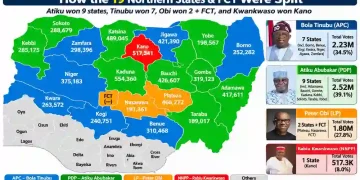
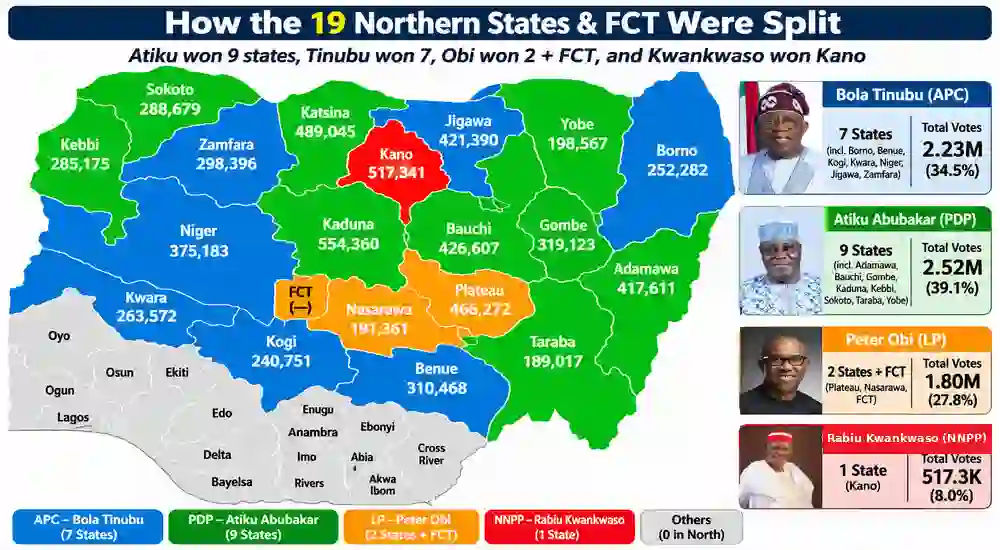
Tinubu secured 8,794,726 votes nationwide, including 5,507,784 from the 19 northern states, representing 62.63 per cent of his total votes.
Atiku, who contested under the Peoples Democratic Party (PDP), secured 6,984,520 votes nationally, with 5,159,279 coming from the North.
This represented 73.87 per cent of his total votes.
Peter Obi, who contested under the Labour Party, polled 6,101,533 votes nationwide, including 1,799,129 from the 19 northern states.
Obi’s northern support was particularly significant in Plateau, where he secured 466,272 votes, Benue with 308,372, Kaduna with 294,494 and Nasarawa with 191,361.
Overall, Tinubu narrowly defeated Atiku across the 19 northern states in 2023, securing 5,507,784 votes against Atiku’s 5,159,279, while Obi came third with 1,799,129 votes.
Buhari’s 12 Million Votes Belong To Atiku, Says Dalung
A chieftain of the ADC and former Minister of Sports, Solomon Dalung, has argued that Buhari’s northern political support base is more likely to benefit Atiku than Tinubu or any other presidential candidate.
Speaking to THE WHISTLER, Dalung described Tinubu’s policies and administration as factors strengthening the opposition ahead of the 2027 election.
He accused the president of failing to adequately address the suffering of Nigerians, particularly in the areas of economic hardship and insecurity.
Dalung also criticised the administration’s handling of killings in Plateau State, arguing that the president’s response to affected communities had further weakened his popularity in the North.
He listed the removal of fuel subsidy, increased electricity tariffs, depreciation of the naira, higher bank charges and rising data costs among the policies he believes have worsened the economic situation.
On the question of who would inherit Buhari’s political support, Dalung pointed to the former president’s funeral, where he said Atiku received significant attention from mourners.
He argued that the incident demonstrated Atiku’s political relevance and strong connection with Buhari’s supporters.
According to Dalung, although Buhari’s votes may not be transferred to one candidate as a single bloc, his political legacy could favour Atiku.
He further claimed that several political associates of the late president had moved closer to Atiku, while some others had faced corruption investigations and prosecution.
Dalung insisted that the North was experiencing serious political dissatisfaction with the Tinubu administration and predicted that the region would largely support Atiku in 2027.
Tinubu Cannot Inherit Buhari’s Votes, Okechukwu Insists
Former Director-General of the Voice of Nigeria, Osita Okechukwu, also dismissed the possibility of Tinubu automatically inheriting Buhari’s northern votes.
Okechukwu argued that the administration’s performance and the economic difficulties facing Nigerians would make it difficult for the president to secure the same level of support enjoyed by his predecessor.
He maintained that although the entire country was experiencing economic challenges, northern communities were particularly affected.
Okechukwu also claimed that Tinubu was gradually losing political support in the region, alleging that some northern governors were beginning to distance themselves from the president.
He predicted that more governors could follow the example of Katsina State Governor Dikko Radda in distancing themselves politically from the president.
Meanwhile, the APC and NDC campaign organisations were reportedly contacted for their reactions to the issues raised but had not responded one week after being approached and before the report was published.
The growing political tension in the North, alongside the voting figures from previous elections, suggests that the region could play a decisive role in determining the outcome of the 2027 presidential election.
READ ALSO:
- Ifẹ́ Oracle Rejects Ayiri, Picks Eyewuoma as Ologbotsere
- Tinubu Approves N250m Relief For Bayelsa Boat Accident Victims As Death Toll Hits 29
- The 74 Seats And No Women In Sight | The Surge By Boma Lilian Braide (Esq)
- Okonkwo Slams Tinubu Over Water, Electricity Shortages At Presidential Villa
- Atiku, Obi Target Buhari’s 12 Million Northern Votes As Tinubu Faces Growing Opposition