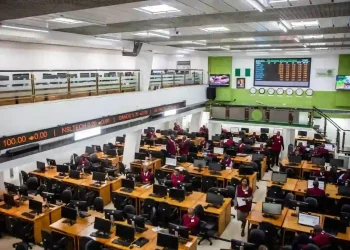










The Central Bank of Nigeria (CBN) has reduced its Monetary Policy Rate (MPR) by 350 basis points, from 26.5 per cent to 23 per cent, in a move that has triggered mixed reactions from economists, business operators and capital market experts.
CBN Governor, Olayemi Cardoso, announced the decision on Tuesday at the end of the 307th meeting of the Monetary Policy Committee (MPC) in Abuja.
Cardoso described the reduction as a reset of the policy rate to reflect current developments in the financial market, stressing that it was not a change in the overall direction of monetary policy.



The MPC also recalibrated the standing facilities corridor to +50/-300 basis points around the MPR.
It retained the Cash Reserve Requirement (CRR) for Deposit Money Banks at 45 per cent, Merchant Banks at 16 per cent and non-Treasury Single Account (TSA) public sector deposits at 75 per cent.
According to Cardoso, the adjustment was necessary because the gap between the MPR and prevailing market rates had weakened the transmission of monetary policy.
He said the CBN’s ongoing reforms, including the adoption of the Nigerian Overnight Financing Average (NOFA) as a transaction-based operational benchmark, had improved transparency in money market operations.
The governor said the new framework was designed to strengthen the effectiveness of monetary policy and restore the MPR as the main signal for monetary conditions.
CBN says economic conditions support rate cut
Cardoso said the current economic environment provided an opportunity for the CBN to adjust its policy framework without undermining efforts to bring down inflation.
He said previous monetary tightening measures had helped strengthen the economy, citing moderating inflation, exchange-rate stability, improved external-sector fundamentals, stronger foreign reserves and renewed investor confidence.
“We are in a position of stability. The tightening we have done in the past has worked. FX pressure has receded. Capital market growth is because of the FX market stability. Investor confidence has come back,” Cardoso said.
The CBN governor also disclosed that Nigeria’s gross external reserves stood at $55.25 billion as of September 18, 2026.
According to him, the reserves represent the highest level recorded in 18 years and are sufficient to cover approximately 11.3 months of imports of goods and services.
Cardoso, who marked three years in office on Tuesday, said reforms implemented by the CBN had helped stabilise the foreign exchange market.
He argued that the economy could not sustain the combination of fuel and foreign-exchange subsidies, which he said had previously amounted to about five per cent of GDP.
CPPE describes reduction as relief for businesses
Chief Executive Officer of the Centre for the Promotion of Private Enterprise (CPPE), Dr Muda Yusuf, described the rate reduction as timely and a major relief for the real sector.
Yusuf said the previous MPR of 26.5 per cent had become increasingly difficult to reconcile with inflation of about 15.4 per cent and prevailing money-market rates of around 20 per cent.
He said the reduction to 23 per cent would help realign the policy rate with current economic and financial-market conditions.
According to him, high borrowing costs have remained a major constraint on investment, production, working capital and job creation.
He said sectors such as manufacturing, agriculture, construction and logistics could benefit if the lower policy rate translates into reduced lending costs.
Yusuf, however, stressed that the impact of the rate cut would depend largely on how effectively the reduction is transmitted to businesses and consumers.
Business operators say 23% remains high
The National President of the National Council of Managing Directors of Licensed Customs Agents (NCMDLCA), Lucky Amiwero, took a different position, arguing that the new rate remained too high to provide meaningful relief for businesses.
Amiwero said companies that depend heavily on bank credit would continue to face significant financing challenges at a 23 per cent policy rate.
“It is still high. When you look at the economy, they have removed subsidies and they have removed the floating currency. What is the bargaining power of anybody today?” he said.
He also identified poor infrastructure, electricity shortages and inadequate roads as additional factors driving up the cost of doing business.
Amiwero called for further measures to make credit more affordable and improve the operating environment for businesses, particularly those engaged in international trade.
Capital market expects asset repricing
President of the Chartered Institute of Stockbrokers (CIS), Fiona Ahimie, described the reduction as a significant development for the capital market.
She said the lower MPR could lead to repricing across financial assets, particularly in the fixed-income market.
According to her, yields on government securities could moderate as investors adjust to a lower interest-rate environment.
She added that declining returns on short-term instruments could encourage some investors to consider longer-term bonds and equities.
Ahimie said lower interest rates could also support equity valuations by reducing companies’ financing costs and improving the value of future corporate cash flows.
However, she noted that the impact would differ across sectors.
She said banks could experience mixed effects, as lower lending rates could encourage credit growth while faster repricing of loans than deposits could affect banks’ interest margins.
Ahimie also said foreign portfolio investment flows would depend not only on interest rates but also on exchange-rate stability, inflation, external reserves and broader investor confidence in the Nigerian economy.
Uwaleke supports MPC decision
President of the Capital Market Academics of Nigeria, Professor Uche Uwaleke, said the decision was supported by recent improvements in key economic indicators.
He cited moderating inflation, exchange-rate stability, improved foreign-exchange liquidity and stronger external reserves as factors supporting the rate reduction.
Uwaleke also welcomed the recent collaboration between the Ministry of Finance and the CBN on fiscal and monetary policy coordination.
Jeremiah calls move an aggressive response
Chief Investment Officer of VNL Capital Asset Management, Dr Ubah Jeremiah, described the 350-basis-point reduction as a strong response to current economic conditions.
Jeremiah said market expectations had largely centred on a smaller reduction of between 50 and 100 basis points.
He said the size of the reduction suggested that the CBN had gained greater confidence in developments surrounding inflation, the naira and foreign reserves.
The latest decision therefore places the MPR at 23 per cent, while the CBN maintains that the move represents an operational reset rather than a shift in its underlying monetary policy stance.
READ ALSO:
- INEC Blames Supreme Court Ruling for Dropping Adebutu, Pantami from Governorship List
- Otunba Gbenga Daniel’s Foundation Brings Free Surgeries to 14 Ogun East Locations
- Historic Success Federation Of Registered Nollywood Guilds And Associations (FRNGA) Holds Maiden Presidents Summit
- Peter Obi Accuses Tinubu Government of Scaring Away Investors
- Tinubu To Inaugurate 2027 Presidential Campaign Council Today