










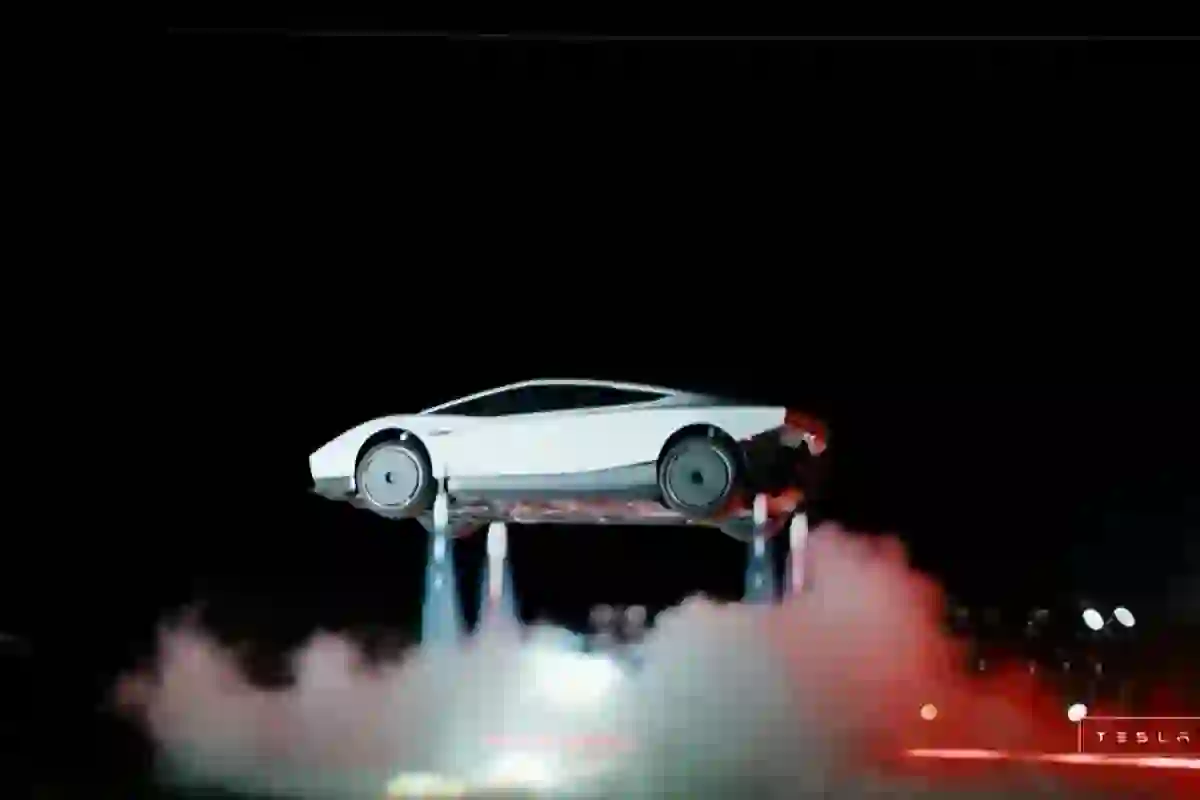
Tesla chief executive officer Elon Musk has unveiled a new Roadster sports car equipped with thrusters, describing the vehicle as a potential flying car during a livestreamed event at SpaceX’s facility in Texas.
The demonstration took place on Thursday at a SpaceX test facility, where Musk presented the vehicle as a product of collaboration between Tesla, the electric vehicle manufacturer, and SpaceX, the rocket company he also leads.
During the event, which was streamed live on Tesla’s X account, the Roadster accelerated up a steep ramp before landing on its wheels.
“Flying cars are real,” Musk declared while showcasing the vehicle.
However, the billionaire entrepreneur acknowledged that the project still carried some uncertainty. He said the vehicle’s success was not guaranteed, although he expressed confidence that the technology would probably work.
Musk explained that the car was fitted with ultra-high-pressure air tanks designed to provide the thrust needed to propel it into the air.
He described the development as the result of combining the expertise of what he called the world’s best car company and the world’s best rocket company, referring to Tesla and SpaceX.
According to Musk, production of the vehicle is expected to begin in 2028, although the project will still need to overcome significant technical and regulatory challenges before it can become commercially available.
Challenges Facing Flying Cars
The idea of flying cars has attracted considerable attention from technology companies and aviation enthusiasts for decades. However, turning the concept into a practical means of transportation has proved difficult because of engineering limitations, safety concerns, regulatory requirements and the challenges associated with operating vehicles that can travel both on roads and in the air.
Although advances in electric motors, battery technology and lightweight materials have renewed interest in the sector in recent years, widespread commercial adoption remains a challenge.



Musk’s latest unveiling could add momentum to the industry, particularly if Tesla can demonstrate that its proposed technology is safe, reliable and suitable for everyday use.
The history of flying cars dates back more than a century. American aviation pioneer Glenn Curtiss introduced an early flying-car prototype in 1917, marking one of the first attempts to combine road transportation with aviation.
Since then, several inventors and companies have explored similar concepts, but technical difficulties and regulatory barriers have prevented flying cars from becoming a common feature of modern transportation.
Tesla’s proposed Roadster will therefore face considerable scrutiny as the company works towards its projected 2028 production timeline.
READ ALSO:
- South Africa Warns Femi Fani-Kayode Over Conduct, Cites Vienna Convention
- ‘I Don’t Owe Anyone an Apology for Doing the Right Thing’ – Commissioner Tokunbo Wahab Defends Tough Environmental Decisions
- EKSU’s NAPE Triumph Signals Bigger Ambition for African Geology Leadership
- Odukoya Rejects Removal, Insists he Remains Senior Pastor of Fountain of Life Church
- Jimmy Odukoya Removed As Senior Pastor Of Fountain Of Life Church