









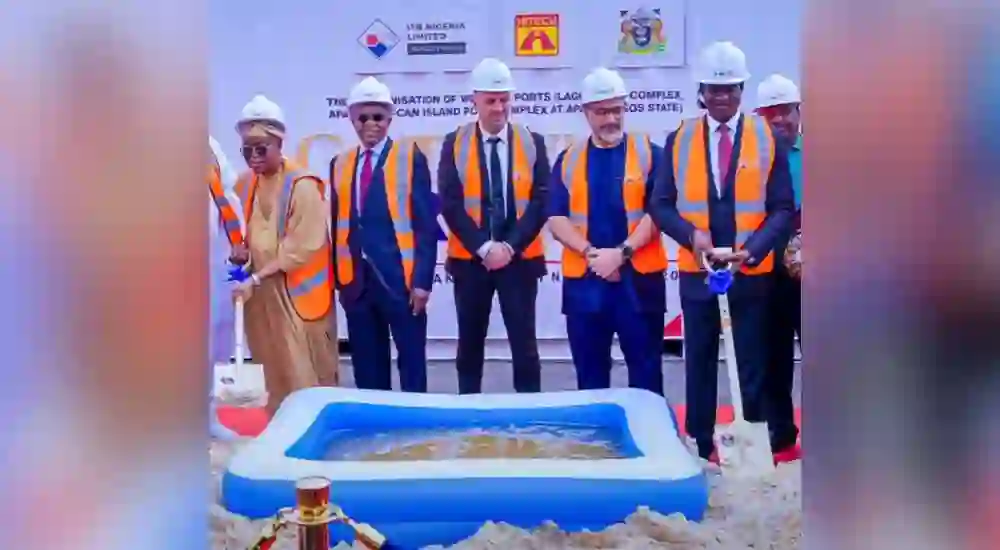
The Federal Government has officially commenced the modernisation and upgrade of the Lagos Port Complex, Apapa, and Tin Can Island Port in a major infrastructure project valued at £746 million, approximately N1.45 trillion.
The Minister of Marine and Blue Economy, Dr Adegboyega Oyetola, alongside the Minister of Finance and Coordinating Minister of the Economy, Taiwo Oyedele, and other senior government officials, performed the groundbreaking ceremony at Tin Can Island Port on Wednesday, November 25, 2026.
Oyetola described the project as a strategic investment aimed at repositioning Nigeria as a leading maritime hub in Africa, improving the country’s competitiveness in international trade and strengthening its economy.
According to the minister, the modernisation programme will address decades of infrastructure challenges, reduce logistics costs, attract international shipping companies, promote industrial development and create at least 20,000 direct and indirect employment opportunities.
He explained that the project aligns with President Bola Tinubu’s Renewed Hope Agenda, which prioritises infrastructure development as a major driver of economic growth, investment and job creation.



The minister noted that Apapa and Tin Can Island ports, which have served as important gateways for Nigeria’s international trade for decades, are no longer adequate to handle the country’s expanding economic activities and changing global shipping demands.
He recalled that Apapa Port was established in 1913, while Tin Can Island Port was commissioned in 1977 when Nigeria had a population of approximately 67.2 million, annual trade valued at about $17 billion and cargo throughput of 8.11 million metric tonnes.
However, Nigeria’s population has since increased to approximately 240 million, merchandise trade now exceeds $100 billion annually, while cargo throughput has risen to 129.3 million metric tonnes, almost 16 times the figure recorded when Tin Can Island Port was established.
Oyetola said the growing pressure on the ports, combined with ageing infrastructure, had made comprehensive modernisation necessary.
He stressed that Nigeria could no longer afford to lose maritime business to neighbouring countries that had invested heavily in modern port facilities and deep-sea infrastructure.
The minister also disclosed that cargo clearance and dwell time at Nigerian ports had historically ranged between 10 and 18 days, compared with three to five days at leading international ports.
He said the delays had resulted in congestion, demurrage, additional storage charges and increased logistics costs, with the inefficiencies estimated to cost the Nigerian economy as much as $4 billion annually.
Oyetola said the Federal Government was targeting a significant improvement in port efficiency, including reducing cargo clearance time to 48 hours.
He explained that the modernisation project would involve the rehabilitation and upgrading of critical port infrastructure, including quay walls, berths, dredging and navigation channels, access facilities, cargo-handling equipment and operational systems.
The project will also introduce more integrated and digitally enabled port operations to improve efficiency, reduce delays and strengthen cargo management.
According to him, the improved facilities will enable Nigeria to attract more direct services from international shipping lines, retain cargo destined for the country, expand transshipment opportunities and position its ports as preferred gateways for trade under the African Continental Free Trade Area.
He added that efficient port operations would support exporters of agricultural products, processed foods, solid minerals, manufactured goods, textiles and petrochemical products by reducing transportation costs, improving delivery schedules and strengthening access to international markets.
The minister further noted that manufacturers, agro-processors and micro, small and medium-sized enterprises would benefit from a more efficient maritime environment.
To minimise disruptions during construction, Oyetola disclosed that he had approved the establishment of an Inter-Ministerial Committee comprising the Federal Ministry of Marine and Blue Economy, the Nigerian Ports Authority and the Nigeria Port Economic Regulatory Agency.
The committee will develop a comprehensive Port Business Continuity and Cargo Flow Management Plan to coordinate construction activities, vessel scheduling, cargo evacuation, truck movements and the use of alternative ports and transportation channels where necessary.
He explained that the Lagos ports modernisation project was part of a broader national maritime development programme, which also included the approved modernisation of Onne Port in Rivers State, Delta Port and Calabar Port.
Also speaking at the ceremony, the Minister of Finance and Coordinating Minister of the Economy, Taiwo Oyedele, described the project as a major step towards reducing the cost of doing business, improving Nigeria’s economic competitiveness and accelerating national development.
Oyedele said modern and efficient port facilities would reduce delays and additional expenses for importers and exporters, improve the competitiveness of Nigerian products and deliver economic benefits to manufacturers, farmers and consumers.
He described the financing arrangement as Nigeria’s largest sovereign export credit transaction since 2009.
He also disclosed that Poland’s Export Credit Insurance Corporation, KUKE, was participating in its first project in Nigeria, describing the development as evidence of growing international confidence in the country’s economic reforms.
The finance minister reaffirmed the Federal Government’s commitment to providing the necessary approvals, maintaining a stable and predictable operating environment and ensuring transparency throughout the financing and implementation of the project.
In his remarks, the Managing Director of the Nigerian Ports Authority, Dr Abubakar Dantsoho, described the groundbreaking ceremony as a historic milestone for the authority and Nigeria’s maritime sector.
Dantsoho assured stakeholders that the NPA would ensure the project was delivered in line with approved designs, engineering standards and contractual timelines.
He also promised effective technical supervision, quality assurance and coordination throughout the construction period, with particular attention to safety, environmental protection and uninterrupted port operations.
The ceremony was attended by Poland’s Deputy Foreign Minister, Marcin Bosacki; Polish Ambassador to Nigeria, Michal Cygan; and the British Deputy High Commissioner in Lagos, Jonny Baxter.
Other attendees included contractors, international financing partners and major stakeholders in Nigeria’s maritime industry.
The Federal Government believes the modernisation of the Apapa and Tin Can Island ports will significantly improve cargo handling, reduce the cost of international trade, attract foreign investment and strengthen Nigeria’s position as a major maritime and commercial centre in Africa.
READ ALSO:
- Lagos Arrests 13 Over Illegal Waste Disposal, Dislodges Cart Pushers
- Ogun PDP Holds Yayi Responsible for Bloodied Head of Rivers Senator’s Aide
- Afreximbank To Raise $1.5bn For Proposed LNG Project In Akwa Ibom
- Court of Appeal Sentences Oil Tycoon Jide Omokore To Seven Years In Prison Over $1.6bn Fraud
- Court Orders Arrest Of Pastor Jimmy Odukoya