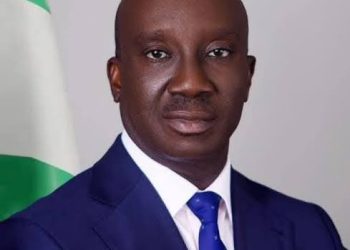











A Nigerian court has sentenced Nnamdi Kanu, the leader of the Indigenous People of Biafra (IPOB), to life imprisonment after finding him guilty of terrorism charges. The conviction comes nearly a decade after his initial arrest.
Justice Omotosho delivered the verdict on Thursday, declaring that Kanu showed no remorse throughout the trial. The judge was satisfied that Kanu had made numerous broadcasts intended to incite violence and killings as part of his campaign for the establishment of an independent state called Biafra in southeastern Nigeria.
Kanu was convicted on all seven counts brought against him by the prosecution. The charges included making broadcasts with the intention to intimidate the population, threaten the public with sit-at-home orders, encourage the killing of security officers, and incite attacks on police officers. He was also accused of encouraging the public to burn federal government facilities in Lagos, causing major economic losses, and importing a radio transmitter known as Tram 50L, which he concealed in a container in Anambra State.
Dramatic Courtroom Scenes
The delivery of the judgment was marked by dramatic scenes in the courtroom as Kanu protested his conviction. When asked to comment on his matter, the IPOB leader questioned why he had been detained when he committed no crime and demanded bail.
“What I am asking for is a referral to the appeal court for this case. Why should I be in detention for a law that does not exist? I want them to grant me bail,” Kanu stated.
However, Justice Omotosho rejected his requests for referral to the appeal court and a stay of proceedings, stating that such applications could not be entertained under the administration of criminal justice law.
As the judge prepared to deliver the judgment, Kanu repeatedly interrupted, demanding that the judge show him the law under which the judgment was being delivered. His disruptions escalated into shouting, prompting the judge to order his removal from the courtroom.
“You do not know the law. Show me the law. Any judgment from this court is rubbish,” Kanu shouted as he was being escorted out of the court.
The judge subsequently ruled that the proceedings could continue in Kanu’s absence, citing his unruly behavior in the courtroom. Justice Omotosho explained that while fundamental rights exist, they are not absolute and must be exercised responsibly. The judge noted that Kanu had been given the opportunity to defend himself but had misused that opportunity.
“If the defendant misbehaves in the courtroom, the judgment can proceed without him,” the judge stated, proceeding with the sentencing.



Background of the Case
Kanu’s prominence in the separatist movement began in 2009 when he founded Radio Biafra, a station that broadcast calls for an independent Igbo state from London. His broadcasts gained significant following among supporters of Biafran independence, particularly among the Igbo people in Nigeria’s southeastern region.
The trial revealed evidence of numerous broadcasts in which Kanu allegedly incited his followers to attack and kill military and police personnel, destroy public property, and comply with sit-at-home orders that paralyzed economic activity in the southeast.
During the trial, the prosecution called five witnesses and presented extensive video and audio recordings of Kanu’s broadcasts as evidence of his involvement in terrorism-related activities. The evidence demonstrated how his communications were used to mobilize followers and coordinate anti-government activities.
Trial Developments
Initially, Kanu and his legal team, led by former Attorney General and Minister of Justice Kanu Agabi, filed a no-case submission, arguing that the prosecution had failed to establish a credible case against him. However, Justice Omotosho overruled this submission, finding that Kanu had answers to provide regarding the evidence presented by the prosecution.
In a surprising turn, Kanu dismissed his legal representatives and opted to conduct his own defense. However, after multiple adjournments and repeated explanations from the judge regarding the implications of his actions, Kanu eventually refused to present his defense, claiming that the charges against him were based on repealed laws that no longer existed.
Justice Omotosho rejected this argument, ruling that the trial had progressed beyond the stage where interlocutory objections could be raised. After approximately six adjournments, the judge ruled that Kanu had waived his opportunity to present his own version of events and adjourned the matter for judgment.
The Seven Counts
Kanu was convicted of the following charges:
Count 1: Committing acts of terrorism against the Federal Republic of Nigeria by making broadcasts intended to intimidate the population as a member and leader of IPOB.
Count 2: Committing acts of terrorism by making broadcasts intended to threaten the public with sit-at-home orders.
Count 3: Making broadcasts declaring himself a member and leader of IPOB, an organization banned by the Nigerian government.
Count 4: Making broadcasts encouraging members of the public to kill Nigerian security officers.
Count 5: Making broadcasts encouraging attacks on Nigerian police officers.
Count 6: Making broadcasts encouraging the public to burn every federal government facility in Lagos, resulting in major economic losses.
Count 7: Importing and concealing a Tram 50L radio transmitter in a container in Ihiala Local Government Area of Anambra State.
Implications and Next Steps
Justice Omotosho indicated that Kanu has the right to appeal the judgment. However, legal experts suggest that the conviction represents a significant development in Nigeria’s efforts to combat terrorism-related activities and separatist movements in the southeastern region of the country.
The life sentence marks a decisive conclusion to a case that has drawn international attention and sparked considerable debate about press freedom, freedom of expression, and the use of counter-terrorism laws in Nigeria.

Madukwe B. Nwabuisi is an accomplished journalist renown for his fearless reporting style and extensive expertise in the field. He is an investigative journalist, who has established himself as a kamikaze reporter.