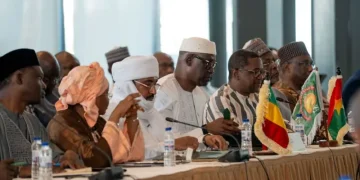









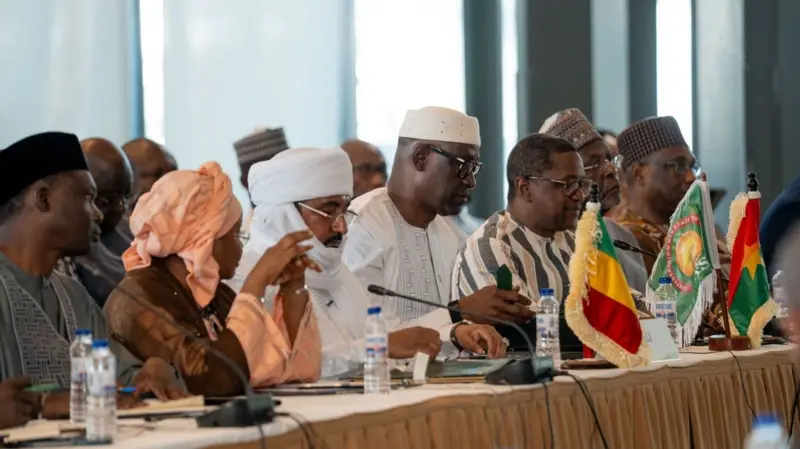
Burkina Faso, Niger and Mali have resumed formal talks with the Economic Community of West African States (ECOWAS), agreeing to work towards a framework for cooperation even though they have left the regional bloc.
The three Sahel countries formally exited ECOWAS in January 2025 after forming the Alliance of Sahel States (AES), following growing disagreements with the bloc. Their meeting in Dakar on Saturday is believed to be the first official ministerial-level engagement between both sides, although discussions had been ongoing since the withdrawal.
Burkina Faso’s Foreign Minister, Karamoko Traore, led the AES delegation, while Senegal’s Foreign Minister, Cheikh Niang, headed the ECOWAS team. In a joint statement issued on Saturday evening, both sides welcomed the talks, citing fraternity, mutual respect and openness as guiding principles. They also stressed good neighbourly relations and respect for national sovereignty. The parties agreed to set up joint thematic working groups to develop a framework cooperation agreement.
The talks come at a time of deep insecurity across the Sahel. Armed groups continue to launch attacks and push towards coastal West African states. Mali, Burkina Faso and Niger have fought jihadist insurgencies for over a decade, with groups linked to al-Qaeda and Islamic State exploiting weak state presence, porous borders and local grievances.
In Mali, coordinated attacks on 25 April targeted several locations and involved Jama’at Nusrat al-Islam wal-Muslimin (JNIM), an al-Qaeda affiliate, and the Azawad Liberation Front, a separatist movement. The country’s Defence Minister, Sadio Camara, was killed in the attacks. In Burkina Faso and Niger, armed groups have kept up pressure on security forces and civilians, while violence increasingly threatens northern Benin and Togo.
Nigeria, the region’s largest economy, faces its own overlapping threats, including Boko Haram and Islamic State West Africa Province (ISWAP) insurgencies, banditry and mass kidnappings. Because these groups operate across borders, strained relations between Nigeria and the AES countries risk weakening intelligence-sharing and joint counterterrorism operations. Niger’s withdrawal from the Multinational Joint Task Force in March 2025 showed how far regional cooperation had collapsed.



The AES states have taken an independent political and security path, distancing themselves from France and deepening ties with Russia. Their exit from ECOWAS has complicated cooperation, even though the threats they face are shared and demand intelligence-sharing, effective border controls and coordinated military responses.
Tensions have also been fuelled by claims from Sahelian leaders that neighbouring countries and foreign powers back armed groups. These claims remain contested and cannot be treated as fact without independently verifiable evidence.
It is not yet clear whether the renewed talks could lead to the AES states returning to ECOWAS. If a return is not on the agenda, the question is how the bloc, which has long stressed democratic governance, will engage the junta-led countries while confronting growing security threats along their shared borders.
- Mali, Burkina Faso and Niger return to the table with ECOWAS nine months after leaving the bloc
- Roadside food is getting smaller, and Nigerians are paying more for it
- Fatai Okoya begs billionaire father Razaq Okoya for forgiveness after four decades apart
- Nine Escape Unhurt as Private Jet Door Falls Off Mid-Air in Abuja
- Megastar Man of the Decade Awards Honour Rone, Gbenga Daniel, 28 Others