






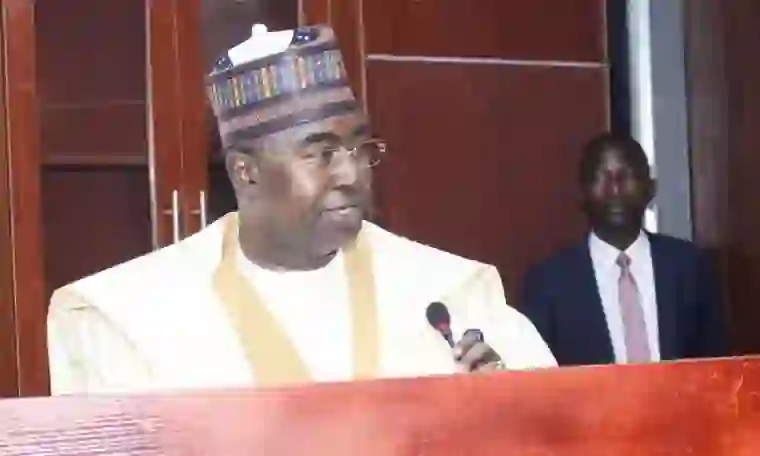
The Chairman of the National Drug Law Enforcement Agency (NDLEA), Brig. Gen. Buba Marwa (retd.), has directed the agency’s investigators to intensify efforts to trace and dismantle the financial networks supporting drug trafficking in Nigeria.
Marwa said the fight against narcotics trafficking must go beyond arresting couriers and seizing drugs to identifying the financiers, money launderers and other individuals who provide the financial backbone of criminal organisations.
He gave the directive in Abuja on Wednesday while speaking at the opening of a specialised training programme on financial investigation, asset tracing and recovery, forfeiture, and asset management.
The programme brought together officials from the NDLEA, Economic and Financial Crimes Commission (EFCC), Independent Corrupt Practices and Other Related Offences Commission (ICPC), Nigeria Financial Intelligence Unit (NFIU), as well as prosecutors and other experts.
Marwa explained that arresting a courier or intercepting a shipment would have limited impact if the financial resources of the criminal organisation remained intact.
He urged investigators to follow the money associated with drug trafficking and ensure that criminals do not retain the wealth generated from their illegal activities.
According to him, weakening the financial capacity of drug traffickers would make it harder for them to replace seized consignments, recruit new operatives and finance subsequent operations.
The NDLEA chairman said modern criminal networks were increasingly using sophisticated methods, including cryptocurrency, corporate structures and legitimate businesses, to conceal proceeds of crime.
He therefore stressed the need for investigators to develop the technical capacity required to trace complex transactions, identify beneficial owners, gather digital evidence and recover assets located within and outside Nigeria.
Marwa said the agency must move towards dismantling entire criminal enterprises rather than focusing solely on individual arrests.
He noted that drug trafficking often operates alongside other forms of organised crime, including money laundering, corruption, cybercrime, human trafficking and illicit arms trafficking.
The NDLEA chairman consequently called for stronger collaboration among intelligence officers, investigators, forensic experts, prosecutors and financial investigators within the agency.
He also stressed the importance of inter-agency cooperation, noting that financial investigations and asset recovery often require the combined expertise of several law enforcement and judicial institutions.
Marwa further warned against poor management of assets seized from suspected criminals.
He said recovered properties and other assets could lose significant value if they were not properly managed while legal proceedings were ongoing.
He called for transparency throughout the process, from seizure and forfeiture to custody, management and eventual disposal or realisation of recovered assets.
The NDLEA chairman urged participants at the training to transfer the knowledge acquired to other officers and apply the skills to ongoing and future investigations.
He said the agency expects its investigators to become more effective in identifying suspicious financial transactions, tracing hidden assets and securing forfeiture orders against drug traffickers.
Meanwhile, the Chief Judge of the Federal High Court, Justice John Tsoho, supported stronger collaboration between the judiciary and law enforcement agencies involved in the fight against drug trafficking and financial crimes.
Tsoho, represented at the event by Justice Inyang Ekwo, said the changing nature of narcotics-related offences had made sophisticated investigative and enforcement techniques increasingly necessary.
He noted that drug-related crimes now extend beyond conventional trafficking to financial crimes and cryptocurrency-enabled money laundering.


The Chief Judge commended the NDLEA for its efforts in combating drug trafficking, adding that improved cooperation between the judiciary and law enforcement agencies would strengthen Nigeria’s response to organised crime.
The training featured experts in financial investigations, money laundering, cryptocurrency and international asset recovery, including retired Southwark Crown Court Circuit Judge Michael Hopmeier, former ICPC Chairman Prof. Bolaji Owasanoye (SAN), and the Director of Public Prosecutions of the Federation, Rotimi Oyedepo (SAN).
READ ALSO:
- Bandits Kill Humanitarian Worker Returning From Fieldwork In Sokoto
- FAAN Deploys Two Ambulifts At Lagos Airport To Assist Passengers With Disabilities
- “Tinubu’s House of Commotion”: Adebayo Slams FG’s 30-Day Petrol Discount as Confused, Baseless
- Trump Rules Out Attack on Iran Before US Midterm Elections
- Zlatan Announces October 24 Wedding Date With Partner Davita