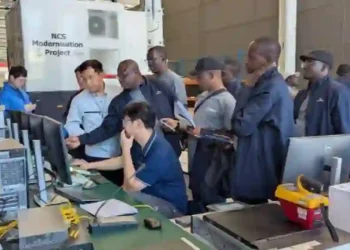





Nigeria has achieved a historic milestone in passport services by launching its first centralised passport production system, ending six decades of decentralised operations across multiple centres.
Interior Minister Dr Olubunmi Tunji-Ojo announced the groundbreaking development on Thursday during an inspection of the new Centralised Passport Personalisation Centre at the Nigeria Immigration Service (NIS) headquarters in Abuja.
The transformation represents the most significant reform in Nigerian passport production since the NIS was established in 1963. For 62 years, the country operated without a central production facility, relying instead on scattered processing centres nationwide.
“The project is 100 per cent ready. Nigeria can now be more productive and efficient in delivering passport services,” Minister Tunji-Ojo declared during the facility tour.
The technological upgrade promises dramatic improvements in processing capacity and speed. While legacy machines could produce only 250 to 300 passports daily, the new centralised system boasts an impressive capacity of 4,500 to 5,000 passports per day.
This enhanced capability means the NIS can now fulfill daily passport demands within just four to five hours of operation, representing what the minister called “a game-changer for passport processing in Nigeria.”
The modernisation also supports the government’s commitment to faster service delivery. Beyond the existing two-week delivery promise, officials are now targeting one-week turnaround times for passport applications.
“Automation and optimisation are crucial for keeping this promise to Nigerians,” Tunji-Ojo emphasised, highlighting the role of technology in achieving these ambitious timelines.



The centralised approach aligns Nigeria with international best practices in travel document production. This standardisation is expected to improve uniformity and strengthen the global credibility of Nigerian passports.
Minister Tunji-Ojo positioned the development as part of a broader transformation agenda, describing it as “a step toward bringing services closer to Nigerians while driving a culture of efficiency and total passport system reform.”
The initiative directly supports President Bola Tinubu’s reform programme, with officials citing enhanced NIS capacity and improved service delivery as key outcomes that will “change the narrative” for Nigerian passport services.