








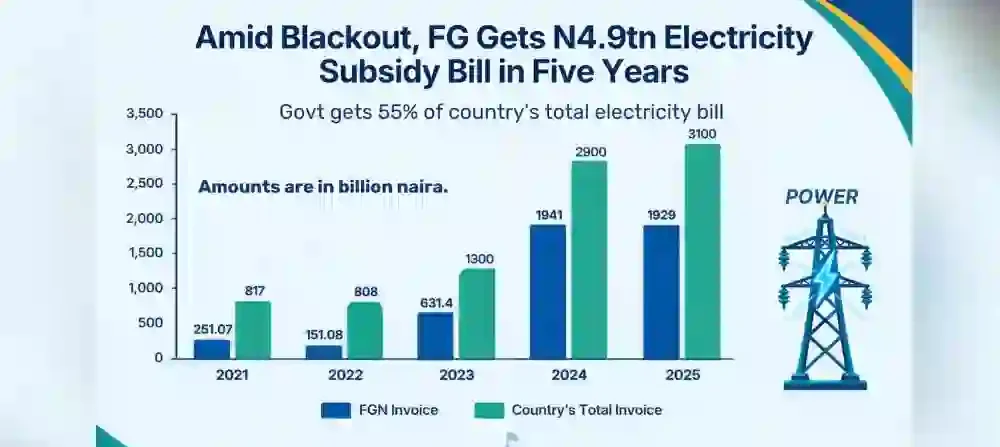
The Federal Government spent a staggering N4.9 trillion on electricity subsidies between 2021 and 2025, representing about 55 per cent of the country’s total electricity bills during the period, despite persistent power outages, poor electricity supply and repeated national grid collapses.
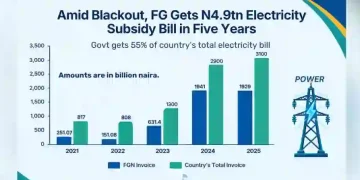
An analysis of data released by the Federal Ministry of Finance shows that the government’s electricity subsidy obligations increased significantly over the five-year period, rising from N251.07 billion in 2021 to N1.929 trillion in 2025.
The figures indicate that electricity subsidy payments experienced their most significant increases in the last two years, raising questions about the impact of the huge government expenditure on the country’s struggling power sector.
According to the data, the Federal Government’s electricity subsidy invoice stood at N151.08 billion in 2022 before increasing to N631.4 billion in 2023. The figure subsequently surged to N1.941 trillion in 2024 and remained high at N1.929 trillion in 2025.
Meanwhile, the total electricity invoices generated across the country increased from N817 billion in 2021 to N808 billion in 2022. The figure rose to N1.3 trillion in 2023, N2.9 trillion in 2024 and N3.1 trillion in 2025.
The combined electricity invoices for the five-year period amounted to approximately N8.9 trillion.

A breakdown of the figures shows that the Federal Government’s subsidy obligations represented 30.7 per cent of the country’s total electricity invoices in 2021 and 18.6 per cent in 2022.
The proportion increased significantly to 48.5 per cent in 2023, 66.9 per cent in 2024 and 62.2 per cent in 2025.
Overall, the government accounted for approximately 55 per cent of Nigeria’s electricity invoices during the period, amounting to N4.9 trillion out of the total N8.9 trillion.
A further breakdown of the subsidy obligations across the country’s 11 electricity distribution companies (DisCos) shows that Abuja Electricity Distribution Company recorded the highest amount between 2021 and 2025.
Abuja Disco accounted for N663.10 billion, closely followed by Ikeja Electricity Distribution Company with N660.7 billion.
Ibadan Disco recorded N613.58 billion, while Eko Disco accounted for N564.96 billion.
Other distribution companies included Benin Disco with N449.9 billion, Enugu Disco with N407.5 billion, Port Harcourt Disco with N378.2 billion and Kaduna Disco with N321.5 billion.
Jos Disco recorded N310.7 billion, Kano Disco accounted for N310.5 billion, while Yola Disco had the lowest subsidy invoice of N223.1 billion.
Despite the substantial financial commitments by the Federal Government, electricity consumers across Nigeria continue to experience prolonged blackouts, unstable power supply and frequent disruptions.
The development has raised concerns about the effectiveness of the electricity subsidy arrangement and whether the huge expenditure has translated into improved electricity generation, transmission and distribution.
In a related development, a previous report indicated that 15 state governments collectively spent N3.47 billion on maintaining electricity plants and generators during the first six months of 2026.
The expenditure was contained in the second-quarter 2026 budget implementation reports of the affected states.
The states had collectively budgeted N13.77 billion for the maintenance of power plants and generators for the entire year, highlighting the continued dependence of public institutions on alternative electricity sources because of the country’s unreliable power supply.
Electricity distribution companies have also acknowledged the difficulties facing consumers.
The Managing Director and Chief Executive Officer of the Association of Nigerian Electricity Distributors (ANED), Sunday Oduntan, previously apologised to Nigerians over persistent electricity shortages during an appearance on Channels Television’s Sunrise Daily.
Oduntan acknowledged the hardship caused by weeks of prolonged blackouts, saying an apology was necessary given the difficulties experienced by electricity consumers.
He said Nigerians had endured significant challenges as a result of the deteriorating power supply situation.
Nigeria’s electricity subsidy arrangement has repeatedly generated controversy, particularly over the rising financial burden on the government and concerns about the failure of the expenditure to guarantee reliable electricity.
The country’s power sector has also suffered several major national grid collapses in recent years.
On September 10, 2025, another grid collapse plunged several parts of the country into darkness, disrupting electricity supply to homes, businesses and public institutions.
Similarly, in March 2025, the national grid experienced another major failure that affected several locations, including Lagos.
The incident occurred only days after the Federal Government celebrated what it described as a historic increase in electricity generation to 6,000 megawatts.
However, the achievement was short-lived as a sudden disturbance caused generation to fall below 1,000 megawatts from approximately 4,000 megawatts recorded before the incident.
The situation deteriorated again in January 2026 when another national grid collapse triggered widespread power outages across the country.
The Nigerian Independent System Operator (NISO) reportedly confirmed that electricity supply to all 11 distribution companies dropped to zero megawatts at exactly 11 a.m., indicating a complete system failure.
The incident resulted in widespread blackouts, disrupting commercial activities, household operations and essential public services.
The latest figures on electricity subsidies have further intensified concerns over Nigeria’s power sector, particularly as consumers continue to pay electricity bills while struggling with unreliable supply despite billions of naira spent by the government to support the industry.
READ ALSO:
- Nigeria Spends N4.9tn On Electricity Subsidies In Five Years Despite Persistent Blackouts
- Lagos Government Removes LAWMA Managing Director Amid Refuse Crisis
- APC Campaign Council Sacks Spokespersons Over 112 Emergency Number Blunder
- Tinubu Rewards U-17 World Cup-Winning Flamingos With N100m Savings Bonds Each
- Nigerian-Born Shirley Emehelu Becomes New Jersey’s First Immigrant Lieutenant Governor