











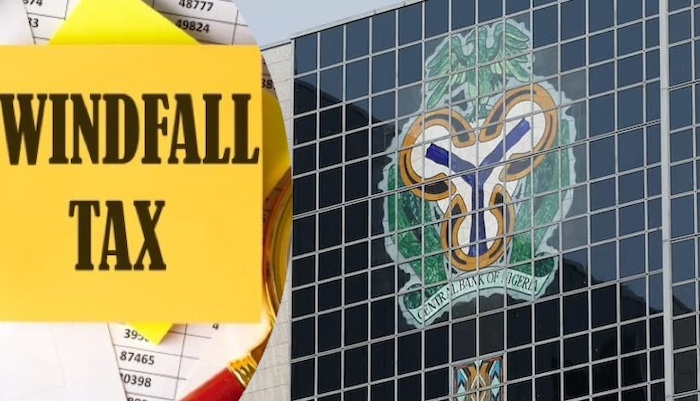
A recent report cautions that Nigeria’s proposed 70% windfall tax conflicts with the Central Bank of Nigeria’s (CBN) recapitalization plans, posing a risk of exacerbating issues within the banking sector. Emerging & Frontier Capital (EFC), a U.S.-based financial research firm, published the report titled “More Pain for Longer,” warning that implementing such a tax amidst mandated recapitalization could “break the camel’s back” for banks.
The report highlights that the Nigerian banking industry is already burdened by substantial regulatory costs, including the Cash Reserve Ratio (CRR), AMCON levy, and deposit insurance premium. These costs amounted to $1.8 billion for the top six banks in 2023 and $7.6 billion over the last five years (2018-2023).
EFC’s analysis suggests that while the government’s need for increased revenue is understandable, the windfall tax may have negative repercussions on the banking sector. The report questions the rationale behind the tax, noting that banks’ dividend payout ratios have been declining despite rising profits. Specifically, the aggregate payout ratio of the top six banks dropped from 38% in 2018 to 16% in 2023.
The proposed tax is seen as directly opposing the current consolidation program within the banking industry. EFC points out that since the Global Financial Crisis (GFC), bank shareholders have faced significant challenges, with valuations now at just one-tenth of their previous levels. The report asks, “Why tax them when they are being asked to invest more and receive lower dividends?”
The report, dated August 5, 2024, raises concerns that the central bank should be attentive to these developments. During the Monetary Policy Committee (MPC) briefing on July 23, CBN Governor Mr. Olayemi Cardoso expressed his concern if market participants perceived that the “CBN and the Nigerian government were not on the right trajectory.”
The report notes that this briefing took place after the amendment to the 2023 Finance Bill was submitted to the National Assembly on July 17. It expressed surprise at the governor’s insistence on a well-coordinated policy directive from both monetary and fiscal perspectives, stating, “The proposed windfall tax of 70% on Nigerian banks’ realized profits from FX transactions from June 2023 to December 2025 conflicts directly with the CBN’s mandated capital raise.”
The EFC report further explains, “Shareholders are being asked to fund banks, some of which do not need capital, so their realized profits from FX transactions are ultimately paid to the government as taxes instead of long-awaited dividends for shareholders. This explains why banks’ share prices are now below their public offer prices, and domestic investors are opting for high-yielding and non-taxable FGN bonds.”
The report emphasizes the need to contextualize FX gains, asserting that “short-term pain does not translate into long-term gain.” It states, “While the top six Nigerian banks collectively booked $3.1 billion of FX trading and revaluation gains in 2023, we estimate that $2.9 billion of these gains were unrealized (non-cash gains). Moreover, these figures do not account for the high cost of raising USD funding.”
The EFC also questions why the Federal Government of Nigeria (FGN) seems to overlook the high regulatory costs of banking in Nigeria, which amounted to $1.8 billion for the top six banks in 2023 and totaled $7.6 billion over the past five years (2018-2023).

The report states, “In June 2008, the collective market capitalization of the top six banks was $36.8 billion, with trailing year profits (2007) at $786 million. Today, their collective market capitalization is $3.1 billion, and trailing year profits are $4.3 billion. These banks have de-rated from a trailing PE of 47x to 0.7x, and shareholders are still being mandated to fund them. Adding to their pain, bank dividend payout ratios have declined despite rising profits.”
It further highlights that the vast majority of bank shareholders are Nigerians (+90%), and these poor policy decisions are diminishing their net worth, questioning, “How is this good for Nigeria in the long term?”

Seunmanuel Faleye is a brand and communications strategist. He is a covert writer and an overt creative head. He publishes Apple’s Bite International Magazine.