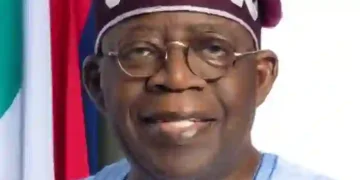





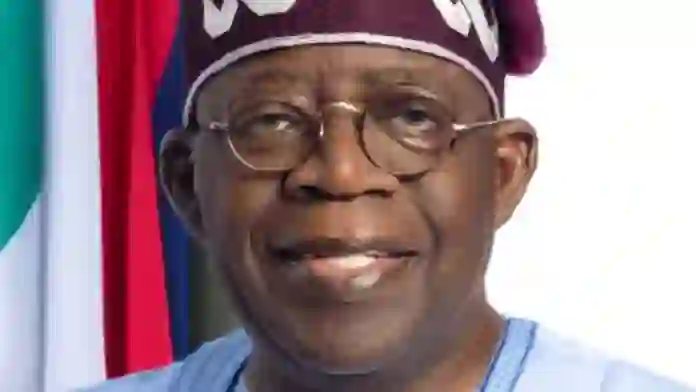
President Bola Tinubu has renewed Nigeria’s call for comprehensive reforms of the United Nations, saying the current structure of the Security Council no longer reflects the realities of the world in 2026.
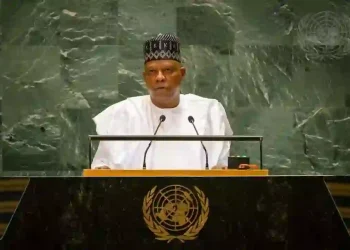
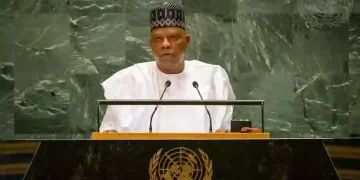
Tinubu made the demand in a speech delivered by Vice President Kashim Shettima during the general debate of the 81st United Nations General Assembly in New York, United States.
The President said reform of the UN should begin with restructuring the Security Council to give Africa a permanent place in the body’s decision-making process.
He argued that Africa should no longer remain on the sidelines while decisions affecting the continent and the wider international community are taken.
According to him, the global power structure established in 1945 cannot adequately address the realities and challenges facing the world today.
“Reform of this institution must begin with the reconstitution of the Security Council, for the world of 2026 cannot remain captive to the distribution of power in 1945.
“Africa cannot continue to fill the Council’s agenda while remaining absent from its permanent membership,” Tinubu said.
Nigeria is seeking at least two permanent seats for Africa, with the full rights and responsibilities attached to permanent membership, including veto power for as long as the veto remains part of the Council’s structure.
The President also called for Africa to have five non-permanent seats, in line with the Ezulwini Consensus and the Sirte Declaration.
Tinubu further urged world leaders to take urgent steps to end armed conflicts and reject rising nationalism, warning that conflicts in one part of the world can have consequences far beyond their immediate locations.
He called for a return to the principles of dialogue, mutual respect, collective responsibility and international law, which he said formed the foundation of the United Nations.
“The persistence of conflict across the world recalls the purpose for which the United Nations was founded: to spare succeeding generations the devastation of war.
“We must therefore return to the founding principles of dialogue, mutual respect and collective responsibility,” he stated.

Tinubu said Nigeria remained committed to the UN Charter and to promoting diplomacy, cooperation and international law over coercion and unilateral action.
He also highlighted Nigeria’s contributions to peacekeeping and conflict resolution across Africa, citing the country’s involvement in Liberia, Sierra Leone, Darfur, Mali and The Gambia.
The President said Nigeria would continue working through the Economic Community of West African States, African Union and Gulf of Guinea partnerships to promote mediation, democratic governance, counter-terrorism and maritime security.
On Nigeria’s domestic development, Tinubu said the country was pursuing its sustainable development goals through macroeconomic management, stronger institutions, private-sector growth and strategic public investment.
He added that Nigeria’s progress was closely linked to the development of Africa and the need for a peaceful, equitable and prosperous international community.
Tinubu also stressed that no country could completely shield itself from the effects of international conflicts, insecurity and climate-related challenges.
He said governments must therefore confront these issues directly, noting that public trust is ultimately strengthened when government decisions translate into improved living conditions for citizens.
READ ALSO:
- Ogun PDP Deputy Governorship Candidate Receives Blessings at Maulud, Gets Qadriyyah Title
- Nigeria Demands Two Permanent UN Seats, Veto Power for Africa
- 2027: Elections Should Be Decided at Polls, Not Courts — Onaiyekan, Osigwe
- Obi Denies Borrowing, Bond Issuance During Eight-Year Anambra Tenure
- Africa needs affordable capital for infrastructure, energy — Oyedele