









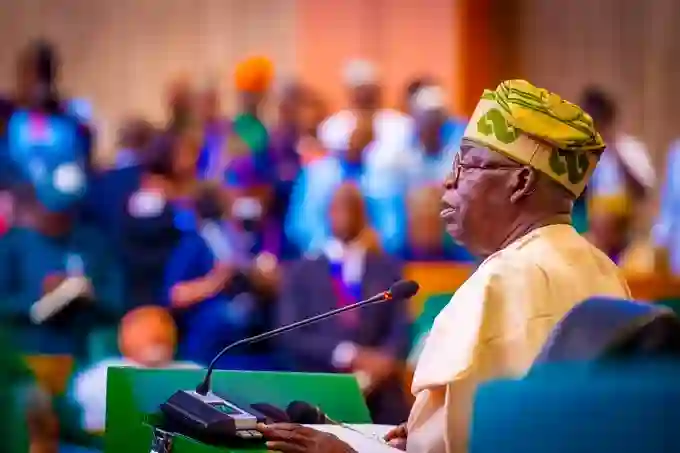
President Bola Ahmed Tinubu on Friday, December 19, presented to the National Assembly a N58.18 trillion Appropriation Bill for the 2026 fiscal year, accompanied by a sweeping declaration that redefines Nigeria’s approach to internal security threats.
The fiscal proposal, themed “Budget of Consolidation, Renewed Resilience and Shared Prosperity,” places national security and infrastructure development at the forefront of government priorities as the administration intensifies efforts to stabilise the economy and combat rising insecurity across the nation.
Security Preset
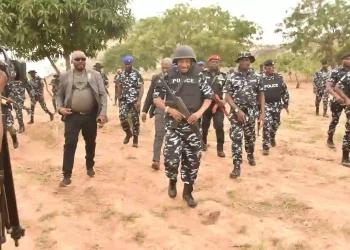
In a landmark announcement that signals a fundamental shift in Nigeria’s security policy, President Tinubu declared a complete overhaul of the national security framework, formally designating all armed non-state actors operating outside government authority as terrorists.
“Henceforth, any armed group or gun-wielding non-state actors operating outside state authority will be regarded as terrorists,” the President stated emphatically during his address to the joint session of lawmakers.
The terrorist designation now encompasses a wide spectrum of criminal elements, including bandits, militias, armed gangs, kidnappers, violent cult groups, forest-based armed collectives, and foreign-linked mercenaries operating within Nigerian territory.
In an expansion of accountability, Tinubu warned that the terrorist classification extends beyond armed operatives to include their support networks. Financiers, ransom negotiators, arms suppliers, and any political or community leaders found aiding, abetting, or providing protection to these groups will face similar designation and prosecution.
Budget Allocations
Reflecting the administration’s commitment to its new counter-terrorism approach, defence and security received the largest sectoral allocation in the proposed budget. The Security and Defence sector leads with N5.41 trillion, representing the single biggest investment in any sector.
Infrastructure development follows with N3.56 trillion, underscoring the government’s continued focus on closing the nation’s infrastructure gap. Education received N3.52 trillion, while the Health sector was allocated N2.48 trillion, demonstrating continued investment in human capital developmentRevenue Projections
The 2026 budget is built on the foundation of the 2026-2028 Medium-Term Expenditure Framework (MTEF) and Fiscal Strategy Paper (FSP), which recently received legislative approval.
Key economic benchmarks underpinning the budget include:
- Daily oil production target of 1.84 million barrels
- Exchange rate assumption of N1,400 to the US Dollar
- Oil benchmark price of $64.85 per barrel
- Projected budget deficit of N23.85 trillion, representing 4.28 percent of GDP
The Federal Government projects total revenue of N34.33 trillion for the fiscal year, leaving a substantial funding gap that will require borrowing and other financing mechanisms.
Of the N58.18 trillion total expenditure, debt servicing claims a significant portion at N15.52 trillion, reflecting the burden of Nigeria’s accumulated debt obligations. Recurrent non-debt spending is pegged at N15.25 trillion to cover the day-to-day operations of government.
Capital expenditure, positioned as the primary vehicle for delivering the administration’s Renewed Hope agenda, received the largest allocation at N26.08 trillion. This substantial investment in capital projects signals the government’s determination to drive infrastructure development, create jobs, and stimulate economic growth.



Security Declaration
The President’s categorical designation of armed non-state actors as terrorists carries significant legal and operational implications. The move provides security forces with expanded powers under anti-terrorism legislation and potentially opens pathways for more aggressive military action against criminal groups that have plagued various regions of the country.
By extending liability to financiers and enablers, the administration appears determined to dismantle not just the operational capacity of armed groups but their entire ecosystem of support, including political protection that has historically shielded some criminal elements.
Legislative Approval
The appropriation bill now begins its journey through the National Assembly, where it will undergo detailed scrutiny by both chambers. Lawmakers will examine sectoral allocations, revenue assumptions, and the feasibility of stated economic benchmarks before final passage.
The proposed budget represents the administration’s blueprint for navigating Nigeria’s complex security and economic challenges in 2026, with the enhanced security spending reflecting the government’s recognition that sustainable development requires a foundation of peace and stability.
As Nigeria grapples with multiple security threats ranging from banditry in the Northwest to separatist agitations in the Southeast and the lingering Boko Haram insurgency in the Northeast, the combination of increased funding and the new terrorist designation framework signals an administration preparing for decisive action against all forms of armed violence threatening the nation’s stability.
READ ALSO:
- INEC Postpones Nationwide Voter Revalidation Exercise to After 2027 Elections
- Edo Government Seals Event Centre After Eedris Abdulkareem’s Criticism of Tinubu
- APC Will Remain in Power for Over 100 Years – Yobe Party Chairman Declares
- CBN Dismisses Viral Claim of ₦5,000 Note Featuring Tinubu
- Tinubu Grants Tax Incentives to Accelerate Shell’s $20bn Deepwater Oil Project