










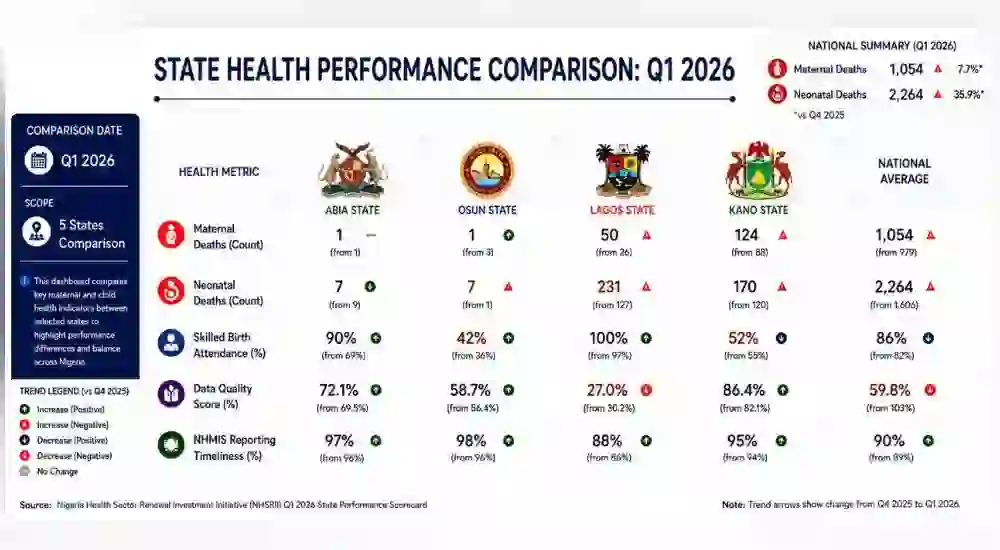
Nigeria recorded 1,054 maternal deaths in the first quarter of 2026, representing an increase from 979 deaths reported in the final quarter of 2025, according to the latest national health sector performance report. During the same period, neonatal deaths also climbed sharply from 1,666 to 2,264, highlighting persistent challenges in maternal and child healthcare across the country.
The figures are contained in the first-quarter 2026 State Performance Scorecard compiled by the Sector-Wide Approach (SWAp) Coordination Office of the Federal Ministry of Health under the Nigeria Health Sector Renewal Investment Initiative (NHSRII).
The report evaluates the performance of all 36 states and the Federal Capital Territory using data from the District Health Information System (DHIS2) and the Maternal and Perinatal Death Surveillance and Response (MPDSR) platform. It assesses indicators such as maternal mortality, neonatal deaths, immunisation coverage, antenatal care, skilled birth attendance, family planning, malaria treatment, non-communicable disease detection and health data reporting.
National Performance
According to the report, maternal deaths increased by 7.7 per cent between the fourth quarter of 2025 and the first quarter of 2026, while neonatal deaths rose by 35.9 per cent.
Although the proportion of pregnant women completing at least four antenatal care visits improved from 48 per cent to 51 per cent, skilled birth attendance declined slightly from 87 per cent to 86 per cent nationwide.
The report also showed a significant decline in family planning uptake and routine immunisation. New family planning acceptors dropped from 23 per cent to 13 per cent, while full immunisation coverage declined from 103 per cent to 80 per cent.
Abia Emerges Among Best Performing States
Despite the nationwide increase in maternal deaths, Abia recorded one maternal death during the first quarter of 2026, maintaining the same figure reported in the previous quarter. The state also reduced neonatal deaths from nine to seven.
Abia posted strong improvements across several healthcare indicators. Full immunisation coverage increased from 69 per cent to 112 per cent, while skilled birth attendance improved from 87 per cent to 90 per cent, exceeding the national average of 86 per cent.
The report noted that immunisation coverage was calculated using population estimates from the National Population Commission rather than actual birth records, explaining why some states recorded figures exceeding 100 per cent.
Abia’s antenatal care continuity ratio (ANC4/ANC1), which measures the proportion of women completing at least four antenatal visits after their first visit, rose from 25 per cent to 37 per cent.
However, the state recorded declines in some areas. Coverage for the third dose of the pentavalent vaccine fell from 81 per cent to 76 per cent, while the percentage of new family planning acceptors dropped from 10 per cent to eight per cent.
Hypertension detection declined from 39 to 32 new cases per 10,000 people, while diabetes detection fell from 13 to 11 cases. Reporting timeliness under the National Health Management Information System improved slightly from 96 per cent to 97 per cent.
According to BudgIT’s Health Financing in Nigeria report, Abia allocated ₦152.4 billion to the health sector from its ₦1.02 trillion 2026 budget, making it one of nine states that met the African Union’s Abuja Declaration target of allocating at least 15 per cent of government expenditure to healthcare.
Osun Records Low Maternal Deaths
Osun also recorded just one maternal death in the first quarter of 2026, improving from three deaths in the previous quarter.
However, neonatal deaths increased from one to seven during the same period.
The state’s skilled birth attendance improved from 36 per cent to 42 per cent, although it remained among the lowest in the country.
Full immunisation coverage rose marginally from 59 per cent to 60 per cent, while the ANC4/ANC1 ratio declined from 61 per cent to 59 per cent.
Osun recorded an impressive 98 per cent reporting timeliness score under the National Health Management Information System, one of the highest in the South-West.
BudgIT reported that Osun allocated ₦31.94 billion to healthcare in its 2025 budget and spent ₦22.67 billion, representing a budget performance rate of 70.99 per cent. Health expenditure accounted for 7.47 per cent of the state’s total budget.



Lagos Records Highest Skilled Birth Attendance but Rising Deaths
Lagos achieved the country’s highest skilled birth attendance rate at 100 per cent during the first quarter of 2026, improving from 97 per cent in the previous quarter.
Despite this achievement, the state recorded the highest number of neonatal deaths nationwide, with fatalities increasing from 127 to 231.
Maternal deaths in Lagos also nearly doubled, rising from 26 to 50.
The report attributed a significant proportion of neonatal deaths to health facilities located in Lagos Island and Ikorodu Local Government Areas.
Routine immunisation indicators also weakened in the state. Full immunisation coverage declined from 62 per cent to 57 per cent, while pentavalent vaccine coverage dropped from 71 per cent to 64 per cent.
The proportion of new family planning acceptors fell from 12 per cent to seven per cent, although antenatal care continuity improved from 77 per cent to 85 per cent.
BudgIT reported that Lagos remained Nigeria’s highest health spender in 2025, disbursing ₦180.99 billion from a ₦216.71 billion health budget, representing an 83.52 per cent implementation rate. With an estimated population of 16.74 million, the state’s per capita health spending stood at ₦10,812, among the highest in the country.
Situation Across Other States
The report revealed notable regional differences in maternal and neonatal health outcomes.
In Kano State, maternal deaths increased from 88 to 124, with most cases concentrated in Bichi, Kano Municipal and Tarauni local government areas. Kano’s ANC4/ANC1 ratio stood at 47 per cent.
Yobe recorded the highest increase in maternal deaths in the North-East, rising from 61 to 75.
Kogi recorded one of the most significant improvements nationally, reducing maternal deaths from 66 to 22.
Zamfara experienced the largest increase in neonatal deaths in the North-West, rising from 79 to 131.
Gombe’s neonatal deaths increased sharply from 48 to 118, while Ebonyi recorded a doubling of neonatal deaths from 32 to 64.
Delta also witnessed a major increase in maternal deaths, with fatalities rising from six to 22.
Health Financing Still Below Global Target
BudgIT noted that Nigeria continues to fall short of the African Union’s Abuja Declaration target, which recommends allocating at least 15 per cent of annual government expenditure to healthcare.
The Federal Government allocated ₦2.48 trillion to health in the 2026 budget, representing only about 4.2 per cent of the ₦58.47 trillion national budget.
Across 34 states reviewed by BudgIT in 2025, total health spending amounted to ₦1.18 trillion out of ₦1.97 trillion budgeted, translating to a budget implementation rate of 61.74 per cent.
Per capita health spending varied significantly across states, ranging from ₦16,386 in Bayelsa to just ₦808 in Cross River.
Although Kano spent ₦63.06 billion on healthcare, its large population of approximately 17.6 million meant per capita spending was only ₦3,583.
BudgIT also reported that of the ₦218 billion allocated for federal health capital projects in 2025, only ₦36 million had been released, while more than 75 per cent of Nigerians continued to finance healthcare through out-of-pocket payments.
Data Quality Raises Concern
The national health scorecard recorded a marginal improvement in overall data quality, increasing from 59.7 per cent in the fourth quarter of 2025 to 59.8 per cent in the first quarter of 2026.
Abia’s data quality score improved from 69.5 per cent to 72.1 per cent, while Osun’s increased from 56.4 per cent to 58.7 per cent.
Lagos, however, recorded the lowest data quality score in the country, dropping from 30.2 per cent to 27 per cent.
Jigawa, Kaduna and Kano achieved the highest data quality scores nationally, all exceeding 80 per cent.
The Federal Ministry of Health urged states to use the quarterly scorecards for programme reviews, policy planning and advocacy, while strengthening monthly data validation processes, improving facility-level discussions and sharing best practices to enhance healthcare delivery across the country.
READ ALSO:
- Elon Musk Unveils Tesla’s Flying Car
- Onanuga Presents Evidence, Insists Nigeria Is Better Under Tinubu
- FG Reopens First Niger Bridge After 38 Days of Repairs
- Defence Minister Denies Nigeria Recruits Underage Soldiers, Says Terrorists Use Children
- Former Texas Mayor Gives Tinubu Conditions To Stop Criticising His Government