








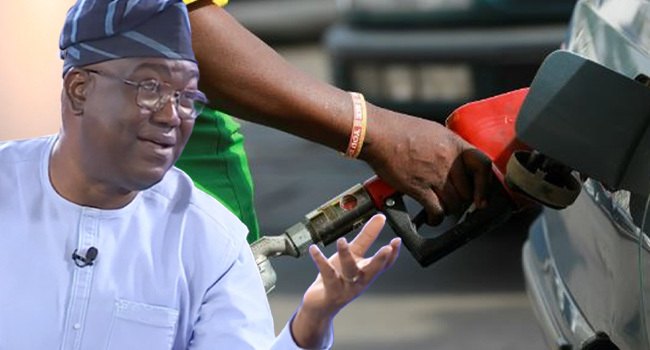
Accord Party presidential aspirant, Gbenga Olawepo-Hashim, has challenged the Federal Government’s justification for the high cost of petrol, arguing that the product could sell for about N605 per litre if Nigeria changes the way crude oil supplied to domestic refineries is priced.
Olawepo-Hashim made the claim while speaking on Channels Television’s Politics Today, where he argued that the current petrol price is inflated by the government’s domestic crude pricing structure. He said Nigerians had been made to believe that cheaper petrol was no longer possible, insisting that a review of the pricing mechanism could substantially reduce the pump price.
According to him, data from the Nigerian National Petroleum Company Limited puts Nigeria’s crude production cost at approximately $30 per barrel. He added that a $15 margin, about $5 for refining and $7 for transportation and insurance would bring the total estimated cost to roughly $57 per barrel.



Using an exchange rate of N1,400 to the dollar, Olawepo-Hashim calculated that the cost could translate to about N501 per litre. He proposed N605 per litre as a possible pump price after adding an estimated N100 energy tax, which he said could be used to support the development of alternative energy sources.
The Accord Party chieftain also rejected the description of Nigeria’s previous fuel pricing arrangement as a conventional subsidy. He argued that what Nigerians had experienced was largely the result of government accounting and the manner in which crude supplied to the domestic market was valued.
“What you have had really has never been any subsidy, even when we had lower pump petrol prices. The subsidy issue is more of an accounting magic,” he said.
Olawepo-Hashim further argued that crude supplied to Nigerian refineries should not automatically be priced at the same rate as crude sold internationally. According to him, while international crude prices represent the opportunity cost of oil, that does not mean the same pricing formula must apply to crude consumed domestically.
He cited Saudi Arabia and Kuwait as examples of oil-producing countries that, according to him, do not apply international crude prices to their domestic markets in the same manner. He also called for greater transparency regarding Nigeria’s crude production costs, questioning the basis for the current domestic pricing structure.
The presidential aspirant alleged that there could be “a lot of over-invoicing” in the system and challenged stakeholders to make the underlying figures public. He called for the publication of the actual cost of producing a barrel of crude in Nigeria, saying alternative calculations should be tested against the government’s figures.
“If anyone has a different idea, they should bring their books. Let’s see what it is, how much it costs to produce a barrel of crude in Nigeria,” he said.
- Otunba Senator Gbenga Daniel Toasts 25 Years of Gateway Front Foundation as US Doctors Deliver 300 Free Surgeries in Ogun
- Umahi: Lagos-Calabar coastal highway may not be completed if Tinubu loses in 2027
- Tope Alabi warns of legal action over false, defamatory claims
- Folorunso Alakija denies EFCC fraud claim, demands removal of “defamatory” report
- NCC Strengthens Ties With Airtel, IHS Towers to Boost Nationwide Connectivity