





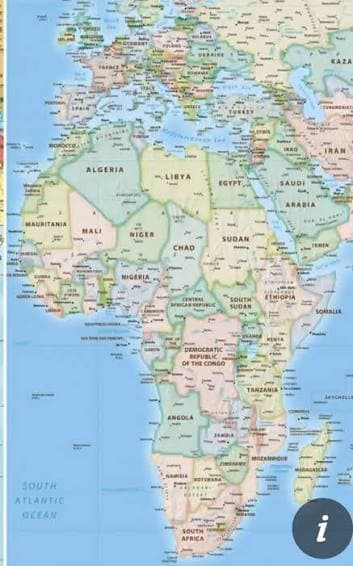
The United Nations General Assembly has adopted a resolution calling for the use of a new world map that more accurately represents the size of Africa and other continents.
The resolution, known as the “Correct the Map” initiative, was sponsored by Togo and supported by members of the African Union. It was approved with the backing of 164 countries, including the United Kingdom and France, while the United States voted against it and six countries abstained.
Although the resolution is non-binding, it is expected to encourage institutions around the world to reconsider the continued use of the Mercator projection, a map that has been widely used since the 16th Century. Critics argue that the projection significantly distorts the size of countries and continents, particularly those located near the equator.
Under the Mercator projection, Africa appears comparable in size to Greenland. In reality, Africa is about 14 times larger than Greenland, with the distortion becoming more pronounced as countries move closer to the poles. The map was originally designed in 1569 by Flemish cartographer Gerardus Mercator, primarily to assist European navigators with maritime travel.
The distortion occurs because it is impossible to accurately represent the curved surface of the Earth on a flat map. The Mercator projection preserves direction and shape for navigation but does so at the expense of accurately representing landmass. As a result, regions close to the equator appear smaller, while areas nearer the poles appear disproportionately large.


To address the problem, cartographers developed the Equal Earth projection in 2018. The map was designed to provide a more accurate representation of the relative sizes of continents. In February, the African Union’s 54 member states adopted the projection, describing it as a map that better represents the actual size of all continents, particularly Africa.
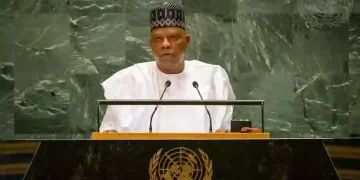
Togo, which led the campaign at the United Nations, argued that correcting the map is about more than cartography. Togolese Foreign Minister Robert Dussey said ahead of the vote that “a fair world begins with a fair map.” He also argued that maps influence how people understand the importance and position of continents and populations in the world.
The campaign has received support from France, with French Foreign Minister Jean-Noël Barrot saying his ministry would stop using the Mercator projection. He argued that changing the map would not change the world itself but would correct a representation that has historically distorted it.
Supporters of the campaign say the issue also has economic and political implications. Lerato Mogoatlhe of Africa No Filter described Africa’s representation on traditional world maps as a narrative problem, arguing that the distortion contributes to long-standing misconceptions about the continent.
Kenyan geographer Kioko Muendo similarly argued that the Mercator projection has helped downplay Africa’s enormous landmass, resources, population and investment opportunities. He noted that maps do more than help people navigate, as they can influence how regions are perceived politically and economically.
The campaign group #CorrectTheMap has sought to demonstrate Africa’s actual scale by pointing out that the continent is large enough to accommodate the United States, China, India, Japan, Mexico and much of Europe, with land still remaining.
However, the initiative has also attracted criticism from the United States. Yaryna Ferencevych, a US representative at the UN, argued that the General Assembly should concentrate on issues such as international peace, prosperity and global relations rather than a map developed centuries ago.
Despite the disagreement, supporters of the resolution view the change as an important symbolic step in correcting the way Africa is represented globally. For them, replacing the Mercator projection is not simply about drawing a different map but about ensuring that the physical scale and significance of Africa are represented more accurately.
- Lonely Chinese Men Turn To Africa For Wives, But Many Get Scammed Instead | By Oluwatomisin Alabi
- FBI Reveals ‘Bola’ and ‘Tinubu’ Searches in Multi-Subject File Linked to President
- Ogun PDP Deputy Governorship Candidate Receives Blessings at Maulud, Gets Qadriyyah Title
- Nigeria Demands Two Permanent UN Seats, Veto Power for Africa
- 2027: Elections Should Be Decided at Polls, Not Courts — Onaiyekan, Osigwe

Seunmanuel Faleye is a brand and communications strategist. He is a covert writer and an overt creative head. He publishes Apple’s Bite International Magazine.