





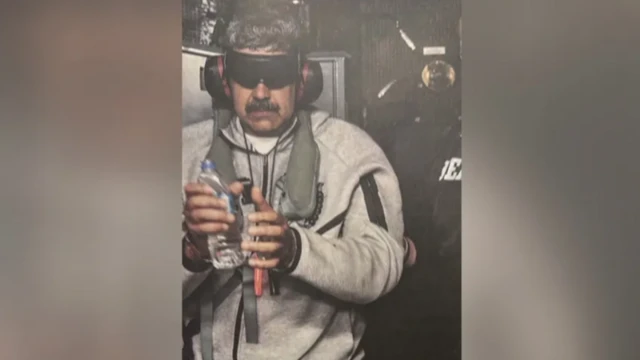
Early Saturday morning, the United States conducted a large-scale strike on Venezuela and captured President Nicolás Maduro, marking one of the most dramatic foreign interventions in modern American history. Here are seven essential facts about why the Venezuelan leader was seized and what led to this unprecedented action.
1. Long-Standing Federal Indictment on Drug Trafficking Charges
Maduro has been under federal indictment since March 2020, when the US Department of Justice charged him with narco-terrorism conspiracy, cocaine importation conspiracy, and weapons possession charges. Prosecutors allege that Maduro led the “Cartel of the Suns,” a drug trafficking organisation made up of high-ranking Venezuelan officials. The cartel’s name refers to sun insignias on Venezuelan military uniforms. The US government had offered a $15 million reward for information leading to his capture, which was later increased to $50 million in 2025.
2. Allegations of Decades-Long Criminal Enterprise
The superseding indictment unveiled Saturday claims that since 1999, Maduro and other Venezuelan officials have systematically used government institutions to facilitate international drug trafficking. According to prosecutors, Maduro coordinated with various criminal organisations, including Colombia’s FARC rebels, Mexico’s Sinaloa Cartel, and the Venezuelan gang Tren de Aragua to import tons of cocaine into the United States. The State Department estimated that between 200 and 250 tons of cocaine were trafficked through Venezuela annually by 2020.
3. Meticulously Planned CIA Operation
In August 2025, the CIA covertly installed a small team inside Venezuela to track Maduro’s movements, patterns, and daily routines. General Dan Caine, Chairman of the Joint Chiefs of Staff, revealed that intelligence operatives determined “how he moved, where he lived, where he traveled, what he ate, what he wore, what were his pets.” A CIA source operating within the Venezuelan government provided real-time intelligence about Maduro’s location leading up to the capture. President Trump gave the final authorization for the operation at 10:46 PM on Friday, January 2, 2026.
4. Massive Military Operation
Operation Absolute Resolve involved overwhelming military force. More than 150 aircraft participated in the strike, including fighter jets, bombers, surveillance aircraft, and helicopters that took off from 20 different bases on land and at sea. The operation began around 2:00 AM local time with airstrikes on military installations around Caracas. Army Delta Force operatives conducted the actual capture, with helicopters flying at just 100 feet above water as they approached Venezuela. The entire capture operation lasted approximately two hours, and Maduro and his wife surrendered without significant resistance.
5. Multiple Motivations Beyond Drug Charges
While the official justification centers on the drug trafficking indictment, President Trump also stated the US would “run” Venezuela and mentioned seizing control of the country’s oil reserves. During his announcement, Trump claimed Venezuela’s oil had been “stolen” from the United States and said American companies would be “very strongly involved” in the Venezuelan oil industry going forward. This has raised questions about whether resource control was a primary motivation alongside enforcing criminal accountability.
The Oil Subtext: Venezuela possesses the world’s largest proven oil reserves, estimated at over 300 billion barrels. However, production has collapsed under Maduro’s government from 3.5 million barrels per day in the 1990s to under 800,000 barrels per day by 2020. Trump’s explicit statements about American control of Venezuelan oil, combined with his comment that “we’re going to be running” Venezuela, suggest economic interests may be as significant as the criminal justice rationale. Critics argue the timing—coming amid global energy concerns and following years of US sanctions on Venezuelan oil—indicates resource acquisition was a core objective disguised by the drug charges. The operation could potentially give US oil companies access to reserves that have been largely inaccessible since sanctions began in 2019.

6. Wife Also Faces Serious Charges
Cilia Flores, Maduro’s wife and Venezuela’s First Lady, was also captured and faces her own charges in the expanded indictment. Prosecutors allege she accepted hundreds of thousands of dollars in bribes to arrange meetings between drug traffickers and Venezuela’s anti-drug chief, Nestor Reverol Torres. The indictment also claims that between 2004 and 2015, Maduro and Flores jointly operated drug trafficking operations using military escorts and ordered kidnappings, beatings, and murders against those who owed them money or threatened their operations.
7. Controversial Legal Status and International Backlash
The legal authority for the military operation remains unclear and highly controversial. Maduro did not have an International Criminal Court arrest warrant, only a US federal indictment. The Trump administration did not notify Congress before the operation. The United Nations Secretary-General António Guterres called the strikes “a dangerous precedent,” and world leaders including those from Russia, China, and Colombia condemned the action as a violation of Venezuela’s sovereignty. Venezuela’s government characterized it as an “illegal and illegitimate kidnapping” and “imperialist aggression.”
Both Maduro and Flores were transported to the USS Iwo Jima, then transferred to New York where they are expected to face trial in the Southern District of New York under Judge Alvin Hellerstein. If convicted, Maduro faces potential life imprisonment on the narco-terrorism and cocaine conspiracy charges alone.
The unprecedented operation has left Venezuela without clear leadership, with Vice President Delcy Rodríguez demanding “proof of life” and the Venezuelan Supreme Court ordering her to assume acting presidential duties. The international community remains deeply divided over the legality and implications of the American military action.
- S-RM and Invest Africa Extend Intelligence Partnership for Third Year to Drive African Investment
- AfDB Launches $3.9M Initiative to Transform Africa’s Energy Plans into Reality
- Nigerian Mechanic, Deceived by Job Offer, Finds Himself in Russian Army Camp
- Kunle Afolayan: “I’ll Return to Cinema When We Stop Dancing to Sell Films”
- Exclusive! Africa’s Democracy at a Crossroads After 2025

Seunmanuel Faleye is a brand and communications strategist. He is a covert writer and an overt creative head. He publishes Apple’s Bite International Magazine.