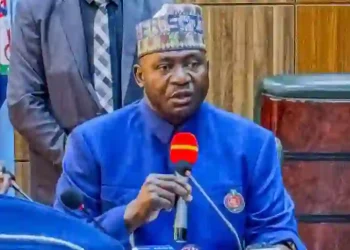









The President of the Nigerian Bar Association (NBA), Afam Osigwe (SAN), has called on state governors yet to comply with the Supreme Court’s ruling on local government financial autonomy to immediately release funds due to local councils, warning that continued disobedience threatens Nigeria’s democracy and the rule of law.
Osigwe made the appeal on Tuesday during an interview on Frontline, a public affairs programme on Eagle 102.5 FM in Ilese Ijebu. He described the refusal by some governors to obey court judgments as a reflection of a deeper governance problem — a persistent disregard for constitutional and legal obligations.
On July 11, 2024, the Supreme Court of Nigeria delivered a landmark judgment affirming the financial autonomy of the country’s 774 Local Government Areas (LGAs). The court ruled that allocations from the Federation Account must be paid directly to local government councils and that neither state governors nor the Minister of the Federal Capital Territory has the authority to withhold or control those funds.
The judgment stressed that respecting the constitutional independence of local governments is critical to ensuring effective governance and service delivery at the grassroots level.
Despite repeated calls by Bola Tinubu and other stakeholders for compliance, several state governments have reportedly continued to route local government allocations through state-controlled accounts.
Reacting to the situation, Osigwe said failure to obey the Supreme Court’s directive demonstrates a troubling attitude toward governance and judicial authority. He emphasized that the Federal Government, particularly the Attorney General, has a responsibility to ensure enforcement of the ruling.
According to him, Nigeria’s development is hampered by a culture of selective obedience to the law, where those in positions of power act as though legal provisions are binding only on the weak.
Constitution Works with the Right Attitude
Osigwe, the 32nd President of the NBA, noted that the country’s constitutional challenges stem less from poor drafting and more from negative attitudes toward implementation.



He argued that laws do not enforce themselves but depend on the commitment of those tasked with applying and enforcing them, including judicial officers and members of the executive. No matter how well crafted a constitution may be, he said, it cannot function effectively without respect and adherence from both leaders and citizens.
He maintained that even if Nigeria were to adopt a new constitution, it would fail to deliver meaningful change unless those in authority demonstrate genuine allegiance to its provisions. The 1999 Constitution, despite its origins, he added, contains sufficient provisions to guide governance if properly applied.
Judicial Independence and Asset Declaration
On the controversy involving the Chief Judge of the Federal High Court, John Terhemba Tsoho, and the Code of Conduct Bureau (CCB), Osigwe stressed the need to protect judicial independence.
The CCB recently summoned Justice Tsoho following reports alleging discrepancies in his asset declaration. Osigwe argued that as a serving judicial officer, he must first be investigated by the National Judicial Council (NJC) before any prosecution can proceed, warning that direct executive action could undermine the independence of the judiciary.
He also advocated for the digitization of asset declarations to enhance transparency and reduce inefficiencies associated with the current paper-based system.
Electoral Reform and the Role of Courts
Commenting on the newly signed Electoral Act 2026, Osigwe acknowledged some improvements, including a shorter timeline for the Independent National Electoral Commission (INEC) to access funding. However, he said the amendments missed an opportunity to strengthen public confidence in the electoral process, particularly regarding electronic transmission of results.
He reiterated that good laws alone do not guarantee credible elections; rather, the conduct of political actors and adherence to legal provisions determine outcomes.
On the judiciary’s role in elections, Osigwe clarified that courts serve as arbiters in resolving disputes and should not be viewed as substitutes for INEC in collating or declaring results. Where the law provides that a court judgment can serve as a certificate of return, he said, such provisions must be respected unless amended through legislative processes.
Police Reform and State Policing
Addressing concerns about policing, Osigwe called for modernization, including the establishment of crime databases, improved forensic capabilities, and automated reporting systems. He urged the new Inspector General of Police to prioritize professionalism, merit-based promotions, and public trust.
On the debate over state police, he expressed cautious support, noting that Nigeria’s current security challenges may require decentralization of policing. However, he stressed that adequate safeguards must be introduced to prevent potential abuse by state authorities.
Osigwe concluded by reiterating that Nigeria’s institutions can function effectively if leaders demonstrate respect for constitutional provisions and judicial pronouncements. He urged all governors yet to comply with the Supreme Court’s ruling to grant local governments direct access to their funds to safeguard democratic governance and grassroots development.
READ ALSO:
- 2027: Gbenga Daniel Urges Nigerians to Choose Performance Over Propaganda
- Osun Traditional Ruler Oba Enoch Akinyemi Dies At 85 After 21-Year Reign
- Elon Musk Unveils Tesla’s Flying Car
- Onanuga Presents Evidence, Insists Nigeria Is Better Under Tinubu
- FG Reopens First Niger Bridge After 38 Days of Repairs