







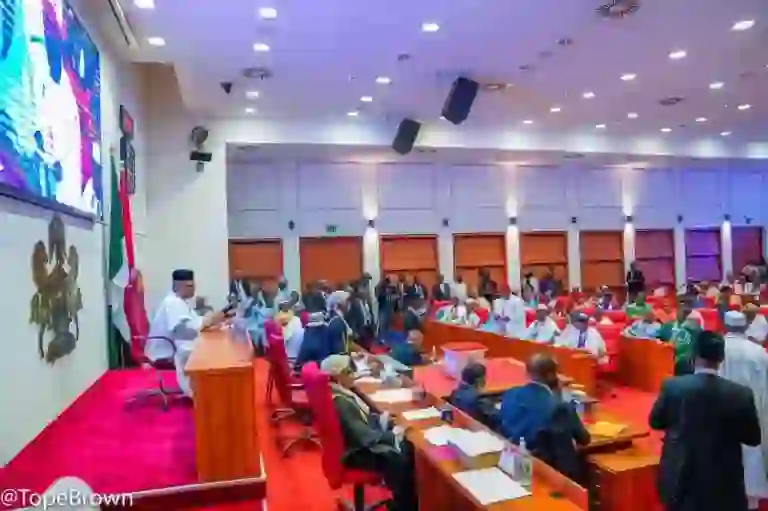
The Nigerian Senate on Wednesday began deliberations on a series of major constitutional amendment proposals, including the controversial establishment of state police, in what lawmakers have described as one of the most significant legislative exercises since the country returned to democratic governance in 1999.
The constitutional review process covers a broad range of reforms aimed at strengthening Nigeria’s electoral system, security architecture, judicial framework, traditional institutions, and human rights protections.
Among the key proposals before the Senate is the creation of a constitutionally recognized Electoral Offences Commission with powers to investigate and prosecute election-related crimes. Lawmakers are also considering a bill that would allow independent candidates to contest governorship, legislative, and local government elections without political party affiliation.
Another proposal seeks to place the Armed Forces of the Federation on first-line charge, ensuring direct funding from the Consolidated Revenue Fund. The Senate is also examining measures that would grant constitutional recognition and financial autonomy to traditional institutions through the establishment of State Councils of Traditional Rulers.
In addition, senators are expected to decide on a bill that would automatically convert death sentences imposed on pregnant women to life imprisonment once pregnancy is confirmed. Another proposal aims to prohibit law enforcement agencies from publicly parading criminal suspects, citing concerns over violations of human dignity and the constitutional principle of presumption of innocence.
However, the proposal attracting the most public attention is the bill seeking to establish State Police Services. The initiative has received strong backing from President Bola Tinubu’s administration, which argues that decentralizing policing would improve intelligence gathering, strengthen community-based security efforts, and enhance responses to crimes such as banditry, kidnapping, terrorism, and communal violence.
Supporters of state police believe local authorities are better positioned to address security challenges within their jurisdictions. Critics, however, have expressed concerns that governors could misuse state-controlled police formations for political purposes, particularly during election periods.
The Senate session drew the attendance of several prominent government officials and political leaders. Among those present were the Chief of Staff to the President, Femi Gbajabiamila, Kaduna State Governor Uba Sani, as well as the governors of Ogun and Ondo states. Attorneys-General from several states, including Anambra and Akwa Ibom, also attended the proceedings as observers.
Their presence generated discussion within the chamber, as non-members are rarely admitted during critical legislative exercises. Although some senators reportedly raised concerns about allowing visitors into the chamber, they were eventually permitted to observe the proceedings.
The Senate had initially planned to begin consideration of the amendment bills immediately after the swearing-in of newly inaugurated senators. However, the process was delayed following a closed-door session that lasted more than an hour. The executive meeting was convened after a motion by Senate Leader Opeyemi Bamidele.
Addressing lawmakers before the closed session, Senate President Godswill Akpabio described the constitutional amendment exercise as a defining moment for both the National Assembly and Nigeria’s democratic journey.
He urged senators to approach the deliberations with patriotism and a commitment to national development, stressing that the decisions taken would have long-term implications for governance, public safety, and intergovernmental relations across the country.
Akpabio also announced a major procedural change, revealing that senators would vote electronically rather than through the traditional voice-vote system. According to him, each vote would be digitally recorded, displayed, and documented to ensure transparency, accountability, and accurate record-keeping.



The Senate subsequently conducted test runs of the electronic voting system, marking the first time the technology would be used for constitutional amendment voting since the inauguration of the 10th Senate.
As deliberations continued, senators prepared to cast votes on the wide-ranging constitutional reform package, with the outcome expected to shape Nigeria’s political and security landscape for years to come.
READ ALSO:
- IBD Dende Mourns the Passing of Actor Ogogo, Says Ilaro Has Lost One of Its Illustrious Sons
- Mary Onyali Appointed WWS Head of Nigeria Operations
- Obi Cubana Denies Any Wrongdoing in 2021 Liberia Visit, Says Meeting Was Legitimate Trade Mission
- Veteran Yoruba Actor Taiwo Hassan, Ogogo, Is Dead”
- RSSOSA National President, Aare Adetola Emmanuelking, Celebrates Damola Aiyeola at 60, Commends His Legacy of Service