







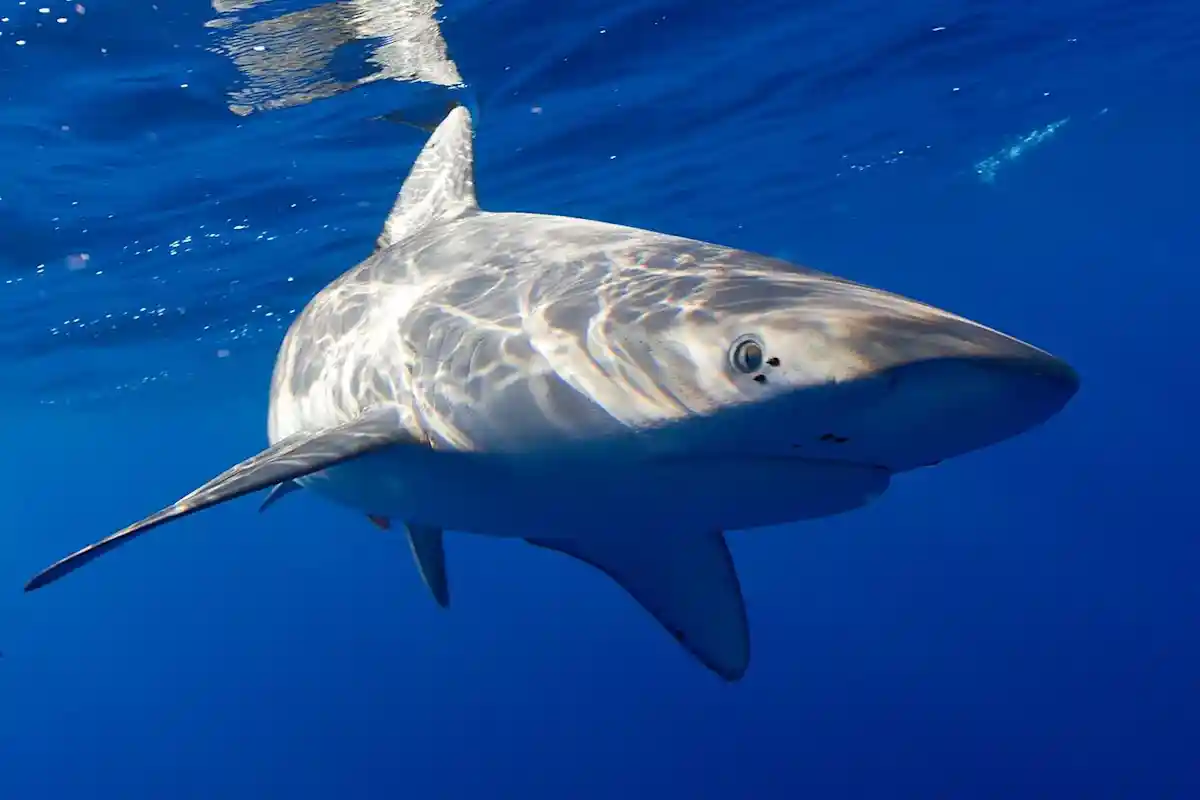
An experienced marine scientist from Mexico, Dr. Mauricio Hoyos, has come out to share his deadly shark experience.
He recently got hold of his scuba gear and dived into the waters off Cocos Island on Saturday to tag sharks for conservation research.
Minutes after diving in, he saw a nine-foot-long Galápagos shark, a migratory species.
Dr Mauricio aimed at it with his pole spear and released a tag, meeting its mark as it landed in the base of the shark’s dorsal fin.
However, what seemed like a routine job quickly got scary, as the scientist immediately became the target.
From about a meter away, the shark charged at him with her dangerous jaws.
“She turned sideways in my direction; it was really fast. It was wide open; my whole head was inside of her mouth in less than a second.
I heard a cracking sound. But it was just pressure. As soon as she felt my skull, she released me. She opened and swam away,” he said during an interview.
Water and blood filled Mauricio’s mask, which the shark had knocked away. Her sharp teeth had damaged the air hoses on his scuba gear.
Admitting that he would’ve been dead if the shark was in the mood to kill, he stated that he could not see anything and only sensed her moving away when he noticed her retreating shadow.
“I saw the shadow twice in front of me. If she wanted, she could have killed me.
My main concern was I felt like I could not breathe. I tried to suck air and it was not working.
To be honest it was like in slow motion. But my mind was very calm. I was thinking the whole time about what to do.
She was heading down and never saw me, and then she felt the puncture of the tag. It was a defensive bite. She wanted me to stay away from her personal space.



It was my first bite, too. I have been doing this for 30 years. She was scared also. It was not her fault,” he continued.
Dr Mauricio began to ascend slowly to decompress properly, despite losing a lot of blood and air. After lots of little exhalations, he finally reached the surface, where he almost lost consciousness.
He was eventually able to cling to the team’s skiff, get help out of the water, before being transported to Cocos Island, where park medics gave him first aid ahead of the journey to the mainland.
Having his say from a hospital bed in San José, Costa Rica’s capital, Dr Hoyos confirmed that he’ll need surgery on his jaw after getting stitches to treat slice wounds on his scalp and punctures to his face.
The scientist stressed that he had a total of 27 injuries, one for each of the 27 teeth that sank into his flesh.
Hoyos was the chief scientist for a team that is studying shark migratory patterns along an underwater mountain ridge off Cocos Island, over 400 miles from mainland Costa Rica, to help protect sharks from commercial fishing.
The team took off from Costa Rica on Sept. 20 and conducted its first dive in the Cocos Island area 2 days later.
Dr. Hoyos’ tragic accident with the shark happened on the 6th day of the research trip.
According to Dr Alex Antoniou, the director of Fins Attached Marine Research and Conservation, a nonprofit group, who leads Pelagios Kakunjá, a conservation organization based in La Paz, Mexico, Dr Hoyos’ reaction to the incident was not normal.
Praising the victim for understanding shark behaviour, he concluded by saying that the wildlife will always be unpredictable.
“How he responded was probably a lot different from a normal diver. He understands shark behavior.
It’s the wild. It’s unpredictable,” he added.