








How many more election cycles must pass before Nigerians admit that our collective Mumu never end in this country?
If you believe Saturday’s governorship election in Osun State was a victory for democracy simply because results were announced by Sunday morning, then you are part of the problem. Let us dispense with the congratulatory messages and confront an uncomfortable truth, what unfolded in Osun was not an election. It was a violent, heavily monetised marketplace of hunger, blood and open intimidation. If Saturday’s contest felt chaotic, brace yourself, because it was only a dress rehearsal for the tragedy Nigeria risks in the 2027 general election if urgent lessons are not learned.
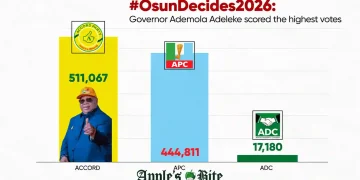
Professor Joshua Olalekan Ogunwole stood before cameras in Osogbo on Sunday morning and declared the incumbent governor, Senator Ademola Adeleke of the Accord Party, winner with 511,067 votes, ahead of Bola Oyebamiji of the All Progressives Congress, who polled 444,815. On paper, this looks like a milestone, a minority party breaking the entrenched two party dominance long enjoyed by the APC and the PDP. This is an easy claim to the state, on paper a sign that Nigeria’s political landscape can still surprise the establishment.
Ordinarily, that outcome would deserve celebration, a genuine third force overcoming the grip of political godfathers who have long decided Nigeria’s electoral fortunes. But there is little room for celebration when the process that produced the result was so chaotic, so primitive and so violent that it left citizens dead and communities traumatised. Families in Osun State are today mourning relatives who went out on Saturday to exercise a constitutional right and did not return. No election result, however historic, justifies that cost. A democracy that cannot guarantee its citizens safe passage to the ballot box has not yet earned the right to celebrate its outcomes.
What should trouble every Nigerian is not merely what happened in Osun, but how familiar it all felt. For how many decades have we recited the same complaints about electoral fraud, only to watch the identical pattern repeat itself unchanged? We condemned voter intimidation in 2019. We condemned it again in 2023. Now, in 2026, we are watching the same horror unfold, as though the nation is permanently tethered to a post of underdevelopment. This is not new to us. From the annulled election of June 12, 1993, through the bloodletting that followed the 2011 general election, Nigeria has repeatedly been warned that unchecked political violence eventually outgrows the elections that birthed it. Yet each warning is filed away and forgotten until the next cycle of bloodshed forces it back onto the front page.
Citizens who woke up on Saturday intending only to exercise a basic constitutional right were instead confronted with locally made guns, machetes and open unrest across several communities. Lives were lost. Real families are now mourning fathers, sons and daughters, casualties of a political class that treats public office as a kingdom to be won at any cost, even human blood.
The most shameless part of this tragedy was captured on camera for the world to witness. A sitting senator and other prominent political figures stood before crowds, openly threatening ordinary indigene’s of Osun with violent consequences should they fail to vote a particular way. These are lawmakers, individuals who ride in bulletproof vehicles funded by taxpayers, behaving like street thugs and warlords on election day. They made no effort to conceal their conduct, because experience has taught them that in Nigeria, the more ruthless a political enforcer proves to be, the greater the federal or state appointment awaiting them after victory. When lawmakers become the chief agents of lawlessness at polling units, the very idea of democratic choice becomes a hollow performance.
This is why Osun matters far beyond Osun. Yesterday’s chaos is an unedited preview of what political actors are preparing to unleash nationwide in 2027, should Nigerians fail to break the pattern now. Operatives have discovered that the Bimodal Voter Accreditation System can be sabotaged through deliberate network delays and convenient hardware failures, leaving voters stranded until exhaustion forces them to abandon the process. They have also perfected what can only be described as weaponised poverty in an economy strained by relentless inflation and costly transportation, a hungry citizen can be persuaded to sell a vote for five thousand naira, a branded bag of salt or a loaf of bread.
If Nigerians approach 2027 with the same fatalism that greeted Osun, the highest bidder will simply purchase the nation’s future, trapping the country in the same bitter cycle for another four years of empty treasuries and broken promises.
The path away from this danger is neither mysterious nor impossible. It begins with the Independent National Electoral Commission enforcing, without exception, the electoral offences provisions already written into our laws, so that vote buying and intimidation carry real consequences rather than becoming an accepted cost of doing political business.
It requires the National Assembly to finally establish the long promised Electoral Offences Commission, a dedicated body empowered to prosecute politicians and thugs who turn polling units into battlefields.
It demands that security agencies treat election violence with the same urgency reserved for terrorism, rather than allowing politically connected offenders to walk free while their foot soldiers are jailed.
It calls for the judiciary to resolve election disputes swiftly and transparently, denying impunity the comfort of delay, and for political parties themselves to discipline members who incite violence instead of quietly rewarding them.



Above all, it requires ordinary Nigerians, civil society organisations and the media to refuse the normalisation of bloodshed as a routine feature of democracy.
Osun was a warning delivered in the clearest possible terms. What Nigeria does with that warning between now and 2027 will determine whether the Nation finally breaks its dangerous roadmap, or walks it once more, eyes wide open, into familiar tragedy.
READ ALSO:
- The Dangerous Roadmap to 2027 | The Surge by Boma Lilian Braide(Esq.)
- Access Bank Moves to Recover ₦1.34bn Lost in Cyber Fraud
- INEC Passed Logistics Test In Osun Election But Vote Buying Persists — YIAGA
- Kebbi Police Arrest 19-Year-Old Woman For Stealing Newborn, Presenting Baby To Husband As Hers
- Lagos Opens Nigeria’s First Alternative Secondary School for Girls