


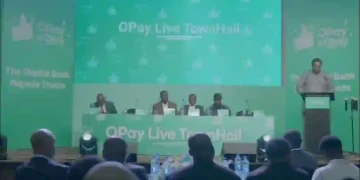







Lagos State Governor, Babajide Sanwo-Olu, has said Lagos is positioning itself to become Africa’s leading innovation hub, with more than $80 billion in commitments supporting the state’s technology and digital economy ambitions.
Sanwo-Olu made the disclosure on Wednesday at the GITEX Nigeria Official Tour held at the Landmark Centre, Victoria Island, Lagos, with the theme, “Beyond Connectivity: The Bridge to Sovereign AI & Innovation.”
The governor, who was represented by his deputy, Dr Obafemi Hamzat, said Lagos’ ambition to become Africa’s innovation capital would require more than policy statements, stressing the importance of sustained investment in infrastructure, human capital, progressive policies and effective implementation.
According to him, Lagos has already established itself as one of Africa’s major economic centres and currently ranks as the continent’s seventh-largest economy.
“Our ambition is clear: we want Lagos recognised not only as Nigeria’s commercial capital, but as Africa’s Innovation Capital. That position cannot simply be declared; it must be earned through infrastructure, talent, policy and execution,” he said.
Sanwo-Olu noted that Lagos was already playing a major role in the continent’s digital transformation, pointing to the emergence of technology companies in fintech, logistics and e-commerce that started locally and expanded into other markets.
He also highlighted the growing importance of artificial intelligence, saying the technology would reshape how people work, learn, create, govern and conduct business.
The governor warned that Africa must avoid becoming merely a consumer of technologies developed outside the continent. Instead, he urged African countries to build local capacity and own the technologies driving the continent’s digital future.
“That means talent, but it also means computers, data infrastructure, research institutions and commercial models that keep value on this continent instead of exporting it,” he said.
On digital infrastructure, Sanwo-Olu disclosed that approximately 3,000 kilometres of fibre-optic network had been deployed across Lagos between 2019 and 2025, as part of the state’s plan to develop a unified 6,000-kilometre network.
He also identified electricity supply as a major challenge to productivity, saying the Lagos State Government had taken regulatory, legal and commercial measures to address the problem.
According to him, the state is working towards securing between 200 and 400 megawatts of electricity capacity through state-backed procurement.
Sanwo-Olu further called on international investors and technology companies to establish deeper operations in Lagos rather than viewing the state solely as a consumer market.
He urged companies to consider setting up engineering centres, data centres and regional headquarters in Lagos, describing the state as a potential gateway to the wider African market.
“Do not look at Lagos as a market of 20 million people. Look at Lagos as a launchpad into Africa.
“The opportunity is not in selling to Lagos. It is in building from Lagos, and exporting from Lagos,” he said.
Meanwhile, Secretary-General of the African Continental Free Trade Area Secretariat, Wamkele Mene, said Nigeria was playing an important role in the development of Africa’s digital economy.
Mene said Nigeria, alongside Kenya and South Africa, was a co-champion of digital trade under the AfCFTA framework.
He attributed Nigeria’s growing influence in the sector to its expanding technology and fintech ecosystem, as well as its large pool of young entrepreneurs whose products and services are reaching markets across Africa.
He said the development of digital trade was expected to help transform technological innovation into commercial opportunities, strengthen regional supply chains and support the emergence of an integrated African digital market.
Also speaking, GITEX Global Chief Executive Officer, Trixie LohMirmand, said the technology event was designed to strengthen Nigeria’s connection with the global technology ecosystem while creating opportunities for international investors to engage with the country.
She said Nigeria had progressed beyond policy development into implementation, adding that the more than $80 billion in technology commitments presented an opportunity to create sustainable businesses and measurable economic value.
The Director-General of the National Identity Management Commission, Dr Abisoye Coker-Odusote, also stressed the importance of digital trust in building a secure and interconnected African digital economy.
She called for greater investment in local expertise in areas such as cryptography, cybersecurity and resilient digital infrastructure, particularly as artificial intelligence and quantum computing continue to evolve.
Coker-Odusote advocated the creation of an African digital trust framework, stronger capacity-building initiatives and practical cross-border digital applications to help turn Africa’s digital ambitions into economic opportunities.
Similarly, the Director-General and Chief Executive Officer of the National Information Technology Development Agency, Kashifu Abdullahi, said Nigeria’s young technology talents needed access to appropriate skills, infrastructure and an enabling environment to develop solutions to the country’s challenges.


The various stakeholders agreed that stronger investment in digital infrastructure, human capital, technology ownership and cross-border digital cooperation would be critical to unlocking Africa’s digital economy.
READ ALSO:
- Tinubu Celebrates Governor Dauda Lawal On His Birthday
- Sanwo-Olu: Lagos Targets Africa’s Innovation Capital Status With $80bn Digital Investments
- Ribadu Not Involved in Illegal Arms Importation — NCCSALW Boss
- Marwa Orders NDLEA To Target Drug Cartels’ Financiers, Illicit Wealth
- DSS, Police Probe Viral Claim That OPay Will Shut Down in Nigeria