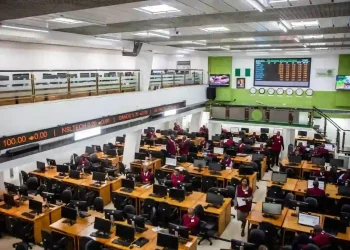











Nigerian Deposit Money Banks (DMBs) reduced lending to eight major sectors of the economy by N5.45 trillion, representing a 14.8 per cent year-on-year decline in 2025, following the Central Bank of Nigeria’s (CBN) withdrawal of regulatory forbearance and an industry-wide clean-up of loan portfolios.
The affected sectors include oil and gas, manufacturing, information and communication technology (ICT), construction, education, real estate, and general services.
Regulatory forbearance had previously allowed banks to temporarily restructure non-performing loans and continue operations despite breaching certain prudential requirements. However, the CBN ended the policy in 2025, compelling banks to absorb or repay high-risk exposures and significantly reducing their lending capacity.
As of the first quarter of 2025, more than ₦6 trillion in high-risk loans across seven major banks were under regulatory forbearance, according to available industry data.
Latest figures from the CBN’s Sectoral Distribution of Credit report showed that total lending to the eight affected sectors dropped to ₦31.31 trillion in 2025 from ₦36.77 trillion recorded in 2024.
Manufacturing suffered one of the biggest declines, with credit falling by 22.5 per cent to ₦6.61 trillion from ₦8.53 trillion, a reduction of ₦1.92 trillion.
General services also recorded a sharp contraction, with lending declining by 25 per cent to ₦4.35 trillion, while credit to the real estate sector fell by 17.2 per cent to ₦792.71 billion.
In the oil and gas sector, lending to service operators dropped by 12.35 per cent to ₦4.85 trillion, while credit to oil and gas industry players declined by 8.77 per cent to ₦10.59 trillion.
Other sectors that recorded lower credit allocation include ICT, where lending declined by 7.5 per cent to ₦1.76 trillion, education, which fell by 5.7 per cent to ₦84.13 billion, and construction, where lending slipped by 3 per cent to ₦2.29 trillion.
Commenting on the development, the Head of Equity Research at Quest Merchant Bank, Tunde Abioye, said the sharp decline was largely driven by the CBN’s decision to discontinue regulatory forbearance.
According to him, the policy change forced banks to write off several troubled loans, leading to a contraction in their overall loan books.
He noted that oil and gas as well as manufacturing were among the sectors most affected by the exercise, adding that banks are expected to adopt stricter credit assessment and risk management processes going forward.



Similarly, the Head of Financial Institutions Ratings at Agusto & Co, Ayokunle Olubunmi, said the industry’s loan portfolio was significantly influenced by the write-offs resulting from the end of the forbearance programme.
He also noted that improved liquidity in the foreign exchange market reduced demand for trade finance, particularly within the manufacturing sector.
Meanwhile, the Manufacturers Association of Nigeria (MAN) described the decline in manufacturing credit as a reflection of deeper structural problems affecting the sector.
MAN’s Director-General, Segun Ajayi-Kadir, warned that the reduction in financing threatens Nigeria’s industrialisation efforts, noting that countries such as India and Vietnam continue to expand credit support for manufacturers to boost production.
The association blamed the situation on high lending rates, stringent banking conditions, the elevated Cash Reserve Ratio (CRR), suspension of the CBN’s direct development finance interventions and delays in implementing the proposed ₦1 trillion Manufacturing Stabilisation Fund.
According to MAN, manufacturers currently face lending rates averaging about 27 per cent, with some borrowing costs exceeding 35 per cent, making long-term industrial investments increasingly difficult.
The association warned that inadequate access to credit could reduce factory output, delay technology upgrades, increase job losses, encourage greater dependence on imports and weaken Nigeria’s industrial diversification agenda.
To improve financing for manufacturers, MAN urged the Federal Government and the CBN to reduce interest rates, lower the CRR for banks supporting the real sector, recapitalise the Bank of Industry, activate the Manufacturing Stabilisation Fund and introduce government-backed credit guarantees.
Despite the overall decline in lending to several productive sectors, banks expanded credit to agriculture, finance, government, transportation, power and other sectors by a combined ₦11.42 trillion during the year.
Agriculture recorded a 26.4 per cent increase in lending to ₦3.61 trillion, while finance, insurance and capital markets attracted ₦9.24 trillion, representing a 19.3 per cent increase.
The largest growth occurred in the “Others” category, where lending surged by more than 722 per cent to ₦9.11 trillion, accounting for the bulk of new credit extended during the period.
Credit to government also rose by 13.5 per cent to ₦3.27 trillion, while lending to the power and energy sector increased by 31.3 per cent to ₦1.49 trillion. Transportation and storage also experienced an 18.1 per cent increase in bank credit.
Abioye attributed the increased lending to finance and insurance to Nigeria’s high-interest-rate environment, noting that financial institutions have continued to benefit from elevated market yields.
Looking ahead, industry analysts expect lending to improve in 2026 as banks complete their loan portfolio restructuring and recapitalisation programmes, creating room for increased financing of critical sectors including manufacturing, telecommunications, ICT, oil and gas, construction and real estate.
READ ALSO:
- Tinubu Bets on Gas and Power to Lift Manufacturing to 25 Per Cent of GDP by 2030
- NESREA to Honour Lagos Community Leader Who Saved a Giant Endangered Sea Turtle
- Hunye Alleges Plot to Strip His Security Detail, Vows to Stay in Race
- Ayo Sogbuyi Takes the Helm as President of Wamufat Youth Community Development Foundation
- Traditional Chief Shot Dead at Burial Ceremony in Ondo