











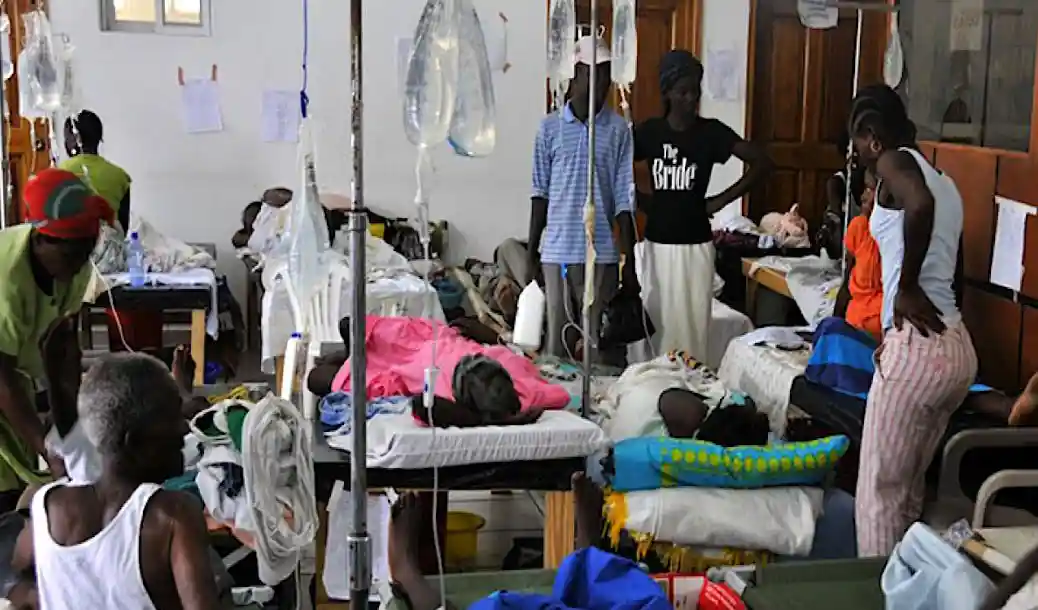
A healthcare practitioner, Livinus Abonyi, has said that the ineffectiveness of primary healthcare centres is to blame for crowded tertiary health institutions. He recently revealed that the poor state of primary healthcare centres is the reason behind the constant lack of bed spaces in secondary/tertiary health facilities across Nigeria.
Speaking during an interview with the News Agency of Nigeria in Lagos, Livinus Abonyi, Dean, Faculty of HealthCare Services of the Federal University of Allied Health Sciences, Enugu, emphasised the need to boost the PHCs across the country for optimal performance.
Lamenting how poorly funded the PHCs are, especially in terms of manpower and facilities/equipment, he disclosed that primary healthcare centres must be equipped with adequate manpower and resources.
According to him, if the PHCs function properly, a higher percentage of health cases would be handled at that level, such that only about 30 per cent of the health cases would be referred to the tertiary health facilities.
He stated that PHCs must be empowered to function 24 hours a day to accommodate health emergencies that usually occur at night.


“Presently, a patient can visit about two to three tertiary hospitals without getting a bed space – that is real.
If anyone wants to test it, the person should just pretend to be very sick; you will go to the first one – they will say no bed space; you go to the second one – the same no bed space.
There are many citizens who are carried back home dead because they are unable to get a bed space,” he said.
Livinus further noted that having efficient primary healthcare facilities and associated levels of care would make Nigeria a better place for every citizen.
He concluded by saying that early intervention will help to halt disease progression to a certain level, where further treatments will be required.
“If we have functional primary healthcare facilities and associated levels of care, we wouldn’t be facing such, because earlier intervention prevents disease progression to a certain level where it will require further treatments.
But, if at the early stage it was addressed and tackled conveniently, the person would have gotten well and it wouldn’t add to the population that would bring pressure to the tertiary health facilities,” he added.
