








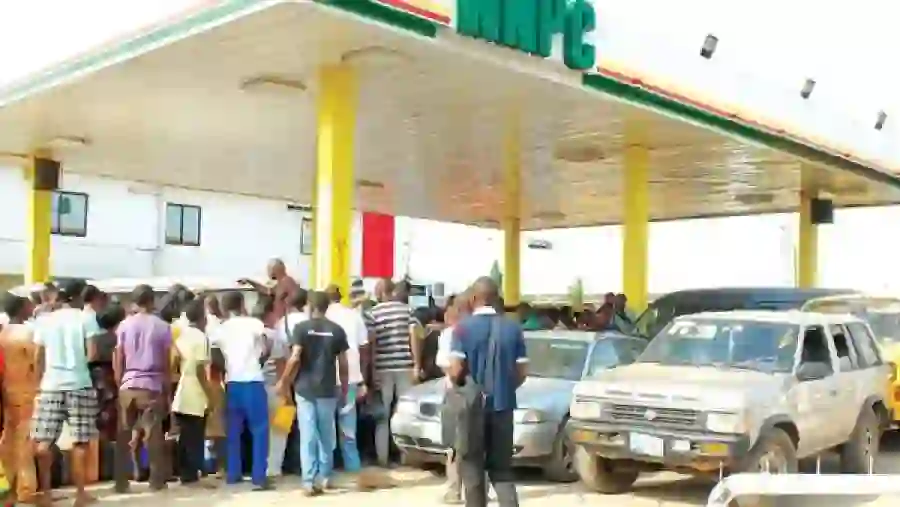
The Federal Government has announced a 30-day petrol price relief programme under which the Nigerian National Petroleum Company Limited (NNPC) will sell petrol at a proposed price of ₦1,350 per litre at its designated filling stations.
The initiative is aimed at reducing the impact of rising global crude oil prices on Nigerians, particularly commercial transport operators and vulnerable households.
The Minister of Finance and Coordinating Minister of the Economy, Taiwo Oyedele, announced the measure in Abuja, explaining that the programme would initially run for 30 days, with the price reviewed monthly.
According to the minister, the arrangement will give priority to public transport operators nationwide and is designed to cushion the effects of rising fuel costs without restoring the general petrol subsidy that the government abolished.
However, the announcement has attracted strong criticism from opposition parties, including the African Democratic Congress (ADC) and the Nigeria Democratic Congress (NDC), which described the intervention as inadequate and politically motivated ahead of the 2027 general elections.
Former Vice-President Atiku Abubakar also criticised the initiative, questioning what would happen after the 30-day period expires.
FG explains petrol price relief plan
Oyedele said the NNPC had agreed to forgo its retail profit margin to sell petrol at cost, thereby helping to reduce the pressure of rising international crude oil prices on consumers.



He stressed that the measure should not be regarded as a return to the fuel subsidy regime, but rather as a temporary arrangement to limit the impact of price fluctuations on Nigerians.
The minister also disclosed that the government was considering forward sales of crude oil to domestic refiners at a price and time yet to be determined.
He said the arrangement would help refiners plan their operations, provide greater certainty in the domestic market and reduce sudden changes in petrol prices.
According to him, the government is negotiating a price ceiling of ₦1,350 per litre at the ex-gantry or landing-cost level to promote price stability.
Oyedele maintained that petrol prices should not necessarily rise or fall with every change in international crude oil prices or foreign exchange rates.
He warned that restoring a broad fuel subsidy could put pressure on government revenue, weaken investor confidence and reverse recent economic gains.
The minister estimated that a return to the subsidy regime could push the exchange rate towards ₦3,000 to the dollar and increase petrol prices to at least ₦2,000 per litre. These figures were presented as government projections rather than confirmed outcomes.
FG highlights measures to reduce transportation costs
Oyedele said the government had introduced several initiatives to reduce the burden of high transportation costs since the removal of petrol subsidies.
He identified the expansion of compressed natural gas (CNG) vehicles, the deployment of CNG-powered buses and tax relief on electric vehicles and solar equipment as part of the government’s efforts.
According to the minister, more than 120,000 vehicles were operating on CNG, supported by over 400 conversion centres, 96 refuelling stations and 18 liquefied-to-compressed natural gas stations.
He added that more than 550 CNG buses had been deployed, with transport fares reportedly falling by between 30 and 50 per cent on routes where the buses operate.
The government has also removed taxes on electric vehicles and solar equipment and reduced import duties on vehicles.
Oyedele said these measures were intended to encourage alternative energy sources, lower transportation expenses and reduce Nigeria’s dependence on petrol.
Government plans strategic fuel reserve
The finance minister further disclosed that the Federal Government was working towards establishing a National Strategic Fuel Reserve to protect households and businesses against future energy supply disruptions.
He explained that refined petroleum products would be released into the market under clearly defined rules whenever international disruptions or hoarding threatened supply and price stability.
According to him, the reserve would not be used to impose fixed prices or restore fuel subsidies. Instead, it would help prevent artificial scarcity, discourage market manipulation and strengthen the country’s long-term energy security.
Oyedele also defended the government’s foreign exchange reforms, arguing that the naira had depreciated because the country lacked sufficient reserves to sustain the previous exchange-rate arrangement.
He said the gap between the official and parallel-market exchange rates had narrowed from more than 60 per cent to less than five per cent, while the country’s foreign reserves stood at approximately $55 billion.
Presidency backs NNPC’s decision
The Presidency confirmed that President Bola Tinubu had approved the NNPC’s decision to sell petrol at cost as a temporary measure to reduce the impact of rising fuel prices.
In a statement, the President’s Special Adviser on Information and Strategy, Bayo Onanuga, said the intervention was not intended to reverse the government’s fuel subsidy removal policy.
Onanuga explained that the government was seeking ways to ensure that the benefits of its economic reforms reached more Nigerians without creating additional long-term financial problems.
He argued that restoring a blanket subsidy could bring back the challenges associated with fuel scarcity, smuggling, pressure on public finances and currency instability.
The Presidency also said the government was preparing a broader package of fiscal measures aimed at reducing inflation to single digits sustainably in the near term.
It added that the NNPC’s retail division would implement the discount arrangement during the initial 30-day period, particularly for commercial transport operators.
Atiku questions what happens after 30 days
Atiku Abubakar, the presidential candidate of the African Democratic Congress, rejected the government’s announcement, describing it as a temporary response that would not address the underlying economic hardship.
In a statement issued by his Director of Strategic Communication, Phrank Shaibu, Atiku argued that Nigerians could not be expected to consider a one-month discount a lasting solution after enduring high transport fares and rising food prices for years.
He questioned what would happen when the programme expired, warning that Nigerians could return to paying the same high prices for petrol and transportation.
Atiku also criticised the decision to restrict the discount to NNPC filling stations, arguing that the government had not explained how much motorists would save per litre or how it would ensure that transport operators passed the savings on to passengers.
The former vice-president maintained that his proposal for production support tied to locally refined fuel could provide a more sustainable alternative.
He called for a properly budgeted and regulated arrangement that would protect consumers while supporting domestic refining.
Atiku insisted that Nigerians needed lasting relief rather than a temporary measure that would expire after one month.
NDC describes initiative as tokenism
The Nigeria Democratic Congress also condemned the announcement, describing the 30-day petrol discount as inadequate and an attempt to mislead Nigerians.
The party’s National Publicity Secretary, Osa Director, argued that the government had removed the fuel subsidy without sufficient consultation or adequate measures to protect households and businesses from the consequences.
The NDC questioned how many NNPC filling stations would participate in the scheme and whether they would be sufficient to serve the country’s large population.
It also raised concerns that limiting the discount to designated outlets could lead to long queues and congestion at filling stations.
The party further questioned the wider social and economic consequences of subsidy removal, including job losses, business closures and pressure on the public healthcare system.
The NDC accused the Tinubu administration of responding to public hardship with a short-term intervention rather than a comprehensive economic solution.
It urged Nigerians to support its presidential candidate, Peter Obi, in the 2027 election.
ADC campaign council accuses FG of political motive
The ADC Presidential Campaign Council also criticised the policy, alleging that the government was attempting to win public support ahead of the 2027 general elections.
In a statement issued by its Director of Media and Publicity, Kola Ologbondiyan, the campaign council argued that the administration had subjected Nigerians to prolonged economic hardship through fuel subsidy removal, currency depreciation and other economic policies.
It questioned why the government was introducing a temporary price relief measure after years of high petrol prices.
The council also asked whether petrol prices would rise again after the 30-day period and accused the administration of using the initiative as a political tool.
According to the ADC campaign council, Nigerians require sustainable measures to reduce the cost of living rather than temporary interventions that may be reviewed every month.
It maintained that voters would judge the government based on its ability to address hunger, unemployment and rising living costs.
Nigerians demand solutions to economic hardship
The announcement has also renewed calls for presidential candidates in the 2027 general elections to focus on practical solutions to Nigeria’s economic and security challenges.
Some Nigerians who spoke on the issue called on candidates to present clear plans for reducing the cost of living, improving electricity supply, creating jobs and addressing insecurity.
They also urged political parties to explain how their proposed policies would be funded and implemented, rather than relying on campaign promises.
Other concerns raised included the need to strengthen the independence of the judiciary and the Independent National Electoral Commission, improve healthcare and education, and promote transparency in government spending.
Some contributors also called for reforms in the petroleum sector, arguing that lower domestic production costs and more efficient refining operations would be essential to achieving affordable fuel prices.
The debate over the Federal Government’s 30-day petrol discount is expected to remain a major issue as political parties prepare for the 2027 elections, with opposition parties demanding lasting relief and the government defending its approach as a way to protect consumers without reversing economic reforms.
READ ALSO:
- Oyo APC Candidate, Alli Accuses Makinde’s Government of Failing to Prevent Attacks on Wife, Party Candidates
- Mother of freed prospective corps member says family paid N6m ransom
- CBN Partners Singapore on Financial Innovation, Investment Opportunities
- FG Sets Petrol Price at ₦1,350 for 30 Days, Opposition Parties Reject Plan
- 5 Reasons Your Phone Has Full Bars Now, No Service The Next Minute