











Nigeria’s Digital Economy Is Surging, But Its Fibre Backbone Is Under Threat
Nigeria processed N1.053 quadrillion in electronic payments in the first quarter of 2026, the highest single-quarter total recorded in the Central Bank of Nigeria’s payment data series since tracking began in 2019. The figure, disclosed in the CBN’s Q1 2026 Quarterly Statistical Bulletin, represents a 2.85 per cent increase from N1.024 quadrillion in the same period of 2025 and captures six channels: mobile pay, ATMs, instant payments, Point of Sale terminals, web transactions, and cheques, across a payments economy that now settles trillions of naira daily.
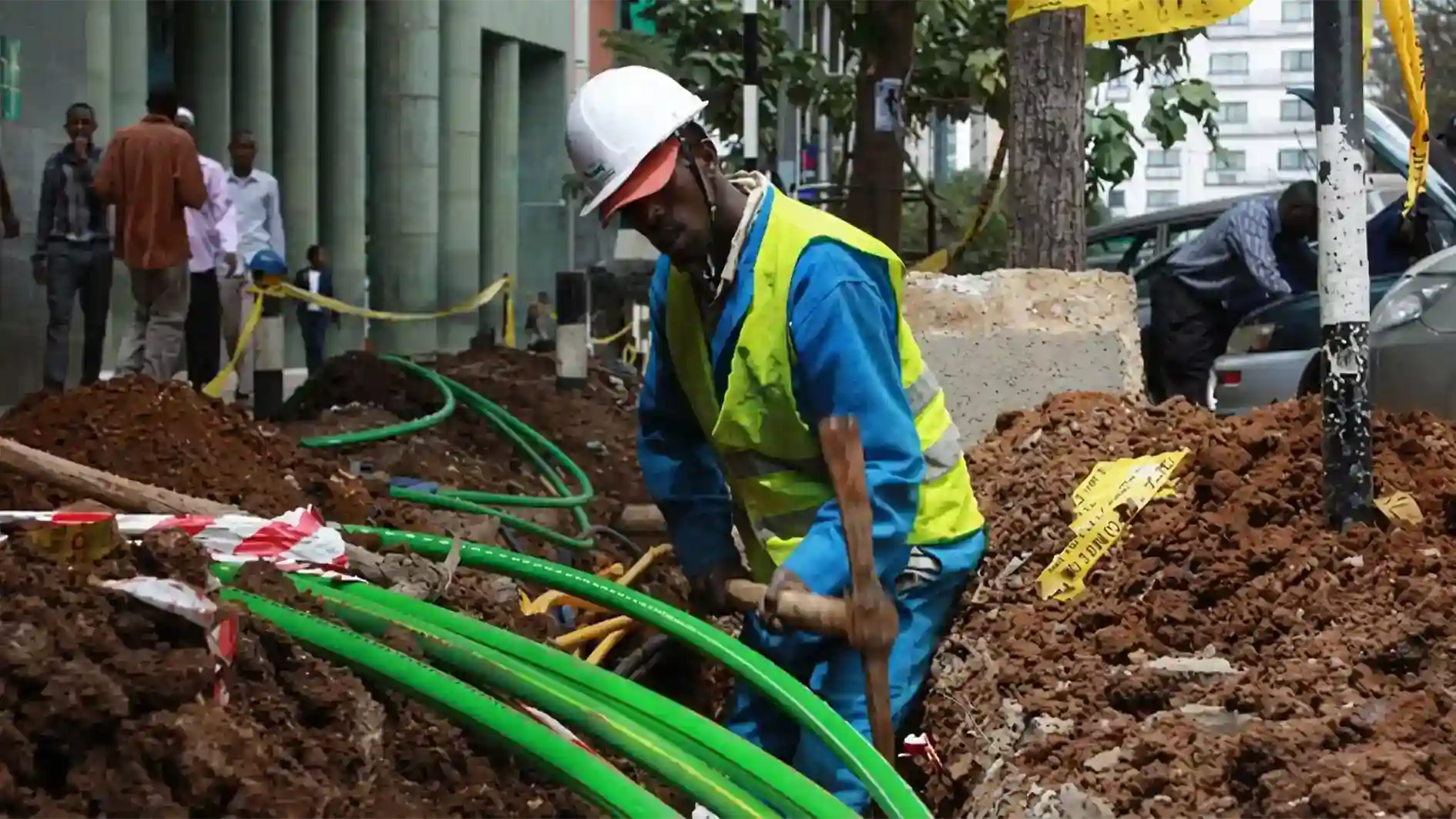
At almost the same moment that figure entered the public record, the Nigerian Communications Commission released data showing that 5,934 fibre-optic cables were cut across the country in the first six months of 2026, an average of 65 incidents every day. The two datasets, taken together, describe a digital economy expanding with speed and ambition on top of infrastructure that is being severed, repeatedly and preventably, by the very road-building programmes meant to modernise the country.
The channel breakdown inside the CBN data tells a sharper story than the headline number. Mobile Pay was the standout performer, with transaction volume rising 28.60 per cent year-on-year to 2.67 billion and value climbing 7.73 per cent to N112.12 trillion. ATM usage also grew, with volume up 6.60 per cent to 438.59 million while value surged 64.62 per cent to N26.30 trillion, a figure that points to Nigerians withdrawing larger amounts per visit even as digital channels expand.
The Nigeria Instant Payment system posted a split result: volume fell 17.70 per cent to 1.82 billion transactions, yet value climbed 12.55 per cent to N320.76 trillion, confirming that fewer but larger sums are settling through the instant rails.
Point of Sale contracted sharply. Volume fell 19.90 per cent to 2.92 billion from 3.64 billion a year earlier, while value dropped 16.42 per cent to N59.33 trillion from N70.98 trillion, representing roughly 724 million fewer transactions and approximately N11.65 trillion less value processed through the channel in a single quarter.
The geography of the fibre cuts maps almost precisely onto the geography of that payment activity. A TechEconomy analysis of NCC network monitoring data shows that Abuja, Lagos, Rivers, Kano, and Kaduna recorded the highest number of disruptions in the first quarter, the same cities that collectively account for the largest share of Nigeria’s enterprise connectivity, banking infrastructure, and fintech transaction volumes. Every major fibre cut in those corridors affects ATMs, Point of Sale terminals, fintech applications, logistics platforms, hospitals, and enterprise communications.
Effiom Ewa, Director of Critical National Security and Infrastructure Protection at the Office of the National Security Adviser, drew the sharpest line between cable damage and national consequence at the NCC’s August 12 stakeholders’ workshop in Abuja. “Every fibre-optic cable damage is more than a disruption to a network, or simply a cable cut,” Ewa told participants, while asserting “, It is indeed a disruption to governance, economic productivity, public services, and the daily lives of Nigerians.”
He noted that fibre-optic infrastructure carries a formal designation as Critical National Information Infrastructure under Nigerian law and that damage through negligence or interference could constitute a criminal offence, though enforcement has remained inconsistent.
Olarinre Adeladan, Permanent Secretary of the Federal Ministry of Works, acknowledged at the same workshop that road construction and telecommunications infrastructure routinely occupy the same physical space, a collision that produces most of the recorded incidents. “Appropriate mapping and coordination with telecoms operators before any excavation will help prevent damage to underground cables,” Adeladan said, adding that her ministry would work with the NCC to develop joint protocols for all federally funded road projects going forward.


Nadungu Gagare, Permanent Secretary of the Federal Ministry of Communications, Innovation and Digital Economy, told the workshop that the Standing Committee on the Protection of Fibre Optic Cables, which the two ministries inaugurated jointly, had expanded its membership to include the Office of the National Security Adviser. “The committee is not just a consultative body,” Gagare said, further disclosing “, It has a mandate to produce enforceable coordination frameworks within a defined timeline.”
NCC data shows that 1,883 of the 5,934 cuts recorded in the first half of 2026 occurred in the first quarter alone, meaning the rate of incidents accelerated in the second quarter. NCC Executive Vice Chairman Aminu Maida, who presented the figures at the Abuja workshop, recalled that fibre cuts in February 2024, including those caused by road construction, contributed to a near network-wide disruption for one telecommunications operator, affecting millions of users for several hours and placing additional load on competing networks.
“To a machine operator on a construction site, it may appear to be one buried cable,” Maida stated. Providing clarity: “To the nation, it can mean failed calls, stalled payments, interrupted services and missed opportunities.”
Gbenga Adebayo, Chairman of the Association of Licensed Telecommunications Operators of Nigeria, told the workshop that the industry had absorbed N2.2 billion in direct repair costs from fibre cuts in the first half of 2026 alone, not counting the revenue lost during outages or the capital diverted from network expansion to reactive maintenance. He called for a legal requirement that all road construction contractors obtain a clearance certificate from the NCC before any excavation work begins in areas with mapped underground telecommunications infrastructure.
The NCC has responded with two parallel tracks. The first is technical: the commission is building a centralised underground infrastructure mapping database, accessible to road agencies and contractors before excavation begins. The second is legislative: the NCC has drafted a framework that would make pre-excavation notification to network operators a legal requirement, with financial penalties for contractors who damage marked infrastructure. Neither track has produced enforceable rules yet. The mapping database remains incomplete for several states, and the legislative framework has not been gazetted.
Web transactions recorded 218.80 million transactions worth N516.10 trillion in Q1 2026, up from N461.96 trillion a year earlier, a 11.72 per cent increase in value even as the channel’s volume data showed modest movement. Cheque usage continued its structural decline, with volume falling to 1.81 million and value dropping to N7.57 trillion from N9.17 trillion in Q1 2025, a 17.45 per cent contraction that reflects the ongoing migration of high-value commercial settlements to electronic rails.
Analysts following the payments sector have flagged a separate POS dataset from the Nigeria Interbank Settlement System, cited by Financial Derivatives Company, which placed POS transaction value at N18.78 trillion for Q1 2026, a 79.03 per cent surge from N10.49 trillion in the same period of 2025. The figure is significantly lower than the CBN’s N59.33 trillion. According to available information, the difference is methodological: the NIBSS figure tracks terminals settled exclusively through its own infrastructure, while the CBN bulletin captures the full POS channel across all settlement pathways.
The NCC has set a target of reducing fibre cut incidents by 40 per cent before the end of 2026. In the first six months of the year, the monthly average stood at 989 incidents. Reaching the 40 per cent reduction target by December would require that average to fall to approximately 593 incidents per month in the second half, a pace that the acceleration between Q1 and Q2 suggests has not yet begun.
- Nigeria’s Digital Economy Is Surging, But Its Fibre Backbone Is Under Threat
- BRICS Leaders Adopt Declaration On Conflicts, Trade, Tariffs
- INEC Releases Final List Of 2027 Presidential Candidates
- Five Islamic Clerics Abducted After Prayer Meeting At Yari’s Zamfara Residence
- Ogun Transport Chairman, Iyeru, Dies

Seunmanuel Faleye is a brand and communications strategist. He is a covert writer and an overt creative head. He publishes Apple’s Bite International Magazine.