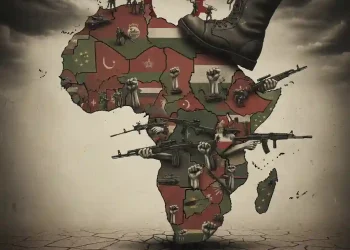










Over the past year, a carefully cultivated narrative about Nigeria has metastasised from the fringes of right-wing media into the formal policy apparatus of the United States Government. What began as talking points circulated among evangelical advocacy groups and conservative lawmakers has now culminated in an unprecedented threat: President Donald Trump, on November 1, ordered the Pentagon to prepare for potential military intervention in Africa’s most populous nation, warning that America could go into Nigeria “guns-a-blazing” to stop what he characterised as the “mass slaughter” of Christians.
The speed and mechanism of this escalation reveal much about how foreign policy is made in the Trump era, and the dangerous intersection of domestic political calculations, religious advocacy, and strategic interests that now threatens to destabilise America’s relationship with one of its most important African partners.
The campaign to frame Nigeria’s complex security crisis as Christian persecution didn’t emerge organically. It was constructed methodically, brick by brick, by a coalition of evangelical groups, conservative politicians, and media figures who found in Nigeria’s troubles a cause that could simultaneously energise Trump’s religious base, deflect attention from other controversial foreign policy positions, and advance a broader narrative about global Christian victimhood.


The narrative’s most prominent champion has been Senator Ted Cruz of Texas, an evangelical Christian and skilled political operator who introduced the Nigeria Religious Freedom Accountability Act in September 2025. Cruz has repeatedly claimed that 50,000 Christians have been killed since 2009, with 2,000 schools and 18,000 churches destroyed, figures he has notably declined to source. His campaign has been amplified by conservative media outlets and even penetrated relatively liberal spaces, with HBO host Bill Maher using his platform to accuse critics of Israel’s actions in Gaza of ignoring what he called a “Christian genocide” in Nigeria.
This messaging found fertile ground among Trump’s evangelical supporters, who constitute a core element of his political coalition. For an administration under pressure over its Middle East policies and facing criticism from religious conservatives on multiple fronts, Nigeria offered a perfect deflection: a cause that could demonstrate Trump’s commitment to protecting Christians worldwide while requiring minimal domestic political cost.
The Inconvenient Reality
The manufactured narrative collides awkwardly with the facts on the ground in Nigeria. While Christians have undoubtedly been victims of violence, the characterisation of Nigeria’s security crisis as a campaign of religious persecution fundamentally misrepresents the country’s multifaceted conflicts.
Nigeria faces overlapping security emergencies that defy simple religious categorisation. In the northeast, the 15-year insurgency by Boko Haram and the Islamic State West Africa Province has killed tens of thousands, but the majority of victims have been Muslims living in the predominantly Muslim region. In the northwest, heavily armed criminal gangs conduct mass kidnappings and raids that target both Muslim and Christian communities indiscriminately. In the Middle Belt, deadly clashes between predominantly Muslim herders and predominantly Christian farming communities are rooted in competition over land and water resources, exacerbated by climate change, not theological differences.
Even Trump’s own appointee initially contradicted the narrative. Massad Boulos, Trump’s envoy on Arab and African affairs, acknowledged just days before Trump’s designation that “Boko Haram and ISIS are killing more Muslims than Christians. So people are suffering from all sorts of backgrounds. This is not specifically targeted at one group or the other.”
Data from the Armed Conflict Location and Event Data Project shows that between January 2020 and September 2025, of 20,409 civilian deaths from 11,862 attacks in Nigeria, only 385 attacks were “targeted events against Christians where Christian identity of the victim was a reported factor,” resulting in 317 deaths. This represents a tragedy, certainly, but hardly the systematic genocide alleged by Trump and his allies.
Nigerian officials, religious leaders, and security analysts have consistently emphasised that the crisis affects Nigerians of all faiths. President Bola Tinubu, a Muslim married to a Christian pastor who has carefully balanced religious representation in government appointments, pushed back against Trump’s characterisation, stating that “the characterisation of Nigeria as religiously intolerant does not reflect our national reality.”
Strategic Interests and Convenient Narratives
Beneath the religious rhetoric lies a more complex calculus of American strategic interests in Nigeria. The United States has maintained significant economic and security ties with Nigeria for decades, driven primarily by oil, trade, and counterterrorism cooperation.
Nigeria remains a crucial energy partner, with crude oil constituting a major portion of its exports to the United States. American companies have invested heavily in Nigeria’s petroleum sector, and bilateral trade exceeded $13 billion in 2024. Beyond oil, Nigeria represents the largest market for U.S. exports in sub-Saharan Africa and serves as a gateway for American business interests across West Africa.
Security cooperation has deepened dramatically since September 11, 2001. The United States has provided over a billion dollars in military equipment and support to help Nigeria combat Boko Haram and other extremist groups. Intelligence sharing, training programs, and joint operations have made Nigeria an anchor of American counterterrorism efforts in the region. With China expanding its influence in Africa through infrastructure investment and Russia strengthening security partnerships with Sahel states, Nigeria’s geopolitical importance to Washington has only grown.
The Gulf of Guinea, where Nigeria’s coastline sits, represents one of the world’s most strategically significant maritime corridors. American naval cooperation with Nigeria on piracy, trafficking, and maritime security reflects enduring interests that transcend any single administration’s rhetoric.
This creates a paradox: Trump threatens to cut all aid and potentially invade a country that serves crucial American interests. The contradiction suggests that the military threats may be more performative than substantive, designed to satisfy domestic political constituencies while preserving the underlying strategic relationship.
The Domestic Political Calculation
Trump’s Nigeria policy cannot be understood outside the context of American domestic politics. Evangelical Christians, who gave Trump overwhelming support in his 2024 election, have long prioritised the protection of Christian communities abroad as a foreign policy concern. The issue of “Christian persecution” resonates deeply within this constituency, offering a cause that unites disparate elements of the religious right around a clear moral imperative.
For Trump, threatened on multiple fronts by criticism of his Middle East policies and seeking to energise his base ahead of the midterm elections, Nigeria offered an attractive target. Unlike more complicated interventions, where American interests might be contested or unclear, protecting Christians presents a seemingly straightforward moral cause that generates minimal domestic opposition. Who, after all, opposes protecting religious minorities from violence?
The timing is also significant. Trump’s threats emerged as international criticism of Israel’s actions in Gaza reached a fever pitch. By pivoting attention to the alleged persecution of Christians in Nigeria, Trump could demonstrate concern for religious minorities while implicitly contrasting Christian victimhood with what many perceive as excessive attention to Palestinian suffering. Bill Maher explicitly made this connection, criticising protesters focused on Gaza for ignoring Nigeria.
The evangelical lobbying campaign had been building for years, but it found a receptive audience in an administration seeking to shore up its religious conservative credentials. Paula White-Cain, Trump’s longtime spiritual adviser and senior adviser to the White House faith office, thanked Trump publicly for his “strong stand on Christian persecution in Nigeria”, a sentiment echoed throughout evangelical media.
The Legal and Diplomatic Quagmire
Trump’s threats to launch military strikes against Nigeria raise profound questions about international law and American foreign policy norms. Military action against a sovereign nation without that country’s consent or United Nations authorisation would violate established principles of international law and could set a dangerous precedent for unilateral intervention.
Under what legal authority would the United States act? Trump referenced the “Department of War”, his rebranding of the Department of Defence, but provided no statutory basis for potential intervention. Typically, U.S. military action requires either host-nation consent, a UN mandate, or authorisation under domestic legislation like the Authorisation for Use of Military Force. None of these conditions currently exists for Nigeria.
The designation of Nigeria as a “Country of Particular Concern” under the International Religious Freedom Act provides a legal mechanism for sanctions and diplomatic pressure, but it does not authorise military intervention. Countries on this list, which includes Russia, China, Pakistan, North Korea, and Saudi Arabia, face potential sanctions, not invasion threats.
Nigeria’s government has attempted to navigate these threats diplomatically while asserting its sovereignty. Presidential adviser Daniel Bwala suggested that Nigeria did not take Trump’s comments “literally” and expressed confidence that direct dialogue between the presidents would produce “better outcomes in our joint resolve to fight terrorism.” He emphasised that any assistance must “recognise our territorial integrity”, a clear boundary on what Nigeria would accept.
But the damage to diplomatic relations may already be done. Nigeria’s redesignation as a CPC complicates security cooperation, potentially restricting military training, intelligence sharing, and arms sales, precisely the tools that would actually help Nigeria address its security challenges. African nations and international organisations have condemned Trump’s threats as violations of national sovereignty, potentially damaging American diplomatic standing across the continent.
The Nigerian Perspective
For Nigerians watching this drama unfold from Lagos to Abuja, Trump’s threats have generated a mixture of confusion, fear, and anger. Many see the narrative as a gross oversimplification of their country’s challenges that threatens to inflame the very sectarian divisions it purports to address.
Nigerian Christians themselves have been among the most forceful critics of the genocide narrative. While acknowledging real security challenges and the suffering of Christian communities, many religious leaders emphasise that framing the crisis as religious persecution obscures its true drivers—poverty, corruption, climate change, weak governance, and makes solutions more difficult.
Danjuma Dickson Auta, a Christian community leader from Plateau state in the Middle Belt, told reporters: “Christians are being killed, we can’t deny the fact that Muslims are [also] being killed.” His statement captures the complexity that Trump’s rhetoric erases.
The governor of Benue state, one of the worst-affected regions, has called for international intervention, but in the context of a Nigerian government he believes has failed to protect his constituents, not as validation of Trump’s religious persecution narrative. His pleas reflect frustration with Abuja’s response to local security crises, not evidence of systematic anti-Christian policy.
Analysts warn that Trump’s intervention threatens to become a self-fulfilling prophecy. By characterising Nigeria’s conflicts in explicitly religious terms, external actors risk hardening sectarian identities and making violence more likely. Groups that currently operate based on criminal or political motives may adopt religious framing to attract international attention and support. Separatist movements, particularly in the southeast, are already attempting to leverage Trump’s rhetoric to advance their agenda in Washington.
Michael Nwankpa, founding director of the London-based Centre for African Conflict and Development, called Trump’s remarks “reckless” and military intervention “unwarranted.” He noted the absurdity of jumping “from diplomatic solutions to then jump straight to talking about military intervention” when Nigeria’s own military, “one of the great militaries in Africa”, has struggled for 20 years to defeat Boko Haram.
The Consequences of Manufactured Crisis
The transformation of Nigeria from a strategic partner to a potential military target represents a case study in how domestic political imperatives can distort foreign policy. The evangelical campaign to protect Nigerian Christians, amplified by conservative politicians and media, has created a narrative that bears little resemblance to the reality on the ground but serves important political functions for multiple actors.
For evangelical groups, Nigeria provides a compelling cause that mobilises support and fundraising. For Ted Cruz and other Republican lawmakers, it offers an opportunity to demonstrate toughness on religious freedom issues and cement relationships with an important constituency. For Trump, it presents a chance to energise his base, demonstrate leadership on a moral issue, and deflect attention from more controversial policies.
But manufactured crises have real consequences. Trump’s threats have strained relations with an important partner, complicated counterterrorism cooperation at a moment when it is most needed, and risked inflaming sectarian tensions in a country that can ill afford them. If implemented, sanctions and aid cuts would harm the very Nigerian security forces and institutions that provide the best hope for addressing the country’s challenges.
More broadly, the episode reveals the fragility of American foreign policy in an era where facts matter less than narratives, where complex geopolitical realities are subordinated to domestic political calculations, and where the president’s statements, regardless of their accuracy or implications, become policy through sheer force of repetition.
Nigeria’s crisis is real and deserves international attention and support. Thousands have died in attacks by extremists, criminals, and ethnic militias. Communities have been displaced, infrastructure destroyed, and social cohesion frayed. Both Christians and Muslims have suffered, along with adherents of traditional religions and people of no faith at all.
What Nigeria needs is not threats of invasion or simplistic narratives about religious persecution, but sustained partnership to address the root causes of instability: poverty, corruption, climate change, weak governance, and the proliferation of weapons. It needs support for its security forces that prioritizes professionalization and respect for human rights. It needs economic development that provides alternatives to extremism and criminality. It needs diplomatic engagement that respects its sovereignty while encouraging good governance.
Instead, Nigeria faces the prospect of an administration more interested in scoring political points than solving problems, more committed to satisfying its base than understanding complex realities, and more willing to threaten force than engage in the patient, difficult work of partnership and development.
Conclusion: The Price of Opportunism
As Trump’s threats hang over U.S.-Nigeria relations, the episode offers a sobering lesson about contemporary American foreign policy. When political opportunism meets strategic interests, when manufactured narratives trump inconvenient facts, and when domestic calculations override diplomatic wisdom, the result is policy that satisfies no one and solves nothing.
The evangelical groups that championed this cause may win symbolic victories but risk undermining the security and prosperity of the Nigerian Christians they claim to protect. Ted Cruz and his colleagues may energise their base but complicate America’s position in a strategically vital region. Trump may demonstrate toughness to his supporters, but alienate a major partner and set dangerous precedents for international relations.
And Nigeria, Africa’s most populous nation, its largest economy, a democratic bulwark in an increasingly authoritarian region, finds itself characterised as a “disgraced country” worthy of invasion, its complex challenges reduced to fodder for American political theatre.
The talking point that gained a foothold in right-wing media has become official government policy. But a policy built on a manufactured crisis, domestic political calculation, and willful misrepresentation of reality cannot succeed; it can only do harm. As Trump’s “guns-a-blazing” rhetoric echoes across the Atlantic, one can only hope that cooler heads, informed by actual facts and genuine strategic thinking, will ultimately prevail.
The alternative—military intervention based on false pretences in pursuit of domestic political advantage—is a tragedy we’ve seen before. That we might be heading down that path again, in Nigeria of all places, speaks volumes about how far American foreign policy has strayed from the principles and pragmatism that should guide it.
The Nigerian people, Christian and Muslim alike, deserve better than to be pawns in American political games. So do the American people, whose government should pursue policies based on reality, not the manufactured narratives of opportunistic politicians and media figures. Until we can distinguish between the two, both nations will continue to pay the price.

Seunmanuel Faleye is a brand and communications strategist. He is a covert writer and an overt creative head. He publishes Apple’s Bite International Magazine.