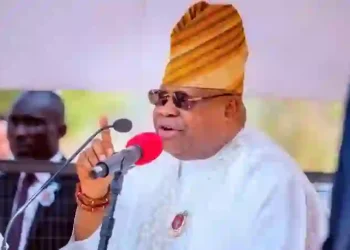






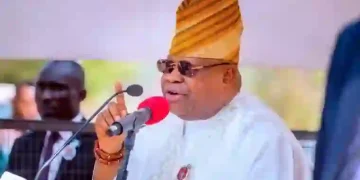




The Chairman of the Nigeria Revenue Service (NRS), Zacch Adedeji, has come under criticism following his recent appearance on Channels Television’s Sunday Politics, where he defended President Bola Tinubu’s lifestyle amid questions about the cost of governance.
Adedeji was on the programme to explain and defend the economic policies of the Tinubu administration, including the government’s difficult reform measures and their impact on Nigerians. However, his responses to questions about government spending and presidential luxury have generated controversy.
During the interview, Adedeji pointed to what he described as signs of the president’s personal frugality. He said Tinubu walks from his residence to his office, eats once a day, spends long periods without travelling abroad and rarely attends parties.
The NRS chairman also questioned the cost of a Cadillac Escalade, asking, “How much is an Escalade that the president of Nigeria cannot afford?” The remark has since attracted criticism, with opponents arguing that the issue was not whether the president could personally afford a luxury vehicle, but whether government expenditure reflects restraint at a time when Nigerians are facing economic difficulties.
Critics of the response argue that the cost-of-governance debate centres on the use of public resources rather than the president’s personal wealth.
They contend that whether Tinubu can personally afford an Escalade, private aircraft or other luxury items is largely irrelevant if such expenditure is being questioned in the context of public funds. According to the argument, government spending should be assessed based on necessity, value, prudence and the public interest.
RelatedPosts


The criticism comes against the backdrop of Nigeria’s continuing cost-of-living pressures. Although some economic indicators have shown signs of improvement, millions of Nigerians continue to struggle with the rising cost of food, transportation and other basic necessities.
For many households, the economic pressure is reflected in everyday decisions over food, transport, rent, school fees and healthcare. Against that background, critics say using the president’s personal habits as evidence of government frugality risks appearing disconnected from the realities faced by ordinary citizens.
Adedeji’s claim that Tinubu walks between his residence and office has also been questioned. While such a habit may demonstrate a personal choice within the presidential complex, critics argue that it does not necessarily address broader issues surrounding government expenditure.
Questions about the cost of governance include the size of the bureaucracy, official vehicles, travel expenses, procurement, overheads and other recurrent expenditures.
The same argument applies to the president’s reported eating habits. Critics say the fact that Tinubu eats once daily does not demonstrate that government is reducing its spending or that the burden of economic adjustment is being fairly shared.
The article argues that a more effective response would have been for the government to provide concrete figures showing reductions in government expenditure, measures taken to control official spending and steps being taken to improve efficiency in procurement, travel and other areas.
Adedeji’s academic and professional credentials have also featured prominently in the criticism. He was described by the Presidency in 2023 as a first-class Accounting graduate of Obafemi Awolowo University. He has served as Oyo State Commissioner for Finance, headed the National Sugar Development Council and worked as a presidential adviser on revenue before becoming chairman of the federal revenue authority.
The criticism therefore centres not on his technical expertise but on what the episode allegedly revealed about public communication and political judgment.
The article maintains that leadership requires more than academic intelligence. It also requires empathy, perspective and the ability to understand how government policies and statements are received by citizens experiencing hardship.
Adedeji has also defended the Tinubu administration’s economic reforms, arguing that the government inherited serious economic distortions and that measures such as fuel subsidy removal and foreign-exchange reforms were necessary to address structural problems.
He reportedly argued that the tax reforms were designed to “tax prosperity” rather than poverty.
However, critics maintain that the government must also demonstrate how increased revenue is being translated into tangible benefits for Nigerians.
They argue that officials should explain where additional revenue is going, what has been achieved in infrastructure and social investment, what has not worked and what measures are being taken to address shortcomings.
The criticism also raises concerns about the relationship between government communication and public trust. The article argues that citizens are entitled to question how public resources are spent and that such scrutiny should not be treated as an attack on the country or the government.
For a revenue administrator, the issue is particularly important because public confidence is central to tax compliance. Nigerians are more likely to accept taxation when they believe government is accountable, responsible and conscious of the sacrifices being made by citizens.
The broader lesson, according to the article, is that President Tinubu needs advisers and officials who can provide honest assessments of public concerns rather than simply defend every aspect of government policy.
Economic reforms are experienced differently by ordinary Nigerians. For households, they are felt through the prices of food, fuel, transportation, school fees, medicines and other necessities rather than through economic statistics alone.
The controversy surrounding Adedeji’s interview has therefore become a broader debate about leadership, empathy and accountability.
For millions of Nigerians, the most pressing questions are not how much a president can afford to spend on a luxury vehicle, but how much it costs to buy food, get to work, pay rent, settle school fees or obtain medical care.
The episode has consequently highlighted the importance of sensitivity in public communication, particularly at a time when many citizens are being asked to endure economic sacrifices.
The central argument is that academic excellence and professional expertise do not automatically translate into sound political judgment. Public officials, particularly those responsible for collecting revenue from citizens, are expected to combine competence with empathy, restraint and an understanding of the realities facing the people they serve.
As the controversy continues, the debate has shifted beyond the Escalade remark to a larger question: Can the government convince Nigerians that the burden of economic reform is being shared fairly and that public resources are being managed responsibly?
READ ALSO:
- Zacch Adedeji Under Fire Over Defence of Tinubu’s Lifestyle
- I Sold My Nissan for N180k, Bought Okada, Had Multiple Accidents — Veteran Actor Sunday Afolabi Cries Out
- From Policy To People: Stakeholders Unveil Roadmap To Transform Nigeria’s Health, Social Care And Youth Employment Landscape
- Osun Election: Adeleke, Oyebamiji, Salaam, Esan Battle Over Plans, Victory
- Two African Countries to Grant Nigerians Visa-Free Entry From 2027