






A diplomatic confrontation between the United States and China has intensified following Beijing’s criticism of President Donald Trump‘s threat of military intervention in Nigeria over the alleged persecution of Christians.
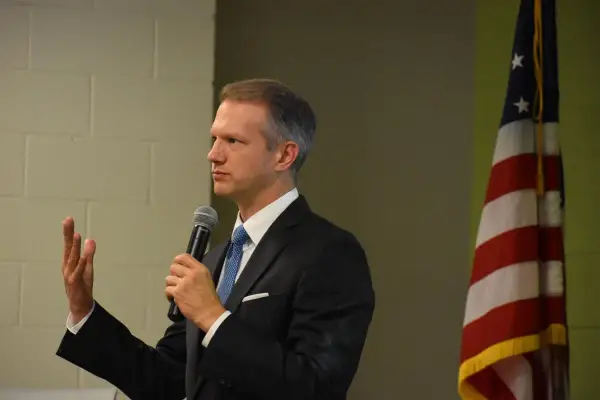
US Congressman Riley Moore, representing West Virginia’s 2nd District, delivered a sharp rebuke to China on Wednesday, rejecting Beijing’s position and asserting that Washington would not allow a foreign power to influence American foreign policy decisions, particularly on issues of religious freedom and human rights.
Writing on X, Moore defended President Trump’s stance and accused China of hypocrisy given its own human rights record.
“President Trump is absolutely right to defend our brothers and sisters in Christ who are suffering horrific persecution, and even martyrdom, for their faith in our Lord and Saviour Jesus Christ,” Moore stated.
He directly challenged Beijing’s moral authority to comment on the matter, citing China’s treatment of religious minorities and ethnic groups.
“China will not dictate our foreign policy to us, and we will not be lectured to by a Communist autocracy that recently arrested 30 Christian pastors for their faith and threw ethnic minorities in concentration camps,” the congressman declared.
Moore argued that the United States has both a moral obligation and global responsibility to defend persecuted Christians worldwide, emphasising that allegations of attacks on religious minorities in Nigeria warrant serious international attention.
China’s Defense of Nigeria
The congressman’s statement came in response to comments by Chinese Foreign Ministry spokesperson Mao Ning, who publicly rejected Trump’s remarks and cautioned against using religious freedom and human rights as justification for interfering in sovereign nations’ internal affairs.


“As Nigeria’s comprehensive strategic partner, China firmly supports the Nigerian government in leading its people on the development path suited to its national conditions,” Ning said, underscoring Beijing’s diplomatic backing for Abuja.
The Chinese spokesperson explicitly opposed any threats of sanctions or military action against Nigeria, arguing that no country should exploit religious issues to advance geopolitical interests or destabilise sovereign states.
“China firmly opposes any country using religion and human rights as an excuse to interfere in other countries’ internal affairs, and threatening other countries with sanctions and force,” Ning stated.
The diplomatic exchange reflects mounting international concern over reported religious-based violence in parts of Nigeria, an issue that has attracted increasing attention from Western political and religious organisations.
President Trump’s warning of potential US military intervention marked a significant escalation in Washington’s rhetoric regarding the situation in Nigeria, a development that has drawn both support from conservative Christian groups and criticism from those cautioning against unilateral intervention.
The dispute also highlights broader geopolitical competition between Washington and Beijing, with Nigeria, Africa’s most populous nation and largest economy, becoming a focal point in the rivalry between the two global powers over influence on the continent.
China has significantly expanded its economic and diplomatic presence in Nigeria in recent years through infrastructure investments and trade partnerships, positioning itself as a major strategic partner to the West African nation.