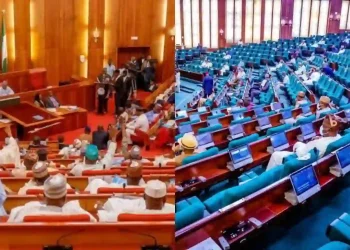









The Federal High Court sitting in Lagos has declared the National Assembly’s ₦110 billion vehicle procurement and lawmakers’ allowance scheme unlawful.
In a judgment delivered by Justice Yellin Bogoro on Wednesday, May 6, 2026, the court held that the spending — which includes ₦40 billion for 465 vehicles and ₦70 billion in support allowances for newly elected lawmakers — violated procurement regulations, constitutional provisions, and principles of public accountability.
The case was filed by the Socio-Economic Rights and Accountability Project (SERAP), which challenged the legality of the expenditure approved by the National Assembly leadership.
Justice Bogoro ruled that the procurement process was “arbitrary, disproportionate and inconsistent with statutory procurement standards,” noting that there was no sufficient evidence of due process.
The judge also described the arrangement as a conflict of interest, stating that lawmakers directly benefited from funds they approved, describing it as “self-dealing” that undermines public trust.
She further observed that the ₦110 billion allocation was unjustifiable given Nigeria’s economic hardship, stressing that public funds must be used in the national interest and not for personal enrichment.
The court dismissed arguments that legislative autonomy protected the spending, holding that separation of powers cannot be used to shield unconstitutional or illegal actions. It affirmed that courts retain jurisdiction to review legislative expenditure where legality is in question.
Justice Bogoro also held that SERAP had the legal standing to institute the case as a public interest organisation committed to accountability and transparency.
On procedural objections, the court ruled that failure to serve a pre-action notice was not fatal in this instance, citing the urgency and public interest nature of the case.
SERAP had argued that the National Assembly approved the purchase of 465 bulletproof vehicles at about ₦305 million each, alongside allowances under a supplementary appropriation plan, despite worsening economic conditions in the country.


The court ultimately ordered that future expenditures by the National Assembly must strictly comply with procurement laws, transparency requirements, and value-for-money principles.
READ ALSO:
- AAC Sues Tinubu, National Assembly Over Europe vacation
- California Recognises Eid al-Fitr, Eid al-Adha As Official State Holidays
- Customs Seeks Forfeiture of Three Aircraft Linked to Sayyu Dantata Over N2.31bn Duty
- Senate extends 2025 budget capital implementation to December 31, 2026
- Osogbo Residents Raid Food Warehouse Amid Police Gunshots