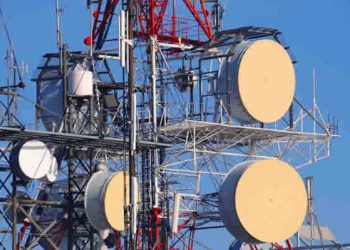











Telecommunications contributed 9.19 per cent to Nigeria’s real Gross Domestic Product (GDP) in the first quarter of 2026, reflecting the sector’s growing role in digital payments, financial services, commerce, remote work, enterprise connectivity and government services.
Beyond its direct contribution to economic output, telecommunications has increasingly become part of the infrastructure through which economic activity is conducted, as businesses and individuals rely on digital platforms and network connectivity to transact, communicate and deliver services.
Financial analyst and chartered accountant, Oluwatosin Olaseinde, said capital deployed into telecommunications infrastructure was creating productive capacity for businesses and individuals across the wider economy.
He said the infrastructure enables software developers and remote professionals to serve international clients, businesses to transact through digital platforms, and educators and service providers to reach customers beyond their immediate locations.
The scale of investment required to sustain that activity is significant.
Financial planner, Kalu Aja, said MTN Nigeria alone had committed more than N1.62tn in cumulative infrastructure investment across the country, covering network infrastructure, fibre deployment, spectrum and power requirements.
Such investment has implications beyond telecom operators as businesses increasingly depend on reliable connectivity to operate.
Telecom and digital payments
The financial services industry provides one of the clearest examples of the growing economic importance of telecommunications.
The expansion of digital banking, fintech platforms, electronic payments and agency banking has been built on networks connecting customers, merchants, financial institutions and payment infrastructure.
Nigeria’s electronic payment ecosystem, which processes transactions worth hundreds of trillions of naira, depends on telecommunications infrastructure for the transmission of data between users, financial institutions and payment platforms.
The growth of Point-of-Sale transactions has similarly expanded the role of connectivity in everyday commerce, creating income opportunities for agents and extending financial services into communities where conventional bank branches are limited.
Digital investment platforms have also widened access to financial products.
Platforms such as Ladda, founded by Olaseinde, now serve more than 75,000 users through digital channels, illustrating how telecommunications can reduce the physical barriers traditionally associated with financial services.
Small businesses are also increasingly using social media, messaging platforms, digital payments and online marketplaces to acquire customers and conduct transactions without the physical infrastructure previously required to operate at scale.
Fibre cuts raise economic concerns
The expansion of digital activity is increasing pressure on the underlying network infrastructure.
The Nigerian Communications Commission recorded more than 5,000 fibre cuts in the first six months of 2026, disruptions that can affect digital payments, business operations, public services and other connectivity-dependent activities.
Israel Ihaza, founder and chief executive officer of PropTech company Oikus, said the problem reflected gaps in coordination around underground infrastructure, particularly during road construction and excavation.
The vulnerability of fibre infrastructure has therefore become an economic issue as well as a telecommunications concern.
When connectivity is interrupted, businesses that depend on digital transactions can lose access to customers and payment channels, while remote workers and digital service providers can experience disruptions to their operations
.
Rising costs threaten network expansion
At the same time, operators face rising costs of maintaining and expanding their networks.
The industry continues to contend with multiple taxes and levies, right-of-way costs, foreign-exchange pressures and the high cost of powering network infrastructure.
These pressures have become more significant as operators seek to expand capacity in response to rising demand for data.
Chief Executive Officer of MTN Nigeria, Karl Toriola, has warned that the economics of continued investment must support sustainable returns, while Chairman of the Association of Licensed Telecommunications Operators of Nigeria, Gbenga Adebayo, has similarly raised concerns about the impact of rising operating costs on network expansion and service quality.
The challenge for policymakers is therefore increasingly two-sided: expanding digital access while ensuring that the infrastructure supporting the economy remains financially and physically sustainable.
The Federal Government’s designation of telecommunications infrastructure as part of Critical National Information Infrastructure provides a framework for greater protection of network assets.
However, implementation will depend heavily on coordination between federal agencies, state governments, local authorities, road contractors and communities.
As more businesses move transactions online and more economic activity becomes dependent on digital platforms, investment in network capacity and protection of fibre infrastructure are increasingly becoming broader economic issues.
For Nigeria, the implication is that telecommunications can no longer be viewed solely as a consumer service.



The reliability, affordability and sustainability of the infrastructure supporting connectivity are increasingly tied to the country’s ability to sustain digital commerce, financial services, productivity and wider economic activity.
- Arise News Drops Anthony Kila Over Alleged Academic Credentials Fraud
- NASU Urges FG To Review Minimum Wage, Ease Economic Hardship
- Pope Leo XIV Hospitalised for Surgery
- FG Demands Arrest, Prosecution Of FMC Abeokuta Stabbing Suspect
- Military Retirees Block Pensions Board Gate In Abuja Over Pension Hike

Seunmanuel Faleye is a brand and communications strategist. He is a covert writer and an overt creative head. He publishes Apple’s Bite International Magazine.