






The July 2025 exclusive interview APPLES BITE MAGAZINE had with Vanessa, not her real name, detailed the risks that African girls, typically between the ages of 18 and 22, are exposed to inside Russia’s Alabuga Special Economic Zone in Tatarstan.
Vanessa, a software engineering student who was taking classes online, had imagined going to work in Alabuga to raise money to fund her studies, but it turned out to be a terrible decision. She had recalled the creeping sense that the glossy promise she had fancied and followed across the world was unravelling before her eyes. She told Apples Bite Magazine her supervisors were unfriendly and subjected the girls to inhuman treatment, which made her experience there uninspiring. And for her, also, combining working in Alabuga with her school work was a struggle; as such, she started to lag academically. Then came the blast. Windows shattered. People ran. And somewhere above the industrial skyline of one of Russia’s most strategically important war production facilities, a Ukrainian drone completed its mission.
This testimony was corroborated by Adau, not her real name, who had spoken to the BBC. She said she and the other participants were not given a choice as to whether to work in the drone factory. They had signed non-disclosure agreements, so they could not even discuss their work with their families.
“On the surface, this is an amazing opportunity for many of these women to see the world, to gain work experience and to earn a living wage. But, in reality, when they’re brought to Alabuga, they have a harsh awakening that these promises are not kept, and the reality of their work is far different from what they’re promised.”
Adau recalled that she knew straight away that she could not keep working at the factory.
“We Were All Scammed”
But perhaps the most damning account comes from a Sudanese woman, a former participant who spoke on condition of anonymity in a private social media chatroom closely monitored by APPLES BITE MAGAZINE. Her testimony peels back the last layers of illusion surrounding a program that has left young African women trapped in a war zone, deceived at every turn.
“Everything was moving smoothly. Like I said, they scammed us. People who went there, we were scammed,” she revealed, her words carrying the weight of someone who watched an entire system of lies unfold around her.
The deception, she insisted, reached the highest levels. “All ministers were scammed. Influencers were scammed. Like everyone is just scammed by these lies.”
The Uniforms and the Performance for Dignitaries
She described in chilling detail how the program maintained its facade when important visitors arrived, ministers, government officials, influencers who would return home to post glowing reviews.
“That’s the university where they ask girls to put on uniforms whenever they have someone coming in, someone that they want to show the place,” she explained. “When they’re coming to see us, they ask girls to put on uniforms and go to the university and sit in one of the classrooms and pretend like you’re taking classes there.”
The performance extended beyond the classroom into the very fields of work advertised to recruits across Africa.
“And also these fields, the fields of logistics and what they like, pick a certain girl, put on the uniform and go and pretend like uh that’s the field that you’re working in. But those fields don’t exist, actually, because you’re not working in that field. You work in one field.”
“But when they want to do advertising, social media advertising, they pick a girl to go and work in that field, dress in that uniform. And that’s who these people go and see. Those are the people that the ministers will meet. Those are the people that the influencers will meet.”
The Sudanese woman confirmed that even visiting Russian officials were kept in the dark. “I think also the m don’t know what’s going on because when they’re coming to see us they ask girls to put on uniforms and go to the university and sit in one of the classrooms and pretend like you’re taking classes there.”
This probably explains why the Russian embassy in Nigeria keeps feigning ignorance of such recruitment.
The Job That Never Came
She described arriving with dreams of specialised work, tower crane operator, production operation, tiling, logistics, front desk management. The list of advertised professions was impressive, designed to appeal to ambitious young women seeking to break into male-dominated fields.
“Going there this is what we all thinking in our heads, we’re going to do, like you’re going to specialise in one of these fields,” she recalled.
The reality was brutal. “The picking jobs is not legit. So there is nothing like a range of jobs because now, as soon as you’re an African girl, according to her, you will be making drones.”
The Sudanese woman discovered that all her friends who had applied for different professions ended up in the same factory. The specialisation was a lie. Every African girl, regardless of what she had been promised, was funnelled into drone manufacturing.
The Months of Waiting
Before the work even began, there was the waiting, four months of it, from March to July, with no salary and no clarity.
“We were told that you need to carry a certain amount with us because we would not work for a whole month before we reach there. They said it would take a month to process all these documents before we start working. So, everyone had to carry a budget of at least $200 with them.”
“This was going to be your upkeep for this one month until you start working. It was supposed to be one month, but somehow it turned to 3 months… out of your own pocket, which is you know a lot of money.”
How did they survive on $200 for three months? “Food in Russia is actually very cheap. It’s very cheap there. You can even spend less than $10 a week. You buy groceries for $10, it can sustain you for the whole week.”
Freedom Within a Cage
Paradoxically, the young women were not physically imprisoned. They could walk the streets, visit supermarkets, go bowling, go skating.
“You’re you’re allowed to move. You can move whenever you want. You can go to the supermarkets. You can go and chill outside. You can go bowling, skating, anything you want to do during the day as long as you had the money.”
But this freedom only deepened the cruelty; they could see ordinary Russian life happening around them while being used for war work.
The Russian citizens on the streets knew more than the African girls did. They would approach them with words that should have been warnings.
“Every time we go out on the streets, people always like uh the African girls, they have come to work in uh they’ve come to work in with bombs and stuff like that.”
“We look at them and we like nah bro. They’re like nah you guys have been lied to. We don’t do that.”
The Sudanese woman admitted she dismissed these comments as propaganda at the time. She didn’t yet understand that the locals saw clearly what she could not.
What Alabuga Start Program Is
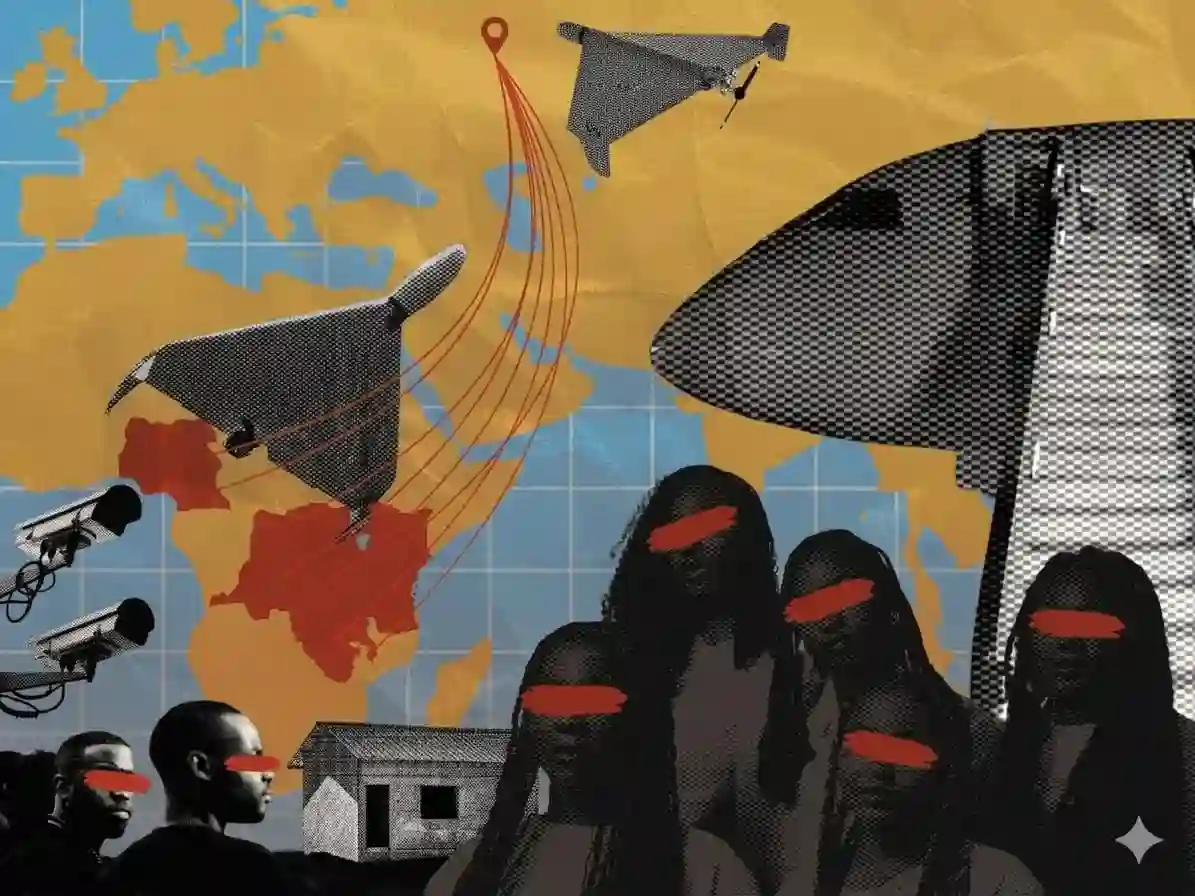
The Alabuga Special Economic Zone sits in Tatarstan, western Russia, and since November 2023 has functioned as one of Russia’s primary manufacturing hubs for Iranian-designed Shahed-136 drones, the same weapons deployed relentlessly against Ukrainian hospitals, power stations, and residential neighbourhoods. Depleted of its male population due to the frontlines and facing acute industrial labour shortages, Russia engineered a coldly efficient solution: recruit young African women under the cover of an educational work-study scheme, and deploy them to staff drone assembly lines.
The program markets itself in the language of opportunity, free flights, competitive salaries, vocational training, career advancement. In practice, participants have reported being funneled into drone manufacturing roles they never selected, signing NDAs that severed them from their own families, having their passports temporarily withheld when they sought to leave, and sleeping within the perimeter of a facility that Ukraine has already bombed.
In April 2024, a confirmed Ukrainian drone strike hit the Alabuga SEZ, with African and Central Asian women reported among the injured. A Ukrainian diplomat has since stated with cold precision: “At some stage, an African woman will be a legitimate target for a Ukrainian missile.”
The international response has been unequivocal. The United Nations has warned that the Alabuga Start program may constitute human trafficking under international law. The Global Initiative Against Transnational Organised Crime has documented the scheme as systematic, coordinated, and deliberately engineered to exploit the economic vulnerabilities of young African women. Western governments have placed the Alabuga SEZ under sanctions. And yet across most of Africa, the recruitment pipeline flows on, uninterrupted, expanding, and growing more sophisticated in how it finds and grooms its targets.
The Sudanese woman was careful to clarify one point: the Alabuga zone itself is real. The farms, factories, and marketplaces all exist. The facilities advertised on the website are genuine.
“They have all these all these bills that are advertised, there are available just not to the Africans, not to us.”
This distinction is crucial. The infrastructure is real. The opportunities are real for Russians. For Africans, there is only the drone factory.



The Architects
Behind every Telegram advertisement and every airport welcome photograph is a small, dedicated group of Russian officials who have spent years methodically constructing recruitment infrastructure across Africa with the resources and coordination of a state-backed operation.
Elmir Saifullin, Head of HR of the Alabuga Start program, is the most senior and visible face of the initiative. He has toured Alabuga facilities with country representatives from across Africa, appeared repeatedly on the official Alabuga Start Telegram channel alongside the Deputy Head of Rossotrudnichestvo, Russia’s state agency for international humanitarian cooperation, and in May 2024, travelled to Tanzania to formalise a partnership with the BDADI Foundation, which agreed to serve as an official program ambassador.
Konstantin Trifonov, Deputy HR Project Manager, has been the most travelled of the Russian recruiters, visiting Kenya, Mali, Zambia, and Zimbabwe, calling on embassies, meeting local organisations, and signing memoranda of understanding to build formal recruitment partnerships on the ground. In July 2025, he travelled to Accra, Ghana, where he used an International Business Cats Olympiad as a recruitment platform alongside HR Specialist Chulpan Islamova, a telling illustration of how ordinary-sounding public events are routinely converted into recruitment opportunities.
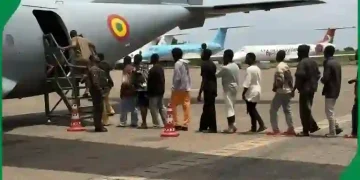
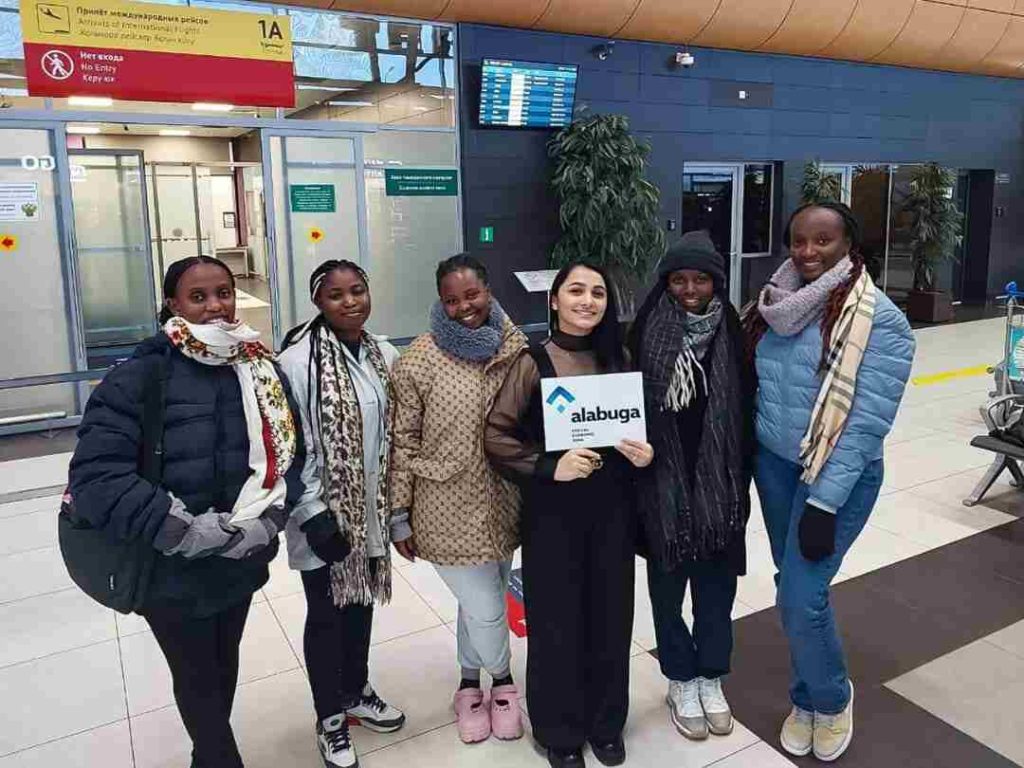
Savsan Yusupova, Lead HR Specialist, has been photographed at airports personally welcoming new participants from Nigeria, Rwanda, Zambia, South Africa, Burkina Faso, Algeria, Uganda, the Central African Republic, South Sudan, Mali, Zimbabwe, Lesotho, and Benin. The sweep of that list is a measure of the program’s continental ambition.
Anastasia Barysheva, Senior HR Specialist, signed an MoU in Zambia in October 2024, committing a local organisation to help Zambian girls gather documentation to join the program, and visited Mauritius in February 2025 to expand recruitment. She is also the official recorded by the UK’s Daily Mail making derogatory remarks about Sierra Leonean participants, privately describing them as women who “smell and look strange”, a window into the institutional contempt that underlies the program’s public-facing warmth.
The Nigerian Promoters
A military-industrial operation of this scale cannot sustain itself on Russian advertising and travel budgets alone. For Alabuga Start to reach the dormitories of Nigerian universities, the family WhatsApp groups of Lagos households, and the feeds of young women across the country, it needed infrastructure on the ground in Nigeria. It built that infrastructure deliberately, with the cooperation of Nigerian individuals and agencies who have served as the essential local layer of the recruitment network.
Across Nigeria, a cluster of travel, recruitment, and education agencies, some formally contracted by Alabuga, others operating informally, have functioned as the ground-level architecture of the conduit. These agencies provide what no Russian Telegram channel ever could, local language, local presence, and local trust.
Among these, Mercy of Success Konsultant stands apart, not merely as a participant, but as a formal institutional partner. Investigations by Premium Times confirmed that Adeleke Oluwatobi, the agency’s director, signed a Memorandum of Understanding with the Alabuga Start program, making a Nigerian individual and his agency official collaborators in recruiting young Nigerian women into a Russian war production facility. This was not casual promotion. This was a signed agreement, with all the deliberateness that implies. The implications, legal, moral, and journalistic, deserve the full attention of Nigerian regulatory and law enforcement authorities.
The network has also exploited a vulnerability beyond any individual agency. According to investigators, the official website of Nigeria’s Federal Ministry of Education was compromised and used to host Alabuga Start scholarship advertisements, granting the program the appearance of government endorsement without any government knowledge or consent. For a young Nigerian woman or her parents, seeing a scholarship listed on the Ministry of Education’s website, the question of legitimacy would never even arise. The hack did not merely steal digital real estate. It stole the institutional trust that Nigerians place in their own government.
Beyond the institutional facilitators, the Alabuga Start program has relied on a second and more visible layer of promotion: content creators, influencers, and media figures whose reach into African households far exceeds anything a Russian government channel could achieve. Through YouTube, Instagram, Facebook, TikTok, and WhatsApp, these promoters have carried the program’s message to its target demographic, young women who trust the people they follow, and who have no reason to suspect that the aspirational content on their screens is connected to a drone factory in western Russia.
The official Alabuga Start Telegram channel has actively amplified this content, sharing and reposting African influencer material to its subscriber base, building a body of social proof designed to neutralise the doubts of cautious recruits and their families.
David Hundeyin, a Nigerian journalist and publisher of the widely-read West Africa Weekly newsletter on Substack, is a prominent Nigerian media figure identified in connection with the promotion of the Alabuga Start program. His involvement is a matter of documented public record.
On 27th February 2025, Hundeyin posted a paid advertisement on his X (formerly Twitter) account promoting the program to his considerable following. The post described Alabuga Start as offering women aged 18 to 22 “the chance to launch their careers with a globally recognized company, with a guaranteed starting salary of $860.” He disclosed it as a paid post.
On 24th March 2025, he published a full promotional article on West Africa Weekly, presenting the program favourably and quoting Nigerian participant Victoria Kilani: “Honestly, I don’t see any downsides to being at Alabuga Start. I really love my experience in Russia. Unlike in America, there is no such racism here,” alongside positive assessments from foreign officials who had visited the site.
In April 2025, he published both a written article and a YouTube video claiming to debunk the Alabuga Truth website, the independent investigative platform that has named recruiters, documented abuses, and provided families with tools to locate missing daughters. In the video, he described the program as doing “what it says on the tin,” framing it as a legitimate labour arrangement addressing Russia’s wartime workforce shortages.
By December 2025, the official Alabuga Start Telegram channel had compiled his Substack and YouTube content into a video titled “When independent analysis speaks louder than rumours”, deploying his journalism as direct propaganda in response to survivor testimonies and critical investigations.
The facts of Hundeyin’s involvement are not in dispute; they are documented across his own platforms. What they mean, in the context of a program the United Nations has flagged as potentially constituting human trafficking, and which has left African women caught in drone strikes, is a matter for public and professional judgement. What belongs squarely to the record is that his content was used by the program’s own operators to suppress the voices of the women it had harmed.
The Reckoning Africa Cannot Postpone
Of all the nations whose women are caught in this pipeline, only Burkina Faso has moved to formally halt recruitment. Nigeria, the country most deeply embedded in this network at every level, from signed agency MOUs to a compromised government website, from named individual facilitators to a prominent media promoter, has yet to mount a coordinated national response.
That silence has a cost measured in young women landing at Kazan airport each month, wide-eyed and hopeful, stepping into a facility within the crosshairs of an active war. It is measured in families who do not know where their daughters are. And it is measured in the sirens that sound in the Tatarstan night, reminding everyone inside those walls exactly where they are, and exactly what they are being used for.
- LASTMA Warns Nigerians Against Consuming Spilled Groundnut Oil After Tanker Accident in Lagos
- 2027 Elections: IGP Disu Promises Nigerians Professional Police Conduct
- Ghana Repatriates 120 Nigerians Rescued From Cybercrime Network
- INEC Blames Supreme Court Ruling for Dropping Adebutu, Pantami from Governorship List
- Otunba Gbenga Daniel’s Foundation Brings Free Surgeries to 14 Ogun East Locations

Seunmanuel Faleye is a brand and communications strategist. He is a covert writer and an overt creative head. He publishes Apple’s Bite International Magazine.