









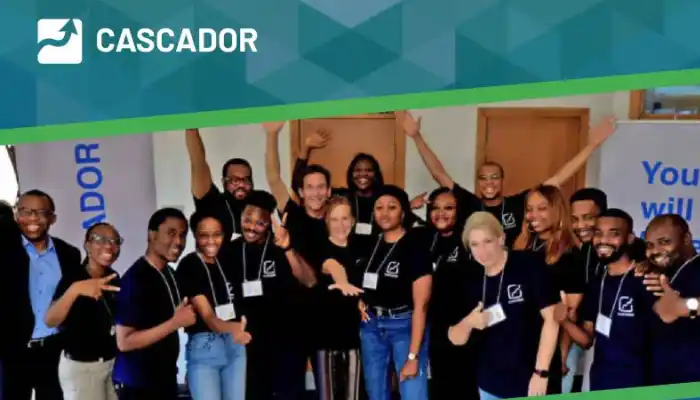
A Lagos-based accelerator programme for mid-stage Nigerian business owners, Cascador, has awarded more than $3m in debt funding facilities to 9 local startups.
Cascador recently revealed that the funding is exclusively for graduates of the Cascador programme, and it will help aid their operations and reposition them for global competitiveness.
The beneficiaries, Crop2Cash, Oriki, N.E.A.T, Adunni Organics, Sycamore, DoChase, Drive45, 24Seven and ExCare, received the financial support at Cascador’s inaugural Pitch Day event recently held in Lagos.
Speaking at the event, the Chief Executive Officer of Cascador, Trish Thomas, said that Cascador does not follow the regular venture capital model because what most businesses need is working capital, not equity.
“Our 2025 cohort will be our seventh. The funding is actually only available to alumni of the Cascador programme. The nine finalists that you see today have been awarded over $3m in debt and equity capital.



We do not follow a traditional venture capital model. Some of them are looking at scaling up with sustainable growth, and what they need is working capital, not equity,” she said.
According to her, the funding will suit the exact needs of each business, many of which are in key sectors like manufacturing and agriculture. She disclosed that because about 74 per cent of applicants opted for debt, it birthed a collaboration with Sterling Bank to provide favourable loan terms.
“We are partnering with Sterling Bank. We are taking on the collateral requirements, pulling down interest rates, and breaking down lending barriers,” Trish said.
Also speaking, Founder of Cascador, Dave Delucia, stated that the programme is not just about financing, as it also offers mentorship and capacity-building to ensure the efficient use of capital. He added that the winners will have direct access to investors who can further support their business growth.
Managing Director and Chief Executive Officer of Sterling Bank, Abubakar Suleiman, rounded up by lauding the partnership between both companies, describing it as a means to ensure Nigerian businesses become bankable and commercially viable.
“Between that energy and becoming a successful business, there are a lot of ravines and obstacles. What capital tries to do is remove some of those obstacles,” he added.