







The recent judgment of the Federal High Court in Lokoja setting aside its earlier order directing the Independent National Electoral Commission (INEC) to register the National Democratic Congress (NDC) has reignited debate over judicial intervention in Nigeria’s electoral process, while reviving controversies surrounding major political cases from the 2023 general elections.
The ruling has drawn widespread political and legal reactions, particularly because the NDC has emerged as the platform of former Labour Party presidential candidate Peter Obi for the 2027 presidential election, with former Kano State Governor Senator Rabiu Musa Kwankwaso named as his running mate.
Court reverses NDC registration order
Justice Isah Dashen vacated the court’s December 10, 2025 judgment that compelled INEC to register the NDC after ruling that the earlier decision affected the interests of the Peace Movement Party (PMP), which had not been joined in the suit.
According to counsel for the applicant, C. S. Ekeocha, the PMP argued that the NDC’s registration was obtained using a logo that the party had previously submitted to INEC before the commencement of the case.
The court agreed that the rights of the PMP had been affected and consequently nullified its earlier judgment.
Justice Dashen ordered all parties to return to the position they occupied before the December 10, 2025 ruling and directed the claimants to include all necessary parties before the substantive suit proceeds.
Ekeocha explained that the implication of the decision is that every action taken by INEC based on the now-vacated judgment—including the recognition of the NDC, issuance of its registration certificate and inclusion in the electoral commission’s records—must be reversed pending a fresh determination of the case.
He stressed, however, that the substantive suit remains before the court and has not been decided.
“The matter has not been concluded. The court merely set aside its previous judgment and directed that the party whose interests were affected be joined so that all sides can be heard before a fresh decision is reached,” he said.
NDC rejects ruling, heads to Appeal Court
The NDC has dismissed the judgment as unusual and immediately challenged it.
National leader of the party, Senator Seriake Dickson, announced that the party had filed an appeal along with an application for stay of execution.
Dickson disclosed that INEC had granted the party access to its candidate nomination portal, enabling it to upload the names of its presidential and other candidates.
He said the names of himself and the presidential candidate had already been uploaded, while the vice-presidential candidate’s details would follow after completion of necessary documentation.
According to him, the party remains within INEC’s timetable for the submission of candidates.
Opposition raises concerns over 2027 elections
The judgment has further heightened concerns among opposition figures who believe the ruling could form part of broader efforts to weaken opposition parties ahead of the 2027 general elections.
Former Vice President Atiku Abubakar, now the presidential candidate of the African Democratic Congress (ADC), argued that the decision reinforces fears of attempts to frustrate viable opposition platforms capable of challenging the ruling All Progressives Congress (APC).
He warned that restricting political competition could weaken democracy, reduce citizens’ confidence in elections and undermine political stability.
According to Atiku, democracy flourishes only when citizens are free to associate politically, support parties of their choice and contest elections without institutional barriers.
Falana faults court’s decision
Senior Advocate of Nigeria, Femi Falana, also criticised the ruling, arguing that a judge lacks the authority to overturn his or her own final judgment.
He maintained that once a court delivers a final decision, the judge becomes functus officio—a legal doctrine preventing the court from revisiting the matter except under circumstances recognised by law.
Falana insisted that any aggrieved party should seek redress at the Court of Appeal rather than asking the same judge to reverse an earlier decision.
He further argued that all actions taken pursuant to the original judgment, including the NDC’s primary elections, remain legally valid.
“The court cannot retrospectively set aside the primary elections of the NDC,” he said.
The human rights lawyer also expressed concern over what he described as an emerging pattern of judicial decisions capable of weakening Nigeria’s multi-party democracy.
Renewed focus on controversial election cases
The latest development has revived public discussion on previous judicial decisions that generated widespread controversy during and after the 2023 elections.
Political analysts argue that the increasing reliance on litigation to determine electoral outcomes raises fundamental questions about judicial accountability and public confidence in democratic institutions.
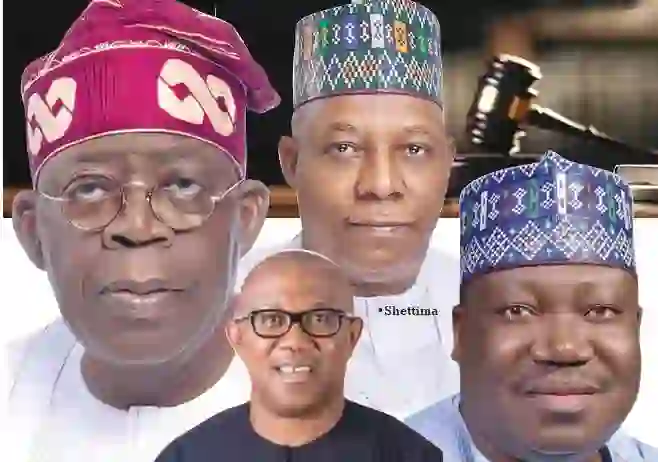
Among the cases frequently cited are the legal disputes involving President Bola Tinubu and Vice President Kashim Shettima’s candidacy, the Yobe North senatorial ticket involving former Senate President Ahmad Lawan and Bashir Machina, and the Plateau State legislative election cases.
ActionAid raises concerns over election litigation
Civil society organisation ActionAid Nigeria has also renewed calls for greater judicial accountability, warning that excessive dependence on the courts threatens Nigeria’s democracy.
Presenting a paper titled Post-Election Judicial Accountability and Reforms in Nigeria: Go to Court at a conference organised by the Nigerian Guild of Editors (NGE) in Yenagoa, Bayelsa State, the organisation noted that election litigation has increased dramatically over the years.
According to the group, the number of election-related court cases rose from just two in 1999 to about 1,996 in 2023.
ActionAid argued that many politicians now view litigation as a preferred route to political victory because of widespread public perception that favourable judicial outcomes can be secured after elections.
“There has been an upsurge in post-election litigations and the judiciary plays a significant role in adjudicating the disputes,” the organisation stated.
Plateau judgments cited
ActionAid pointed to conflicting judgments arising from Plateau State after the 2023 elections as examples of inconsistencies within Nigeria’s judicial system.
The group noted that while some courts nullified the elections of Peoples Democratic Party (PDP) lawmakers over alleged irregularities in party primaries, other courts correctly held that issues relating to party primaries are pre-election matters that cannot be entertained by election petition tribunals.
Although the Supreme Court eventually restored Governor Caleb Mutfwang’s mandate, several National Assembly and State Assembly lawmakers permanently lost their seats because the Court of Appeal was the final court for those cases.
Lawan-Machina case revisited
The organisation also revisited the legal dispute between Ahmad Lawan and Bashir Machina over the APC’s Yobe North senatorial ticket.
ActionAid recalled that Machina won at both the Federal High Court and the Court of Appeal after challenging Lawan’s emergence despite not participating in the party’s primary election.
However, the Supreme Court later dismissed Machina’s case on technical grounds, ruling that the action ought to have been commenced through a different legal procedure.
The organisation criticised the decision, arguing that the apex court relied on procedural technicalities rather than addressing the substantive issue of whether Lawan participated in the primary election.
Questions over Tinubu and Shettima cases
ActionAid also revisited the 2023 presidential election petitions challenging President Bola Tinubu’s election.
Among the issues highlighted were allegations that Vice President Kashim Shettima was subjected to double nomination by being nominated simultaneously as a senatorial and vice-presidential candidate before withdrawing from one position.
Although the courts dismissed the challenge largely on grounds of legal standing, the organisation noted that many Nigerians remained unconvinced because the Electoral Act prohibits multiple nominations.
The group also revisited debates surrounding the civil forfeiture proceedings involving Tinubu in the United States, arguing that the tribunal’s interpretation differed from earlier judicial authorities on the legal implications of forfeiture.
Judiciary under scrutiny
ActionAid said the recurring controversies point to broader concerns regarding judicial independence, political interference and public trust in democratic institutions.
According to the organisation, political pressure, inadequate funding, corruption, conflicting judgments and delays in election cases continue to undermine confidence in Nigeria’s justice system.
It also questioned the effectiveness of oversight institutions such as the National Judicial Council (NJC) in ensuring judicial accountability.


The organisation asked whether Nigerians could continue to rely on the judiciary if confidence in the electoral process and INEC continues to decline.
Call for media partnership
ActionAid urged the Nigerian Guild of Editors to support campaigns for judicial accountability through sustained media advocacy.
The organisation argued that editors and investigative journalists can play a critical role in exposing judicial misconduct, shaping public discourse and encouraging reforms capable of strengthening Nigeria’s democratic institutions.
It concluded that stronger collaboration between civil society organisations and the media would help mobilise public support for transparency, judicial independence and credible elections ahead of the 2027 general elections.
READ ALSO:
- Nigerian Man Jailed 44 Weeks for Masturbating in Front of Woman on UK Train.
- Wike Has Tinubu’s Backing For Rainbow Coalition
- NDLEA seizes N3.4bn worth of drugs, arrests fake police officer, others
- Akpabio prays in Italy for peaceful 2027 polls, end to banditry and terrorism
- Catholic Bishops Reject Foreign Aid Regulation Bill